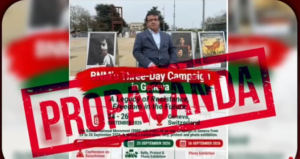
The legitimacy of international human rights mechanisms rests on a simple but powerful idea: they must remain neutral and guided by verified facts. The moment that neutrality is questioned, even by perception, the credibility of institutions built over decades begins to weaken. The recent developments surrounding a Geneva event organized by the Baloch National Movement (BNM) bring this concern into sharp focus. This is not just about one event or a few individuals; it raises deeper questions about the integrity of the broader human rights system.
Concerns about the recent Geneva event become clearer when one looks at the profile and role of Naseem Baloch and the organization he represents, the Baloch National Movement. As a leading figure of BNM, Naseem Baloch has consistently advocated for what he calls the “liberation” of Balochistan, framing the issue not just as a human rights concern but as a political struggle for separation. Over the years, BNM has actively used international platforms, particularly in Europe, to highlight alleged rights violations in Pakistan, organizing conferences, lobbying diaspora communities, and engaging with global institutions to shape a specific narrative. However, this activism is not seen as neutral advocacy but as part of a broader information campaign that aligns with separatist agendas and, at times, overlaps with groups involved in terrorism.
This is precisely why the optics of the Geneva event matter so much. When a UN-affiliated rapporteur appears on the same platform as such actors, it naturally raises concerns about neutrality and institutional boundaries. As critics argue, Dr. Naseem Baloch and BNM openly demand “liberation,” yet a UN Working Group rapporteur shares the stage with them. This isn’t human rights advocacy; it risks legitimizing their agenda. The impartiality of UNWGEID is now seriously in question. In this context, the issue goes beyond one individual. It highlights how international platforms can amplify politically charged narratives, blurring the line between genuine human rights engagement and strategic messaging.
At its core, this is not merely a political reaction; it is a structural concern. The United Nations Working Group on Enforced or Involuntary Disappearances (UNWGEID) operates under a mandate that requires strict neutrality, independence, and reliance on verified evidence. Its authority comes from being seen as an impartial observer, not a participant in politically charged spaces.
But the Geneva platform in question was not neutral. It was organized by BNM, whose leadership has consistently framed its objective in terms of the “liberation” of Balochistan. That framing moves beyond human rights advocacy into the realm of political separatism. BNM’s so-called ‘International Conference’ was nothing more than a rally disguised as advocacy. There are no calls for dialogue and diplomacy; ultimately, it supports radical objectives aimed at undermining Pakistan’s territorial integrity.
This matters because the United Nations itself is bound by foundational legal principles. Under the United Nations Charter, particularly Article 2(7), the organization is obligated to respect the sovereignty and territorial integrity of its member states. Any engagement that appears to validate separatist narratives risks contradicting that principle, whether intentionally or not.
At the same time, the issue becomes more complicated when we look at how facts are presented in such forums. Human rights discussions often focus heavily on allegations against the state, but they sometimes overlook the broader security realities on the ground. In Balochistan, this context cannot be ignored.
According to reports by the Pakistan Institute for Peace Studies (PIPS), the province has faced years of terrorist violence. These include attacks on civilians, teachers, laborers, and infrastructure projects such as those linked to the China-Pakistan Economic Corridor (CPEC). Schools have been targeted, non-local workers killed, and public spaces attacked. These are not isolated events; they are part of a sustained pattern that shapes the region’s human rights environment.
International datasets support this broader picture. The Global Terrorism Index consistently ranks Pakistan among countries affected by terrorism, with Balochistan identified as a key hotspot in several annual assessments. Similarly, data from the South Asia Terrorism Portal shows recurring incidents involving militant groups operating in the province.
Yet, the victims of this violence are often missing from discussions at international advocacy events. Real issues of enforced disappearances deserve transparent, credible investigation within Pakistan’s constitutional framework, not amplification through events organized by groups that serve as international mouthpieces for banned networks.
This is where balance becomes critical. Pakistan has, over the years, established institutional mechanisms to deal with cases of enforced disappearances. The Commission of Inquiry on Enforced Disappearances (COIED), formed in 2011, has handled more than 10,600 cases. Official data suggests that approximately 84% of these have been resolved through tracing individuals, confirming detention status, or clarifying circumstances.
This does not mean the issue is fully resolved. Even the Human Rights Commission of Pakistan (HRCP) has acknowledged that enforced disappearances remain a serious concern and has called for greater transparency and accountability. But it also emphasizes the need for credible verification and institutional engagement rather than relying solely on unverified claims. The figures presented by BNM lack independent verification and credibility, as they primarily originate from diaspora sources rather than established institutional processes.
This is where the danger lies. When unverified numbers are repeated in international forums, they can quickly gain legitimacy simply through visibility. Over time, these claims begin to shape global narratives, even if they lack strong empirical backing.
Reports by organizations like Amnesty International and Human Rights Watch consistently stress that human rights documentation must be grounded in verified evidence, multiple independent sources, and careful contextual analysis, especially in conflict zones. These principles are essential to ensure that advocacy remains credible and does not become a vehicle for selective or politically motivated narratives.
When a UN-affiliated representative appears on a platform associated with groups that promote separatist narratives and are perceived as aligned with or enabling militant agendas, it creates a troubling perception. Such participation risks being interpreted not as neutral engagement, but as indirectly reinforcing narratives that overlap with extremist or violent objectives. In this context, the concern is not just about optics but about the possibility that international platforms are used to amplify narratives that feed into broader destabilizing agendas.
Even if that interpretation is debated, perception itself becomes the problem. For international mechanisms like UNWGEID, credibility is everything. A single incident that appears politically tilted can undermine years of work not just in Pakistan, but globally. The broader consequence is institutional. If UN mechanisms are seen as selective, politically influenced, or aligned with particular narratives, their ability to advocate for genuine victims weakens everywhere from South Asia to Africa to Latin America.
Human rights advocacy, at its best, is about fairness. It means acknowledging state responsibility where it exists, but also recognizing the role of non-state actors in creating insecurity and suffering. It requires engaging with official institutions, supporting transparent investigations, and avoiding platforms that blur the line between advocacy and political activism.
In the end, this is not about denying problems or defending any single narrative. It is about protecting the credibility of a system that millions of people around the world rely on for justice. When human rights platforms become political arenas, that credibility is put at risk and rebuilding trust becomes far more difficult than preserving it in the first place.