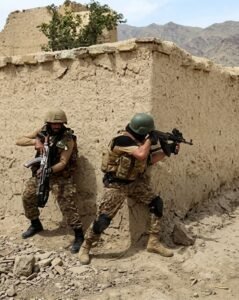
Balochistan one of the largest province by area in Pakistan, spans approximately 347,190 square kilometers nearly 44 percent of the national landmass yet remains the least populated, with an estimated 14-15 million residents. Its vast terrain, mineral reserves, 770-kilometer coastline along the Arabian Sea, and strategic border with Afghanistan place it at the center of Pakistan’s national security framework. As regional dynamics fluctuate, particularly amid evolving relations between Islamabad and Kabul, Balochistan frequently becomes the arena where geopolitical tensions translate into tangible local consequences.
The Pakistan–Afghanistan border stretching roughly 2,640 kilometers and commonly known as the Durand Line cuts across mountainous and semi-desert terrain, with approximately 1,200 kilometers running along Balochistan. Major crossing points such as Chaman–Spin Boldak function as critical trade arteries. In the past, the border was not strictly controlled, allowing tribes on both sides to stay connected and trade freely. However, this openness also made it easier for illegal activities and militant groups to move across the frontier. Recognizing these vulnerabilities, Pakistan launched an extensive border management initiative in 2017 under the supervision of the Ministry of Interior, the Pakistan Army, and the Frontier Corps. By 2023, authorities reported that fencing along most of the western border had been completed, supported by new forts, surveillance systems, and biometric verification mechanisms operated in coordination with the National Database and Registration Authority (NADRA).
Security concerns intensified after the return of the Afghan Taliban to power in August 2021. Pakistani authorities expressed hope for improved counterterrorism cooperation. However, militant activity surged in subsequent years. A report by the Pakistan Institute for Conflict and Security Studies identified 2025 as the deadliest year in over a decade, recording 3,413 conflict-related fatalities nationwide, including 667 security personnel and 580 civilians. Much of the violence was attributed to the Fitna al-Khawarij also referred as Tehrik-i-Taliban Pakistan (TTP), which Pakistan claims uses safe areas in Afghanistan to plan and launch attacks
Similarly, data from the Center for Research and Security Studies documented a 34 percent year-on-year increase in violence in 2025, with Balochistan accounting for 956 fatalities, an increase of nearly 22 percent compared to the previous year. These figures underscore that instability in Afghanistan directly resonates inside Balochistan’s districts, particularly Chaman, Qila Abdullah, Pishin, and Zhob.
The security challenge is not confined to cross-border militancy. Internal insurgent actors, including the Balochistan Liberation Army (BLA), have targeted infrastructure projects, foreign investments, and security installations. In one of the largest counterterrorism operations in recent years, Pakistani forces eliminated 177 militants in a 48-hour operation, signaling the state’s resolve to dismantle networks seeking to destabilize the province.
From the government’s standpoint, such measures fall squarely within its constitutional obligation to safeguard sovereignty and territorial integrity. The Ministry of Interior and Ministry of Defence have repeatedly emphasized that enhanced border regulation and intelligence-based operations are preventive security instruments not punitive measures against local populations.
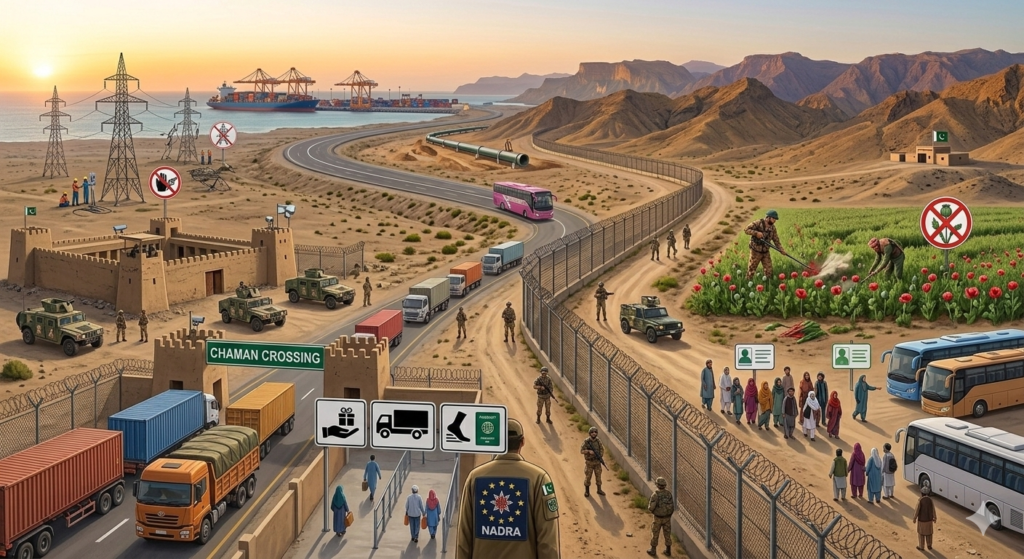
The economic implications of border tensions are equally significant. The Chaman crossing historically handles thousands of daily pedestrian crossings and hundreds of cargo vehicles transporting agricultural produce, construction materials, textiles, and consumer goods. Bilateral trade between Pakistan and Afghanistan has fluctuated between approximately $1 billion and $2.5 billion annually in recent years. However, periodic border closures such as the prolonged shutdown in October 2025 disrupted commercial flows. Several official reports indicated that Afghanistan incurred losses of approximately $45 million within one month of closure, highlighting the interconnected nature of border economies.
Pakistan’s broader regional trade context also reflects strain. In fiscal year 2024-25, Pakistan’s trade deficit with its nine neighboring countries reached $12.297 billion, according to official reporting. Unregulated cross-border trade further compounds fiscal challenges. Customs authorities reported seizures worth Rs 930.46 million between 2019 and 2023 along the western border, demonstrating the scale of smuggling and revenue leakage.
To address these challenges, Pakistan introduced stricter documentation requirements, including Afghan Citizen Cards (ACC) and Proof of Registration (PoR) systems, implemented under the Ministry of Interior in coordination with NADRA. While such reforms triggered protests in Chaman in mid-2024, they align with international border management norms and aim to transition informal crossings into regulated trade corridors.
Migration dynamics add another layer of complexity. Since 1979, Pakistan has hosted one of the world’s largest protracted refugee populations. According to findings cited by the United Nations High Commissioner for Refugees and the International Organization for Migration, enforcement operations in recent years led to 7,764 Afghan nationals being detained in a single week, with 86 percent of arrests recorded in Balochistan. Between 2023 and 2026, over 1.66 million individuals returned to Afghanistan, reflecting one of the largest deportation phases in recent history.
Although Pakistan is not a formal signatory to the 1951 Refugee Convention, it operates under humanitarian coordination frameworks with UN agencies. Authorities maintain that documentation and deportation policies are essential to balance humanitarian commitments with national capacity and security considerations.
Illicit economies further complicate the security landscape. The United Nations Office on Drugs and Crime has consistently identified Afghanistan as a major source of global opium production. Although cultivation reportedly declined sharply after 2022, trafficking networks adapted routes. Balochistan’s vast terrain and coastline present logistical vulnerabilities. In 2025, Pakistan’s Anti-Narcotics Force, along with provincial paramilitary forces and police, destroyed opium crops across tens of thousands of acres in districts like Chaman, Pishin, Duki, and Loralai.
International law also frames the border dynamic. The Article 2 of the United Nations Charter obligates states to respect territorial integrity while recognizing the inherent right to self-defense. Pakistani officials consistently ground cross-border security measures within this doctrine, emphasizing that counterterrorism actions aim to neutralize threats rather than escalate hostilities.
Simultaneously, development initiatives underscore the state’s dual-track strategy. The China-Pakistan Economic Corridor (CPEC), a flagship component of the Belt and Road Initiative, positions Balochistan as a hub of regional connectivity. The expansion of Gwadar Port, associated road networks, and special economic zones is projected to generate employment and enhance Pakistan’s access to Central Asian markets. Energy connectivity projects such as the Turkmenistan-Afghanistan-Pakistan-India (TAPI) gas pipeline further illustrate the economic dividends of regional stability.
Critics argue that intensified border enforcement disrupts traditional livelihoods. These concerns merit policy sensitivity. Balochistan’s development indicators like literacy, healthcare access, and employment rates remain below national averages. However, policymakers maintain that sustainable economic growth requires secure borders, regulated commerce, and suppression of armed networks that deter investment.
Ultimately, Balochistan’s trajectory is inseparable from Afghanistan’s stability. A peaceful western frontier would unlock trade corridors, expand transit potential, and reduce the fiscal burden of prolonged security deployments. Conversely, unchecked militancy risks undermining investor confidence, inflating security expenditures, and slowing development momentum.
Balochistan thus stands at a defining intersection: a frontline exposed to regional volatility, yet also a bridge capable of linking South Asia to Central Asia and beyond. Pakistan’s evolving strategy combining firm border governance, diplomatic engagement, institutional coordination, and economic integration reflects an effort to convert vulnerability into resilience.
Geopolitical tensions may start in distant capitals, but their effects are felt most strongly in provinces like Balochistan. How these challenges are addressed depends not only on the strategic policies of the state but also on the active engagement of the local people. When both the government and communities work together, these pressures can be transformed into opportunities for stability, development, and resilience, ensuring that Balochistan’s progress contributes to the strength of the entire nation.