Few narratives have been repeated as frequently in Pakistan’s political discourse as the claim that Balochistan and Khyber Pakhtunkhwa (KP) have been neglected by the federation. It is a powerful argument because it appeals to genuine grievances, historical underdevelopment, and the undeniable challenges facing both provinces.
Public policy should be judged by evidence rather than slogans. When one examines Pakistan’s health and education budgets, a different picture begins to emerge, one that suggests the state is allocating significant resources toward its less-developed regions, particularly Balochistan and KP.
The debate is often dominated by absolute numbers. Punjab, because of its population of around 140 million people, naturally receives the largest overall allocations. However, development spending cannot be understood through totals alone. What matters is how much is being spent per citizen and whether public resources are being directed toward provinces that face greater developmental challenges.
Pakistan’s combined health budget stands at approximately Rs 1.34 trillion. Of this, the federal government allocates Rs 53 billion, Punjab Rs 500 billion, Sindh Rs 402 billion, KP Rs 276 billion, Balochistan Rs 96 billion, AJK Rs 12 billion, and Gilgit-Baltistan Rs 1.25 billion. These figures reveal that health remains one of the largest areas of public expenditure across the federation.
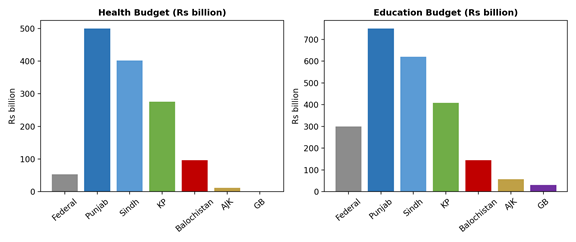
Figure 1: Provincial health and education budget allocations (Rs billion)
More importantly, they reveal how resources are distributed. Punjab’s Rs 500 billion health budget serves a population ten times larger than that of Balochistan. When calculated on a per-capita basis, Punjab spends approximately Rs 3,570 per citizen on health, while Balochistan spends nearly Rs 6,850 per citizen. In simple terms, per-capita health spending in Balochistan is almost double that of Punjab.
The same pattern is visible in education. Pakistan’s total education spending exceeds Rs 2.3 trillion. The federal government allocates Rs 300 billion, Punjab Rs 750 billion, Sindh Rs 620 billion, KP Rs 408 billion, Balochistan Rs 144 billion, Gilgit-Baltistan Rs 30 billion, and AJK Rs 57 billion. Again, Punjab receives the largest allocation because it educates the largest number of students.
However, once population is taken into account, Balochistan’s position becomes clear. Punjab spends approximately Rs 5,360 per citizen on education, whereas Balochistan spends more than Rs 10,280 per citizen. Once again, per-capita spending is almost twice as high in Balochistan as in Pakistan’s largest province.
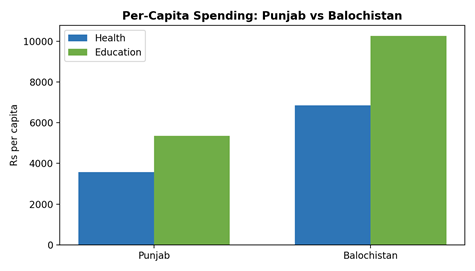
Figure 2: Per-capita health and education spending, Punjab vs Balochistan (Rs per citizen)
These figures challenge the simplistic notion that the federation is indifferent to smaller provinces. In reality, Pakistan’s fiscal architecture is specifically designed to allocate proportionally greater resources to regions facing greater developmental difficulties. The National Finance Commission Award does not rely solely on population; it also incorporates factors such as poverty, backwardness, revenue generation, and inverse population density. As a result, provinces like Balochistan receive a larger share of resources relative to their population because delivering public services there is inherently more expensive.
The reasons are obvious. Building and maintaining a hospital in Lahore is fundamentally different from operating one in a remote district of Balochistan. Schools, roads, electricity networks, and healthcare facilities in sparsely populated and geographically challenging regions require significantly greater investment per resident.
A single health facility in Balochistan may serve communities scattered across hundreds of kilometers. Transporting medicines, retaining qualified doctors, and maintaining infrastructure all increase costs. Similar realities exist in parts of KP, particularly in the merged districts where decades of conflict and underinvestment created serious developmental gaps.
KP’s allocations illustrate this commitment. With Rs 276 billion allocated for health and over Rs 400 billion for education, the province receives some of the highest social-sector investments in its history. These resources are particularly important given the province’s responsibility for integrating former tribal districts into the mainstream administrative and development framework. Recent budget documents show that health and education remain among KP’s largest spending priorities.
None of this means that Balochistan and KP have overcome all their problems. Educational attainment remains below national averages in many districts. Healthcare access continues to be uneven. Infrastructure deficits persist, particularly in remote areas. But the existence of these challenges should not be confused with a lack of financial commitment. Budget allocations indicate that Pakistan is investing heavily in these provinces. The question is increasingly not whether money is being allocated, but how effectively it is being spent.
This distinction matters because development outcomes depend on more than budgets alone. Governance capacity, institutional performance, security conditions, administrative efficiency, and project implementation all influence whether public spending translates into better schools and hospitals.
Even the largest budget cannot produce results if resources are delayed, mismanaged, or poorly targeted. The challenge for policymakers today is therefore to ensure that higher spending produces measurable improvements in literacy, healthcare access, and quality of life.
What the numbers demonstrate beyond any doubt is that the federation has not abandoned its peripheral regions. On the contrary, public spending patterns reveal a deliberate attempt to reduce regional inequalities through higher per-capita investment. Balochistan receives nearly twice the per-capita health and education spending of Punjab, while KP continues to benefit from substantial social-sector allocations aimed at accelerating development and integration.
In an era where political narratives often overshadow facts, these figures deserve attention. They do not suggest that all grievances are unfounded or that all developmental problems have been solved. They do, however, show that Pakistan’s fiscal priorities increasingly recognize the need to uplift historically underserved regions.
The path forward lies not in repeating claims of neglect, but in ensuring that these unprecedented investments translate into tangible improvements for ordinary citizens. Ultimately, the true measure of success will not be how much money is allocated on paper, but how effectively it improves the lives of people in Quetta, Gwadar, Wana, Chitral, Zhob, and every other corner of the federation.