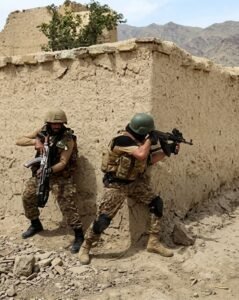
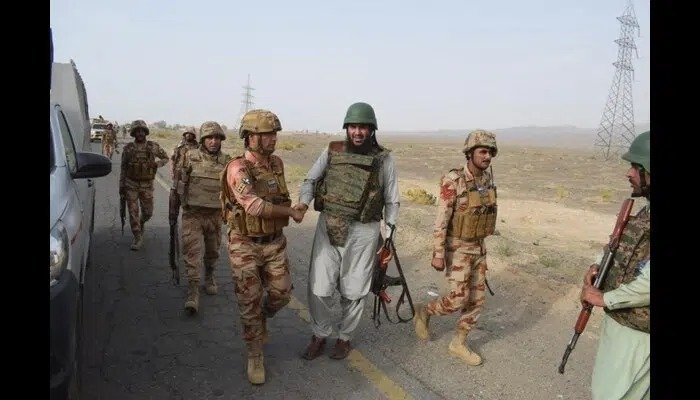
It happened again, and it happened in exactly the way it always happens. Terrorists affiliated with Fitna al-Hindustan set up an illegal roadblock on the Quetta-Taftan Highway in Noshki on Tuesday 16th June 2026, intending to stop passenger vehicles, intimidate travelers, and extract money through looting and extortion. Frontier Corps Nushki responded with a swift clearance operation, engaging the militants in an intense exchange of fire that resulted in the killing of five terrorists, while the remaining attackers fled into the surrounding rugged terrain.
The Quetta-Taftan Highway is a critical corridor connecting Quetta with western Balochistan and the border regions, serving as a major artery for passenger traffic, trade, and the movement of goods. The people who use this highway every single day are ordinary Baloch citizens: traders moving fruit and products, families travelling for work or for medical care, transporters whose entire livelihood depends on the road staying open. When militants block this route, intimidate travelers, and extort money from passing vehicles, they are not striking at the Pakistani state in any meaningful sense. They are striking at the income, mobility, and daily survival of the very communities they claim to represent.
Security sources were clear about the nature of this attempt. It was an effort to disrupt civilian movement, loot travelers, and extort money from motorists using one of the province’s most vital transport routes. It is organized economic terrorism against the livelihoods of ordinary Baloch citizens to in order to please their foreign masters.
Official figures show that the scale of operations in the province has expanded dramatically, with the annual count of neutralized terrorists rising from 63 in 2020 to 792 by the end of 2025. By the end of May 2026 alone, security forces had already eliminated 798 terrorists, already surpassing the entirety of the previous year’s total.
Security officials attribute the surge to improved intelligence gathering, enhanced coordination among security institutions, and sustained efforts to dismantle terrorist networks operating across the province. The institutional machinery built around Operation Azm-e-Istehkam and its successors is producing measurable, compounding results. Terrorist organizations that once operated with relative impunity on strategic highways are now being intercepted within hours of attempting a blockade, their fighters killed or scattered into the hills before they can complete the extortion operation they set out to run.
Officials emphasized that the timely intervention in Noshki prevented what could have become a serious disruption to a route that serves passenger traffic as well the broader economic life of western Balochistan. This is the understated, daily reality of what security operations actually protect. They protect the truck driver who reaches Taftan on schedule, the family that completes its journey without being stopped at gunpoint, the trader whose goods arrive intact.
There is a deeper question buried inside every one of these highway attacks, the same question raised by the BLA’s earlier threats against convoys linked to Saindak and Reko Diq. If these organizations claim to fight for Baloch rights, why does every operation end up targeting Baloch livelihoods? Why is the highway that feeds thousands of Baloch transporters, traders, and laborers the recurring target, rather than any installation that could plausibly be called a symbol of state oppression? The pattern answers itself. An organization interested in extortion revenue from passing vehicles is not waging an ideological struggle. It is running a protection racket and dressing it in political language.
Authorities reaffirmed their commitment to protecting national highways, safeguarding civilian lives, and maintaining peace and stability across the province, stating clearly that operations against terrorist networks will continue to ensure that key transportation routes remain secure. Five terrorists killed in Noshki on Tuesday is one data point in a much longer ledger, one that has been moving consistently in the direction of denying these networks the operational space they once took for granted. The Quetta-Taftan Highway stayed open. The travelers reached their destinations. And five fewer men remain to threaten the next convoy.