Khabar Kada’s Twitter Space titled “Unfiltered Truths of Balochistan” brought together some of the most informed voices on the Balochistan security situation, CPEC projects in Gwadar, and the province’s ground realities for a conversation that social media rarely allows. Hosted by Shehzad Qayyum, the session featured a panel that cut through the noise with clarity, credibility, and at times, uncomfortable honesty.
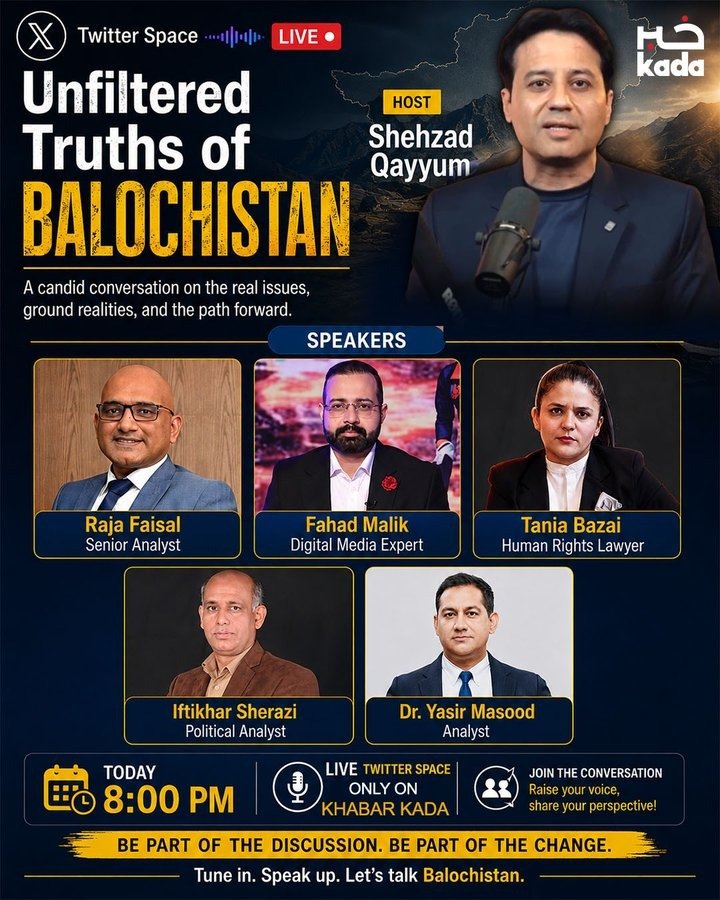
Perhaps the most striking voice of the evening came from Dr. Yasir Masood, a geostrategic and foreign affairs commentator, former Director of Media for CPEC, and UNESCO consultant, offered the development lens the conversation needed. He argued that CPEC investment arrived in Pakistan at a critical moment and that the benefits to local people of Balochistan have been real and measurable: a new airport, hospitals, schools, and a 90 percent Pakistani workforce ratio in Gwadar projects. His point that Balochistan is effectively a gold reserve for all of Pakistan, and that Gwadar port’s geostrategic importance extends well beyond Pakistan’s borders, reframes the province from a conflict zone into an opportunity that hostile actors are desperate to prevent from being realized. His assessment of Baloch youth as extremely talented and politically aware deserves particular attention. The current youth movement in Balochistan is not uniformly radical. The majority want jobs, education, and dignity.
Secondly, Raja Faisal, journalist and 2021 Pride of Pakistan recipient, situated the Balochistan question within its regional architecture. India, he argued, wants to open a western front for Pakistan because Pakistan’s eastern border is too well secured against Indian aggression. Afghanistan serves as the epicenter of that strategy, with RAW and Mossad using terrorists’ proxies in the shape of Fitna Al Hindustan to target CPEC projects and the Iran-Pakistan border trade corridor simultaneously. His reference to Kulbhushan Yadav as a living, documented example of Indian operational presence in Balochistan is a point that Pakistani diplomacy has now carried successfully to the ICJ and United Nations. He also highlighted the Shari Wasta Group, described as a RAW-linked media operation running coordinated propaganda from Nowada India against Pakistan and Balochistan, as part of the same information warfare infrastructure.
The most striking arguments came from Miss Tania Bazai, a name that itself tells a story about Balochistan’s potential. A Kakar from Quetta, Bazai completed her LLB and LLM locally before moving to Islamabad in 2019, becoming the first female lawyer from Balochistan to practice at the Islamabad High Court and the first internationally accredited civil and commercial mediator in Pakistan. She has appeared on Al Jazeera and BBC, and her professional trajectory is precisely the kind of Baloch success story that never trends on the same platforms running separatist hashtag campaigns.
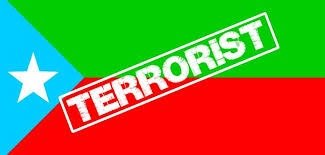
Her words on the current Balochistan security situation were direct. “What kind of Balochistan are they portraying on social media? I didn’t find any state oppression in Quetta or Balochistan,” she said. On the Baloch Yakjehti Committee, she was equally unambiguous: BYC protests have never been about rights. They do not raise demands around education, health, or infrastructure in Balochistan. Instead, she argued, the organization picked up bodies of terrorists from hospital. The same terrorists who carried out Jaffar Express Terrorist attack in 2025. BYC times its protests to disrupt events like international conferences in Gwadar, and systematically portrays designated terrorists as missing persons. She further stated that BYC functions as the soft face of Fitna al-Hindustan, serving as a recruitment ground for female suicide bombers and providing narrative cover for terrorist networks operating across the province.
Last but not the least Fahad Malik, co-founder of Lumu.pk and former head of digital at multiple major Pakistani news organizations, closed the technical loop. The AI-driven information crisis, he argued, has made it nearly impossible for average citizens to distinguish factual reporting from manufactured content. Pakistan needs a dedicated, credible fact-checking infrastructure, not just from government institutions but from the media ecosystem itself. In a province where disinformation about the Balochistan security situation, enforced disappearances, and CPEC projects in Gwadar circulates at industrial scale, that observation is urgent.
What the evening made clear is that the people with the deepest knowledge of Balochistan, including a lawyer who grew up there, a CPEC policy expert, a seasoned security journalist, and a digital media strategist, are telling a fundamentally different story than the one being amplified through coordinated online campaigns by those who work on Indian Agenda providing cover to terrorist organizations operating to disrupt the peace of Balochistan. This is the unfiltered reality of Balochistan that requires much wider perspective.