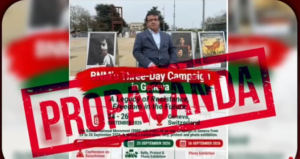
BSO-Azad’s article titled “Enforced Disappearance in Balochistan: A Historical Overview Through British and Pakistani Colonial Rule” represents a carefully constructed piece of propaganda that distorts the complex security reality of Balochistan Province. A critical analysis of the article reveals systematic factual misrepresentation, the deliberate omission of terrorist involvement, and the instrumentalization of human rights narratives to advance terrorist agendas.
The argument presenting Pakistan as a ‘colonial state’ collapses at the very first instance. In 1948, the Khan of Kalat formally acceded to Pakistan, establishing Balochistan’s integration as a voluntary constitutional act rather than a conquest. Furthermore, the province enjoys well-defined representation at every level of the Pakistani state. The Constitution grants Balochistan equal representation in the Senate along with a protected revenue share through the NFC Awards. Pakistan also elected Mir Zafarullah Khan Jamali, a Baloch leader, as Prime Minister in 2002, while Dr. Abdul Malik Baloch of the National Party served as Chief Minister in 2013. Indeed, barring two or three Pakhtun chief ministers, the overwhelming majority of chief ministers of Balochistan have been ethnic Baloch. Such realities are inconsistent with historical colonial systems, which rarely empowered the colonized population through democratic institutions.
Another defining feature of colonial rule is the exploitation of local resources. However, Pakistan has maintained a comprehensive policy regarding resource utilization in the province. The CPEC projects are empowering infrastructure, economic growth, and social development, benefiting the local population. Moreover, the Saindak Gold-Copper Project has prioritized local employment, with approximately 87% of its workforce drawn from the province. In the renegotiated Reko Diq Project, Balochistan holds a direct equity stake of 25%. In all these cases, the inclusion of the people of Balochistan reflects policies consistent with a democratic state rather than a colonial one.
Turning to the disappearance cases, Zakir Majeed was not merely a student activist but the Vice Chairman of BSO-Azad, itself a banned organization that functioned as an ideological pipeline to the terrorist group BLA. These are not mere claims; Bashir Zaib Baloch, who served as Chairman of BSO-Azad and later became the head of the BLA’s Majeed Brigade, exposed this linkage. Similarly, Shabir Baloch served as the Information Secretary of BSO-Azad, while Asadullah and Zahid Kurd were also associated with the same banned organization. This indicates that these cases were not of ordinary civilians but of individuals embedded within terrorist organizational structures. They were presented as missing persons while, in reality, they were involved in terrorist training and recruitment—constituting a deliberate misrepresentation designed to manufacture international sympathy.
The cases involving women, presented in the article are equally problematic upon factual examination. Zarina Marri, described as a teacher at a Government Middle School in Kohlu, was found to have no official record in the school’s documentation, as confirmed by the concerned principal. On the other hand, Khadija Baloch -widow of a terrorist Hasil, has been cited by official sources as a facilitator to the terrorist organizations.
Pakistan has established a robust legal framework to address enforced disappearances through the Commission of Inquiry. This body holds the authority to summon intelligence officials and has resolved over 83% of cases nationwide, including 94% in Balochistan. Furthermore, the Balochistan Prevention of Detention and Deradicalization Act 2025 provides strict legal safeguards for handling suspects. The Supreme Court also protects civilian rights by holding security officials accountable before democratic courts. These measures demonstrate that Pakistan operates under a constitutional framework rather than as a colonial state.
In a nutshell, the BSO-Azad article fails to withstand factual examination on every major claim it advances. The colonial framework it imposes on Balochistan’s relationship with Pakistan is contradicted by the province’s constitutional representation, its democratic political participation, and its status as a net beneficiary of foreign Investment. The article is not a human rights document but a propaganda instrument designed to delegitimize the Pakistani state and generate international cover for a terrorist agenda.