
Pakistan has always been an agricultural country. Agriculture feeds millions of people, supports rural livelihoods, and remains one of the most important pillars of the national economy. Within this landscape, Balochistan occupies a unique position. Covering nearly 44 percent of Pakistan’s total land area, it is the country’s largest province by size and possesses immense agricultural potential. Unlocking this potential requires investment, modern irrigation, access to finance, and the tools that enable farmers to cultivate at scale.
Against this backdrop, the Green Pakistan Initiative (GPI) was launched as a national effort to modernize agriculture, improve water management, and strengthen rural economies. The initiative seeks to transform agricultural productivity through interest-free financing, solar-powered irrigation, modern machinery, and technical assistance.
In Balochistan, the program has emerged as one of the most significant agricultural development efforts in recent years, helping farming communities expand cultivation and improve their livelihoods. Its importance lies in its focus on addressing the practical constraints that have historically limited agricultural growth. By combining financing, irrigation, technology, and technical support within a single framework, the initiative adopts a comprehensive approach to strengthening the agricultural sector.
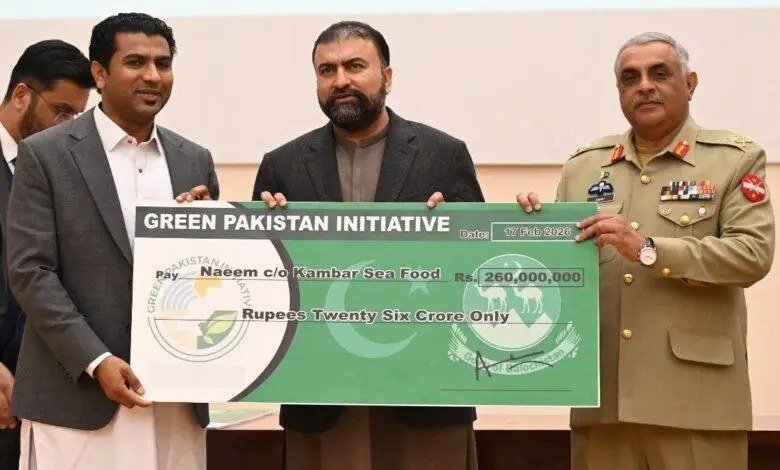
The initiative began on a relatively modest scale in the southern districts of Kech, Panjgur, and Washuk. The first phase of the initiative combined financial assistance with modern infrastructure to strengthen farming activity in the region. Farmers were provided access to loans, solar-powered tubewells, land-leveling services, and modern farming equipment. The phase focused on improving productivity through a combination of financial support, irrigation infrastructure, and modern agricultural inputs.
The impact of the first phase quickly became evident. A total of Rs24.9 crore in loans was disbursed among farming families in the three districts. As a result, 2,460 acres of land were brought under cultivation, while approximately 121 families directly benefited from the program. More importantly, the initiative demonstrated that targeted investment and modern agricultural support could deliver tangible results for farming communities. The success of the first phase provided evidence that farmer-focused interventions can generate measurable outcomes even in areas facing longstanding development challenges.
One of the most important components of the program was the introduction of solar-powered tubewells. Irrigation costs had long limited the ability of many farmers to expand cultivation. Solar-powered systems provided a more affordable and sustainable solution, reducing dependence on costly fuel-based alternatives. Improved access to water, combined with technical guidance and modern machinery, helped farmers prepare land more efficiently and increase agricultural productivity. The adoption of solar-powered irrigation also highlights the role of technology in reducing production costs and improving the long-term sustainability of agricultural practices.
Building on the success of the pilot phase, the Green Pakistan Initiative entered a much larger second phase. This expansion reflected growing confidence in the model and a commitment to extending its benefits to more communities. During this phase, over Rs106 crore in interest-free loans were disbursed among 251 farming families. The impact was significant: more than 10,037 acres were brought under cultivation, representing a substantial increase compared to the first phase. The rapid expansion of cultivated acreage reflected the effectiveness of a model built around farmer empowerment and practical support. It also demonstrated the scalability of an approach that had already proven successful during the pilot phase.
The expansion continues to gain momentum. An additional Rs59.7 crore is currently under disbursement, with another 141 families expected to benefit. This next round is projected to bring a further 9,280 acres under cultivation, extending the reach of the initiative and creating new opportunities for farming communities across the region.
The Green Pakistan Initiative has evolved from a pilot project in three districts into a large-scale effort that is delivering measurable results across Balochistan. Interest-free financing, solar-powered irrigation, modern machinery, and technical assistance have enabled hundreds of farming families to expand cultivation and improve productivity. The steady expansion of the program reflects the effectiveness of an approach built around practical support, modern technology, and long-term investment.
Beyond the figures, the initiative reflects a broader vision for agricultural transformation in Balochistan. Increased cultivation, stronger rural incomes, and greater participation in farming are creating new opportunities for communities across the province. The progress achieved so far demonstrates the value of investing in farmers and equipping them with the resources needed to succeed. By modernizing agricultural practices and expanding access to critical support systems, the Green Pakistan Initiative is laying the foundation for a more productive, prosperous, and self-reliant future for Balochistan’s farming communities.