Jiwani has long been known as one of Balochistan’s most beautiful coastal destinations. Nestled on the western edge of Gwadar district, it is renowned for its beaches, dramatic cliffs, rich marine life, and breathtaking sunsets. Beyond its natural beauty, Jiwani occupies immense strategic significance because of its proximity to vital Arabian Sea shipping lanes and the China Pakistan Economic Corridor (CPEC). It is a place where tourism, commerce, and national security converge.
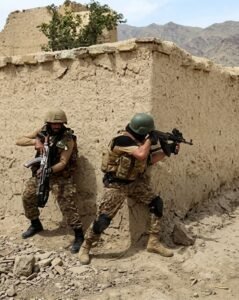
On July 3, this peaceful coastal town became the scene of a devastating terrorist attack. A vehicle packed with explosives rammed into a Pakistan Coast Guards checkpoint in Panwan, Jiwani, killing security personnel in a suicide attack claimed by the Baloch Liberation Army (BLA). The attacker was identified as Attaullah, a member of the BLA’s Majeed Brigade, a unit responsible for carrying out suicide missions.
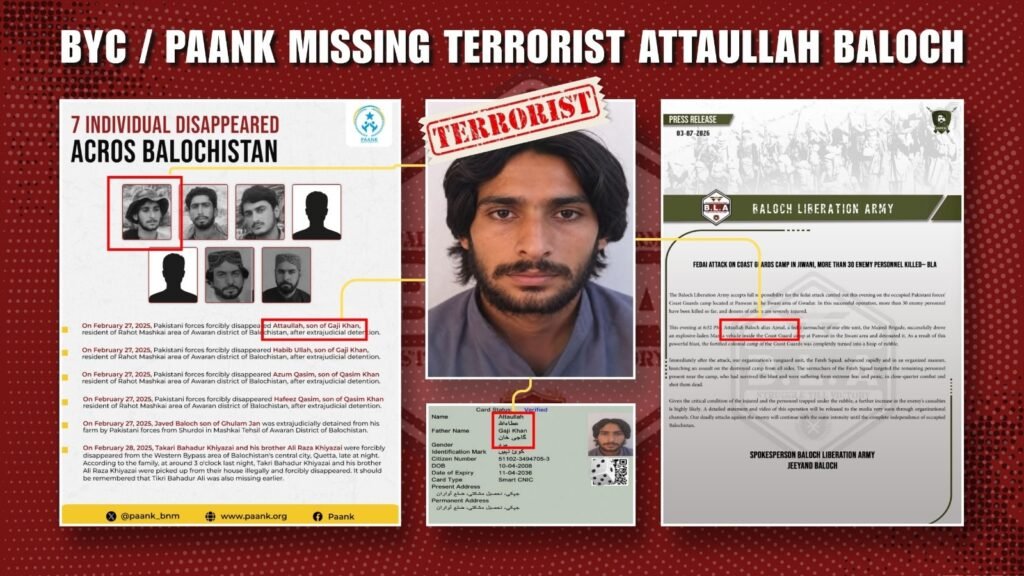
The name Attaullah was not unfamiliar.
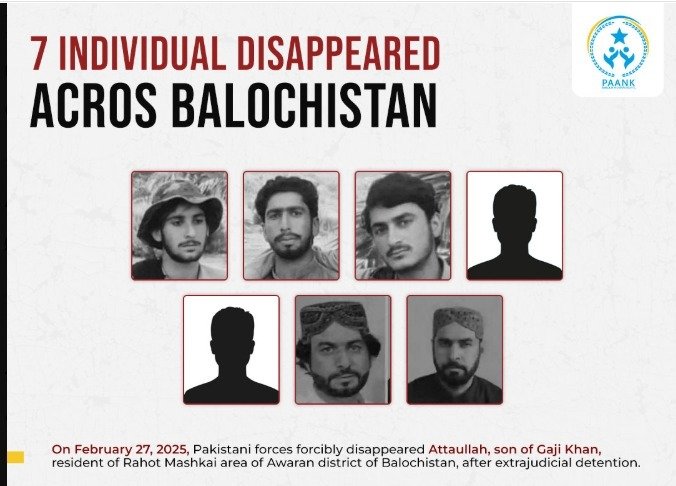
Long before the attack, his photograph and name had circulated across social media campaigns run by the Baloch Yakjehti Committee (BYC) and PAANK Media. On February 27 and 28, 2025, PAANK publicly listed Attaullah, son of Gaji Khan, as a “missing person,” portraying him as another alleged victim of enforced disappearance. For more than a year, his case remained part of the organization’s missing persons campaign. Following the Jiwani attack, the same individual was identified as the suicide bomber who carried out one of the deadliest attacks in the area. The contrast between these two narratives exposes serious flaws in the way such campaigns are compiled, verified, and promoted.
More importantly, Attaullah’s case is not an isolated incident. It reflects a pattern that has emerged repeatedly over recent years. Individuals publicly projected as missing persons have later been identified by authorities as members of terrorist organizations involved in attacks against security forces and civilians. These recurring cases demonstrate a consistent pattern in which organizations claiming to advocate for human rights repeatedly promote individuals who later emerge as members of terrorist organizations.
This pattern demonstrates that these platforms function as more than advocacy groups. By portraying suspected terrorists as victims before investigations are complete, they generate public sympathy, attract international attention, and create political pressure that benefits terrorist organizations.
Several documented cases reinforce these concerns. Bilal Shahwani was widely portrayed in so called activist campaigns as a missing person before authorities identified him as an active BLA terrorist. Salim Baloch was similarly linked to BLA operations after appearing in missing persons narratives. Mahal Baloch was later identified as a suicide bomber associated with the Baloch Liberation Front, while Khair-un-Nisa, whose name also appeared in missing persons campaigns, was arrested during what authorities described as suicide bomber training. Together with Attaullah’s case, these documented cases provide compelling evidence of a recurring pattern in which individuals portrayed as “missing persons” later emerged as members of terrorist organizations.
The repeated appearance of the same individuals in missing persons campaigns and subsequent terrorism investigations reflects a deeper structural problem rather than isolated errors. Every inaccurate listing undermines the credibility of genuine missing persons cases while providing terrorist organizations with a narrative shield that complicates lawful counterterrorism operations.
In conclusion, the case of Attaullah and similar incidents highlight a troubling pattern that can no longer be dismissed as coincidence or isolated error. When individuals repeatedly presented as ‘missing persons’ later emerge as active participants in terrorist activities, it exposes the true face of such self-proclaimed human rights groups.
Addressing the issue of missing persons requires accuracy, responsibility, and integrity. Countering such misleading narratives is essential for ensuring lasting peace and stability in Balochistan.