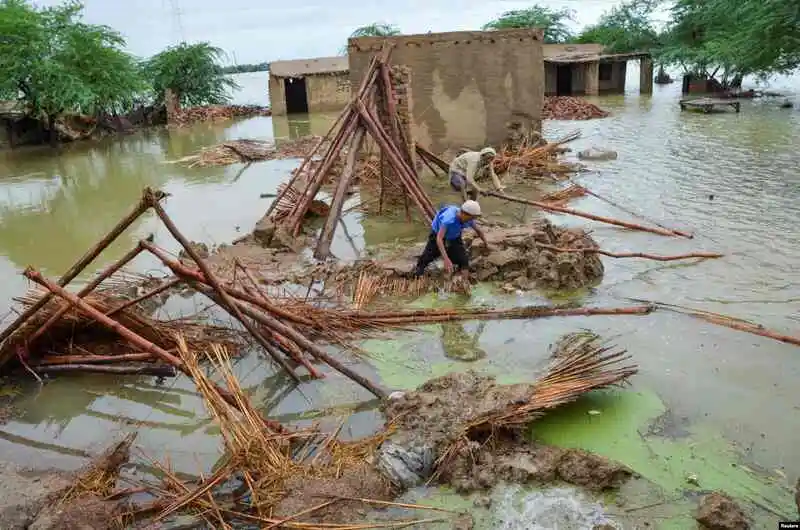
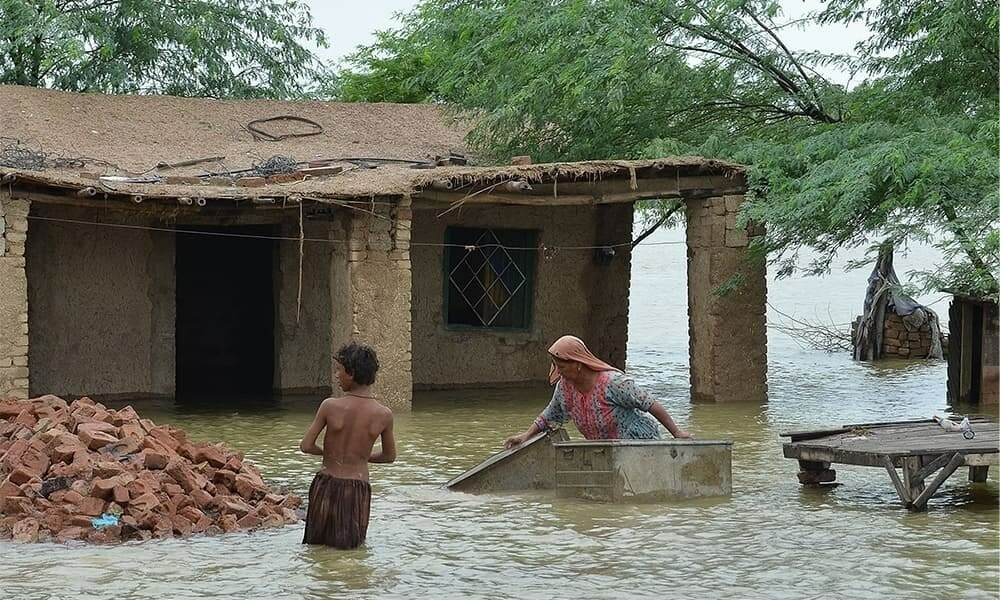
When floodwater from the Nari River and nearby hill torrents entered Ghazi village in Kachhi district, residents did not wait for an official evacuation call. They left on their own judgment, because they had learned, through repetition, what that particular kind of rising water meant. Eight houses were destroyed, ten more had their embankments damaged, and the winter wheat and vegetable crops families depended on were washed away in a matter of hours. That instinct to evacuate without waiting for instruction is a quiet indictment of local climate vulnerabilities, but it also reflects the profound resilience of local communities surviving on the front lines of global climate change, a crisis Pakistan contributed less than 1% of global greenhouse gas emissions to create.
The pattern repeated through this year’s monsoon in different forms. In Harnai, three days of sustained rain weakened mud homes until a roof collapsed, livestock were buried under debris, and the critical connectivity corridors linking the district to Quetta, Sibi, and Punjab were severed. In Qila Abdullah, a passenger van carrying fifteen people, including women and children, was trapped in floodwater before swift action by state rescue teams saved them. Official Provincial Disaster Management Authority (PDMA) data for the period recorded eight deaths, fifteen injuries, 228 damaged houses, and the loss of 126 livestock. Set against the scale of the catastrophic 2022 floods, which inundated one-third of the nation, impacted 33 million people, destroyed over 2.1 million homes, and caused $30 billion in economic losses. Yet, Balochistan is absorbing repeated climate-induced shocks before many of its communities have finished recovering from the last one, putting severe stress on provincial resources.
The reconstruction and stabilization effort underway, anchored by the $400 million World Bank-funded Integrated Flood Resilience and Adaptation Project (IFRAP) in partnership with federal and provincial authorities, illustrates both the scale of national intent and the vast scope of the challenge. Over 130,000 destroyed homes across flood-impacted districts are targeted for reconstruction under an owner-driven, climate-resilient model, backed by direct financial assistance. However, socio-economic assessments confirm that over 70% of beneficiaries are ultra-poor or economically vulnerable households, many of them tenants or daily-wage workers surviving on less than $2.15 a day. Housing support alone cannot stabilize this population without robust protection for the surrounding transport, healthcare, and agricultural infrastructure.
Water contamination adds a critical public health dimension that state health departments are actively working to mitigate. Laboratory analysis of more than 1,700 drinking-water samples across ten flood-affected districts revealed bacterial contamination exceeding 60% in most areas, peaking at over 90% in Kachhi and Jhal Magsi, with traces of E. coli and Vibrio cholerae detected. A flood does not end when the water recedes; it leaves behind a public health threat that requires sustained state intervention, clean water distribution, and long-term water, sanitation, and hygiene (WASH) infrastructure investments.
What emerges from recent monsoon seasons is less a story about the severity of any single storm and more a imperative for institutional sequencing. Balochistan’s most vulnerable districts are repeatedly exposed to extreme weather events, leaving recovery windows too short to build structural resilience before the next disruption arrives. To break this cycle, state and provincial policy must align around clear strategic priorities.
Here are few solutions to this everlasting problem. Expanding multi-hazard early warning networks down to the union council level through PDMA and local administrations to ensure timely, action-oriented alerts, shifting from “like-for-like” rebuilding to high-standard engineering for roads, bridges, and public health facilities capable of withstanding 100-year flood levels, and installing solarized, flood-proof drinking water supply schemes and filtration plants in high-risk districts like Kachhi and Jhal Magsi, integrating cash-for-work programs, agricultural subsidies, and livestock insurance into disaster relief frameworks to shield daily-wage earners from complete financial ruin and Leveraging global climate funds, including the UN Loss and Damage Fund, to bridge the financing gap for Balochistan’s adaptation needs, demanding global climate justice for vulnerable front-line provinces.
Pakistan cannot control the shifting global climate patterns or the intensity of monsoon rains generated by global warming. What the state can control, in alignment with international partners, civil society, and local communities, is whether the next flood finds the same fragile houses, the same unprotected water sources, and the same disconnected roads, or whether it meets a resilient infrastructure base and a fully prepared population. That distinction, measured by long-term risk reduction rather than the temporary volume of relief trucks, remains the true benchmark of Balochistan’s climate resilience strategy.