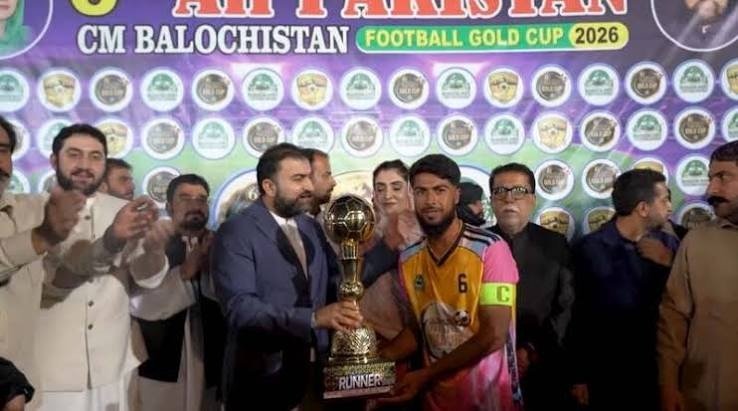
The roar of the crowd at Quetta’s Ayub Sports Complex carried a message beyond the football pitch. The sixth All-Pakistan Chief Minister Balochistan Football Gold Cup 2026 brought together 81 teams from across Pakistan, turning the provincial capital into a centre of sporting competition and youth engagement. With a large crowd attending the final, the tournament showcased football’s enduring popularity in Balochistan and the potential of sports to bring communities together.
Chief Minister Mir Sarfraz Bugti attended the final and distributed trophies and prizes among the winner and runner-up teams. Organised by the Balochistan government’s Sports Department on the chief minister’s instructions, the tournament provided players from different regions with a national platform to demonstrate their abilities. Baloch Club Nushki, Afghan FC Chaman, Muslim Football Club and AK FC Quetta were among the prominent participating teams.
Addressing the media after the final, Bugti described the occasion as a day of great happiness for Balochistan and pledged to keep sports grounds active across the province. He announced that the government would organise major sporting events in all districts, signalling its intention to expand sporting activity beyond the provincial capital.
“The future of our youth is not in the mountains,” Bugti declared, placing youth opportunity at the centre of his message.
The chief minister argued that Baloch youth had been pushed into a futile conflict and emphasised the need to provide them with employment opportunities and constructive avenues for their ambitions. His remarks linked the football tournament to a broader provincial challenge: ensuring that young people have meaningful opportunities to participate in economic, social and civic life.
For Balochistan, the message carries particular significance. The province possesses considerable sporting talent, and football has a strong following across its towns and communities. Competitions such as the Gold Cup give young players an opportunity to represent their clubs, gain exposure and pursue their ambitions through discipline and competition. They also offer a positive public platform where achievement, teamwork and shared enthusiasm take precedence over divisions.
Bugti reaffirmed that his government was prepared to make every sacrifice in the fight against terrorism. He also challenged the narrative that government representatives could not engage directly with the people of Balochistan, pointing to his presence among spectators as evidence of public engagement. His remarks presented the tournament as part of a wider effort to connect public participation, youth development and the province’s security priorities.
The competition’s substantial prize pool added to its significance. According to the tournament information, the winning team received Rs30 million, the runner-up Rs15 million and the third-placed team Rs5 million. These rewards recognised sporting achievement while giving participating clubs a strong incentive to compete at the national level.
The gathering of 81 teams also gave the event a wider national dimension. Players and supporters from different regions came together in Quetta, demonstrating how sport can create common ground across geographical and cultural differences. For Balochistan, hosting a competition of this scale offered an opportunity to showcase its sporting enthusiasm and capacity to bring people together through shared interests.
Bugti also took aim at political mobilisation directed towards confrontation, contrasting the use of public gatherings for festivals and constructive activities with calls to mobilise people for an assault on the federal capital. The comparison reinforced his argument that young people and communities should be directed towards productive engagement rather than conflict.
The Gold Cup concluded as a celebration of football, but its broader significance rested in the message delivered alongside the competition. Balochistan’s youth need opportunities to develop their abilities, earn livelihoods and contribute to society. By bringing 81 teams together in Quetta, the tournament placed sporting achievement and youth participation at the heart of that message.