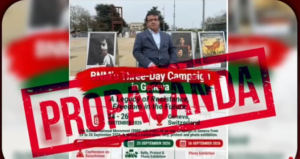
Balochistan has long been one of Pakistan’s most politically contested regions, where competing narratives shape both domestic and international perceptions of the province. Activist groups often frame the region through the lens of human rights violations, enforced disappearances, and political marginalization. Conversely, the Pakistani state presents the conflict primarily as a security challenge driven by militant insurgency and external interference. Two webinars were recently organized, one by the Balochistan Yakjehti Committee (BYC) on 6th March 2026 on topic “One Year of Detention, and One Year of Suppression”, second by Baloch Women Forum (BWF)on 8th March, 2026 on topic “Enforced Disappearance and Imprisonment of Baloch Women”, portraying the issue as part of a broader pattern of systematic suppression. However, when these claims are evaluated alongside available data, official records, and the wider security context of the province, a more complex picture emerges. In order to understand the issue, we need to comparatively and factually analyze the data as well as narrative. The debate about Balochistan cannot be understood by viewing it as discrete issue of human rights or security, it is also about information, perception, and the political framing of conflict.
During the webinar, speakers emphasized the arrests and disappearances of Baloch women, describing these events as unprecedented and indicative of state repression. BYC leaders (including its president Dr. Mahrang Baloch) have been jailed since March 2025, and many members remain in custody for “peaceful” protest activities. They called these “political detentions” lacking due process. (Dr. Mahrang herself was arrested March 22, 2025.) Relatives of detainees, spoke of isolation (e.g. Sibghatullah Baloch’s mother). Organizers claimed hearings were held behind closed doors and without media. Activists alleged hundreds of Baloch (including women and students) have been “forcibly disappeared” by security agencies, creating “widespread psychological trauma”. Activists asserted that these arrests represent a break with traditional Baloch cultural norms, where women have historically enjoyed protection and respect. Discussions also addressed broader issues related to internet censorship, restrictions on freedom of expression, and blatant attempts to cover up discrimination. The narrative presented by the organizers portrayed Baloch women as rising figures of resistance. According to the speakers, women’s political participation is increasing as bereaved families turn to their female relatives to continue the resistance when men are imprisoned or subjected to harassment.
Activists also argued that the incident highlighted that the Baloch women are facing three structural issues: patriarchy, economic exclusion, and military exclusion. Webinar also emphasized that the Baloch conflict is a human rights issue, not a security one. By focusing on women as victims of violence, international discourse on refugees seeks to gather international attention and sympathy, particularly within the context of human rights issues, where gender-related tragedies are receiving increasing attention.
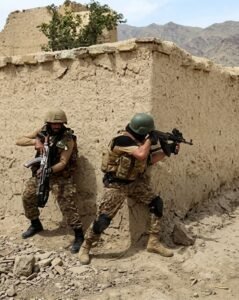
When you look at the ground reality, the things are very different. Security officials argue that the country has been experiencing nearly two decades of ongoing insurgency, led by armed groups such as the Balochistan Liberation Army (BLA and the Baloch Liberation Front (BLF). The state lists numerous attacks by insurgents on civilians, security personnel, and infrastructure in 2025–26. For example, the March 2025 Jaffar Express train hijacking (claimed by the BLA) killed dozens of passengers and soldiers; security forces then killed 33 attackers. Similarly, coordinated BLA attacks on January 31–February 1, 2026 (code-named “Operation Herof”) killed 31 civilians and 17 security personnel, after which Pakistani forces reported killing roughly 145 militants in retaliatory operations. Militant attacks across Balochistan have targeted development projects, railway lines, military installations, and Chinese nationals associated with the China–Pakistan Economic Corridor (CPEC). Such incidents have reinforced the state’s perception that terrorism poses a direct threat to economic development and regional stability. Security officials therefore argue that counter-terrorism operations in Balochistan are not aimed at suppressing political dissent but at preventing militant attacks. The state’s priority is the protection of citizens, strategic infrastructure, and economic projects.
Probably, the most controversial aspect of the Balochistan conflict is the issue of enforced disappearances. Activists often claim that thousands of Baloch have been forcibly disappeared by security agencies. These allegations are widely circulated in advocacy campaigns and social media activism. The state emphasizes that arrests of activists are carried out under legal provisions (Anti-Terrorism Act, Maintenance of Public Order Ordinance, etc.) and decided in Anti-Terrorism or regular courts. For instance, cases against Dr. Mahrang Baloch were heard in a court, and charges have been formally filed under terrorism-related sections.
Official data from the Commission of Inquiry on Enforced Disappearances (COIED) presents a different picture. According to the commission’s reports, 10,636 missing-person cases were registered across Pakistan between 2011 and October 2025. Of these, 8,986 cases were resolved, indicating a resolution rate of approximately 84 percent. Within Balochistan specifically, around 2,885 cases have been registered since 2011. Government officials state that many of these cases were resolved after individuals returned home voluntarily, were traced abroad, or were found to be in legal custody. Authorities also argue that some missing-person complaints involve individuals who joined militant organizations or left the country without informing their families. These cases, officials claim, are sometimes presented in activist narratives as enforced disappearances. The gap between activist estimates and official figures highlights the difficulty of verifying claims in conflict zones.
Another often overlooked aspect in military discourse is the issue of women within armed groups. The irony is these groups use women to carry out their attacks. The state points to recent attacks using female suicide bombers (e.g. assaults on Karachi university [April 2022], Bela FC post [Aug 2024], Noshki ISI HQ [Nov 2025]) as proof that militant groups target all segments of society and even pressure women into terrorism. This practice marks a significant break with the traditional values of the Baloch community, which exclude women from any participation in armed conflict. Several striking cases illustrate this phenomenon. Security analysts believe that militants use women among their fighters for both operational and propaganda purposes. Female suicides often attract international media attention and increase the visibility of armed groups. These events complicate the portrayal of Baloch women as mere victims of violence.
Among the frequent topics discussed by many activists is the internet shutdown and communications restrictions in Balochistan. Mobile internet access is usually temporarily blocked in most areas during the state of high alert or when under some kind of threat. Internet shutdowns in Balochistan do occur for “security reasons” (e.g. a complete mobile outage Aug 6–21, 2025). Authorities claim these measures are intended to prevent collusion between armed groups during special operations or national events. Courts have upheld these bans in some cases. In others, the Balochistan High Court has ordered authorities to restore services when prolonged power outages disrupt daily life and economic activity. BYC’s webinars themselves have thousands of online viewers that activists themselves are using social media and internet openly.
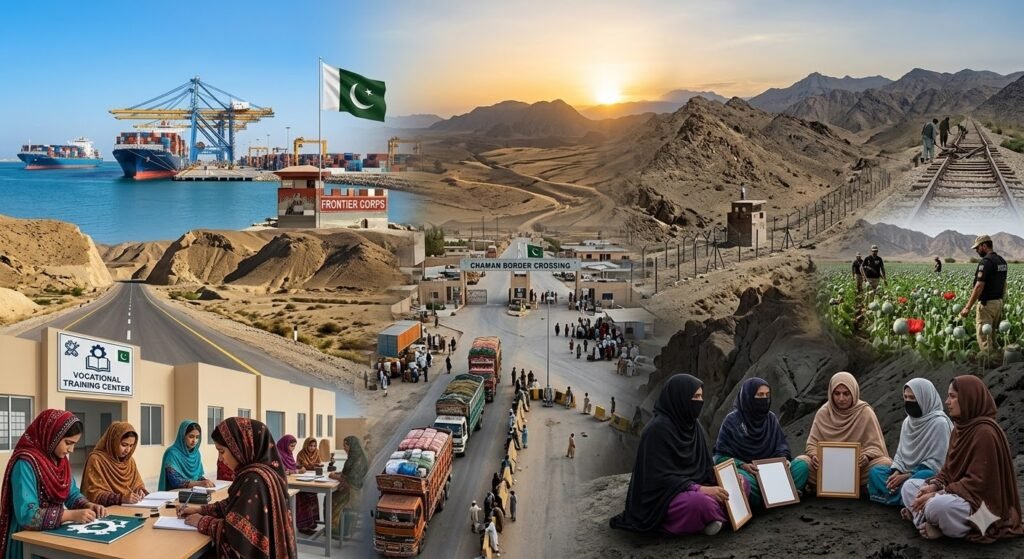
The Government of Pakistan attaches great importance to development projects as part of its overall strategy to stabilize Balochistan. State and local officials are trying to improve infrastructure, increase access to education, and expand the state’s economy. The construction of the China-Pakistan Economic Corridor (CPEC) is often presented as a key step in this development agenda. Federal and provincial budgets allocate billions for infrastructure, health, education, and security. Official figures include 150+ federal Public Sector Development Programme (PSDP) projects (~Rs 1,459 bn investment in Balochistan) and a provincial ADP of Rs 249.50 bn for 2025–26 (covering 3,633 ongoing and 2,550 new schemes). This includes spending on roads (N-25 upgrades), schools and hospitals, water projects, and CPEC-related facilities (Gwadar airport/expressway, special economic zones, etc.). The state also points out fiscal safeguards like the 7th NFC Award which guarantees Balochistan’s 9.09% revenue share and compensates shortfalls, and ongoing post-flood housing reconstruction. Government officials also emphasized programs specifically targeting women. Programs organized by the Balochistan Women Development Department include vocational training, legal assistance, and counseling services. Organizations such as the Balochistan Commission on the Status of Women monitor the policies for gender equality and recommend legal amendments. In addition, financially inclusive initiatives such as the State Bank of Pakistan’s “Banking on Equality” initiative aim to increase women’s access to finance and entrepreneurial opportunities. The government is prioritizing long-term socio-economic development over corruption.
One of the most discussed topics during the Webinar was imposition of “Fourth Schedule” on BYC members. The Anti-Terrorism Act 1997 empowers the state to list individuals in the “Fourth Schedule” if there are reasonable grounds to suspect them of terrorism or links to banned organizations. This allows courts to impose bonds, travel restrictions, and regular reporting on listed persons. The government stresses these powers target militants and prevents violence, not peaceful activists. (In fact, Section 11EE of the ATA explicitly requires “reasonable grounds” for proscription and provides judicial review.
To counter the narrative that “Baloch women have no opportunities,” government has listed programs and success stories: for instance, Pari Gul Tareen, a woman from Balochistan, became the first female Assistant Superintendent of Police in Quetta Cantonment, is a sign of “education-based empowerment.” Additional federal programs benefit women – Benazir Income Support, subsidized loans, and broad-based health/welfare schemes. Chief Minister Mir Sarfraz Bugti has publicly emphasized women’s issues in development plans.
The things these activists stay silent about is the situation of security concerns, including foreign-backed military attacks and instability. In this context, counterterrorism is recognized as playing a crucial role in national security and development. Activists deliberately highlight propaganda and anti-state narrative while ignoring others. Their discourse tends to downplay the impact of terrorism on Balochistan which is the most important aspect when one tries to study the situation of Balochistan.
The webinar organized by the Balochistan Yakjehti Committee and Baloch Women Forum provides a perfect example of how narratives about Balochistan are negatively constructed and communicated. Activists use personal stories and emotional appeals to soften their cause (e.g. mothers of disappeared activists, threats to women). They label state actors as “death squads” or “instruments of oppression,” framing Baloch struggle in terms of justice versus tyranny. By emphasizing the abduction of women and enforced disappearances, activists seek to portray the conflict primarily as a human rights crisis. However, when examined alongside official data and the regional security context, the situation appears more complex than these activists narrate. Balochistan remains a province plagued by numerous interconnected conflicts, including terrorism, political crisis, economic unparallel development, and information warfare. Understanding these dynamics requires a careful analysis of activist claims and state responses, rather than blindly accepting one narrative. In such conflicts, the search for truth often unfolds not only spatially, but also psychologically and emotionally. Balochistan’s future depends as much on addressing the flaws in this propaganda narrative as on resolving the political and security problems that perpetuate the conflict.