Women Inclusivity: Essential for Socio-Economic Development of Balochistan
Cultural acceptance of Gender Based Violence is generally tied with the behavior of women. Informal Jirgas have strong hold in the tribal, feudal and rural settings of Balochistan. An upsetting video went viral on social media from Deghari, near Quetta, where Ehsan Ullah and Bano Bibi were executed on 4th June, 2025, for marrying by choice. The couple was shot multiple times and they calmy accepted their fate. These kinds of incidents are not separate but when societal system has normalized inequality and injustice, violence becomes systematic rather than exception. In the tribal parts of Pakistan, traditions have been weaponized to justify violence. According to Pakistan Bureau of Statistics, the female population of Balochistan is around 7.12 million makes up 47.84% of total population of the province but their involvement in socio-economic activities of Balochistan is very less, despite government’s efforts to provide inclusive environment to Baloch women. This has impacted Pakistan’s overall standing in Global Gender Gap Report, where the country has ranked 148th out of 148. As the province has the largest gender disparities, Balochistan pulls down national averages across all four pillars of the index. These socio-economic inequalities coexist with patriarchal norms and intensified militarization in the province, disproportionately affecting women in Balochistan through economic marginalization, patriarchal constraints, and militarized conditions.
As evident by the reports of UNDP, Balochistan is lowest in female literacy and enrollment rates in the country. In some districts, the female literacy rate is as low as 5% as compared to 36.5% for male. Approximately 77% of girls aged 6-15 are out of school in rural areas. The situation in the urban areas is not very different as well. According to Balochistan Education Management Information System (BEMIS), in a gender-wise comparison, 39% males and 69% females of the 6-15 age group are out of school.
Similarly, Women participation in labor force is on decline. It dropped from 24% in 2016 to 22% today in Balochistan. According to sticky floor theory, women are usually stuck in low-pay, low-mobility jobs. Cultural norms often limit women’s mobility and access to financial resources, though women-led entrepreneurship in urban centers like Quetta is increasingly seen as a viable alternative to formal employment.
While, Pakistan’s health gap is narrower than other categories, Balochistan’s high maternal mortality and limited healthcare access negatively weigh on the national score. The situation of Gender-Based Violence is very harsh in the province of Balochistan. The sociological roots of the Gender Based Violence are embedded in enduring patriarchal norms. According to the Armed Conflict Location and Event Data Project, a shocking 35% of women in Balochistan face intimate partner violence. A larger number of women fell victim to so-called honor crimes at the hands of their close relatives like husband, brother and father. Situation of minority and transgender women is way more vulnerable in such traditional societies who also face barriers to access formal justice system.
Last but not least, Balochistan has the largest gender gap when it comes to political participation. The gender gap in the electoral roll is highest in Balochistan at 15.65%. As of 2025, women’s representation in senior management and ministerial roles remains minimal, contributing to Pakistan’s “freefall” in this subindex.
Gender inequality in Balochistan is not simply a political failure; it is a complex web woven from deeply entrenched patriarchal structures, rigid tribal traditions, and the unique sociopolitical realities of the local population. Behind this inequality lies the “honor code” (Pashtunwali or Balochmayar), where the concept of honor is often associated with the limitations and isolation of women. In many villages and tribal areas, a woman’s presence in public spaces – whether for education, work, or health – is viewed with suspicion, creating a protective mentality that, in practice, eliminates women’s active role. This patriarchal control ensures that decision-making power remains concentrated in the hands of tribal men and family heads, who often consider investing in a daughter’s education a “loss,” as she will eventually move to another home. Local customs, such as blood feuds and early forced marriages, further exacerbate this inequality. When a girl is married off at a young age, her path to education and economic independence is permanently blocked, reinforcing the cycle of dependency. This situation is exacerbated by the province’s vast and rugged terrain. The lack of dedicated transportation for women and the underutilization of female professionals in schools and clinics means that even families willing to break with tradition fear the “moral hazard” of their daughters traveling alone over long distances. Economically, the male-dominated inheritance system often marginalizes women, despite legal and religious regulations. Without land or capital, Indigenous women are relegated to unpaid domestic work or informal agriculture, invisible to the national economy. Therefore, gender inequality in Balochistan is among the highest in Pakistan, as it is based on a social contract in which male authority is the primary currency for stability and status.
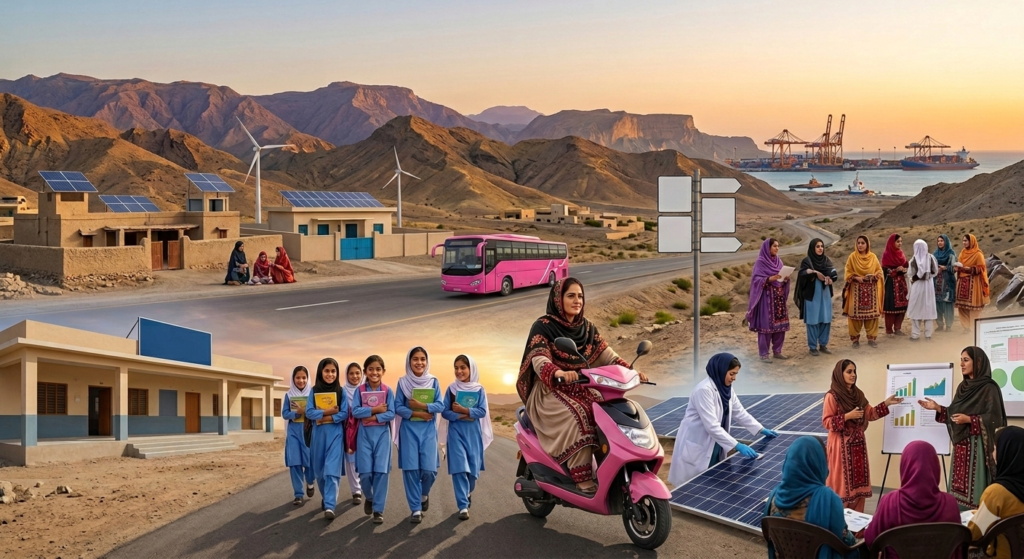
Despite these challenges, progress has been made in legislation at both the federal and provincial levels, indicating a shift towards protecting and empowering women. In recent years, the Balochistan government has worked tirelessly to close the gender gap. Balochistan Chief Minister Sarfraz Bugti has stated that sustainable progress is impossible without the integration of women into society. In February 2026, the provincial education minister announced “decisive measures” to combat girls dropping out of school and increase their access to feminine hygiene products, noting that the lack of these products is a “silent driver” in girls dropping out. Furthermore, the Balochistan Child Marriage Restraint Act 2025 was passed in November 2025. This important reform sets the minimum age of marriage at 18, bringing Balochistan in line with Sindh and Islamabad in ending a practice that has long prevented girls from accessing education prematurely.
The Balochistan Assembly adopted The Balochistan Protection Against Harassment of Women at the Workplace (Amendment) Act, 2025 in July 2025 without any opposition. The members termed it a significant step towards ensuring a safe and inclusive environment for working women in the province. Chief Minister Sarfraz Bugti praised the passage of the bill without any opposition and said it is an important development for the women of Balochistan.
The Balochistan Maternal and Perinatal Death Surveillance and Response Act, 2025 was enacted to formalize the tracking of maternal health outcomes, directly addressing the province’s high maternal mortality rates. Similarly, the Balochistan cabinet adopted Balochistan’s first-ever transgender policy to safeguard rights and ensure social and economic inclusion of the transgender community. An Endowment Fund for Minority Welfare was also approved to provide equal opportunities and facilities for minority groups.
The Women’s Inheritance Rights Bill 2025 was tabled to ensure women receive their rightful share under Islamic law with strict penalties for violators, its full implementation remains a focus for 2026. The government continues to roll out its Gender Equality and Women’s Empowerment Policy, which is aligned with the Sustainable Development Goals (SDGs) to increase female representation in government institutions.
Furthermore, the advisor to Chief Minister on Women Development, Dr. Rubaba Khan Buledi said, “Gender equality is not merely a goal; it is the foundation of our development. Without providing women with their rights and opportunities, we cannot build a better social system.” She also added that women’s full participation in social, economic and political sectors is crucial for Balochistan’s progress.
Most important aspect for economic integration of Baloch women is state’s efforts and strategies to transform women role in low-paid, informal economy to a high-tech and value-added industrial sector through targeted CPEC-linked initiatives. Pakistan is treating Gwadar as a catalyst for “Blue-Economy”. Through the resistance movements like Haq Do Tehreek (Give Rights Movement) and recent long marches, women in Gwadar are being used against the state to propagate the separatist narrative. They made them believe that Baloch women are treated as “disposable labor” or “invisible caregivers.” However, in 2026, Pak-China Technical and Vocational Institute (PCTVI) intake, women represented nearly 44% of successful candidates (191 out of 435). Operating since 2020, the Gwadar Women Factory, also known as the Gwadar Women’s Development Employment Center, is a collaborative effort between the Chinese Consulate in Karachi and the Gwadar Women Development Organization of the China Overseas Port Holding Company. In early 2026, the Balochistan cabinet approved a 30% subsidy on electric bikes specifically for working women and students to ease transportation costs and safety concerns. Also, the Pink Scooty Scheme was inaugurated in late 2024, with a distribution of 50 scooties at the Government Girls Postgraduate Degree College, Quetta. Complementing this, Pink Bus Service was formally launched in Quetta on December 10, 2025. Initially 5 buses were made operational on urban corridors, like University Road and Sona Khan to Kuchlak.
Despite the challenges, Balochistan has seen significant legislative progress at the federal and provincial levels, demonstrating a shift towards women’s protection and empowerment. However, legal milestones require local participation and strong support through law enforcement to achieve meaningful results. These changes, although gradual, are effective and important in transforming social mobility in Balochistan. The province has sought to align its laws regarding women’s property rights with constitutional guarantees and address issues related to inheritance. The government’s law enforcement efforts demonstrate progress in improving the socioeconomic situation and women’s rights.