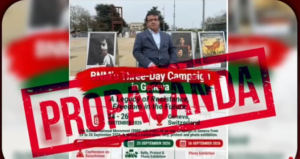
Every year, as 11 August approaches, the same claim returns with fresh graphics and louder volume. Diaspora channels and partisan pages insist that Balochistan was a free and sovereign nation that declared independence on that date in 1947. The claim is repeated with confidence. The historical record does not support it.
The first problem is definitional. There was no single, unified state called Balochistan in 1947 that could declare independence. What exists today as Pakistan’s Balochistan province was a patchwork of territories with different legal statuses and different political trajectories.
Chief Commissioner’s Balochistan, which included Quetta, Pishin and Sibi, was administered directly by the British Crown. Its future was decided through recognized institutions. The Shahi Jirga, a representative tribal assembly, together with the Quetta Municipal Committee, voted to accede to Pakistan in 1947. That decision covered a substantial portion of the territory and population that now form the province.
Kharan, Lasbela and Makran were separate princely states. Each had its own ruler and its own treaty relationship with the British. Each rejected the idea that it owed allegiance to the Khan of Kalat. Each negotiated its own accession to Pakistan independently. By the time Kalat enters the discussion, most of the territory and people of modern Balochistan had already chosen Pakistan through their own political institutions.
Kalat itself was never a sovereign state in the international legal sense. Like every other princely state under British paramountcy, it held internal autonomy but had no independent control over defence, foreign affairs or communications. Those powers remained with the British Crown under treaty. British authorities were asked more than once to recognise Kalat as fully independent. They consistently declined. They treated it as part of the same framework that governed the roughly 560 other princely states of the subcontinent. None of those states is described today as a sovereign country that was later annexed.
Geographically, Kalat covered only a fraction of today’s Balochistan, commonly estimated at about a quarter of the province. When the Khan of Kalat signed the Instrument of Accession in March 1948, he used the same legal instrument employed by the rulers of Hyderabad, Junagadh and hundreds of other princely states that joined either India or Pakistan. Those accessions are not described as foreign annexations. Applying a different legal standard only to Kalat, while using the same document and the same constitutional mechanism, is not historical analysis. It is selective storytelling.
One further fact dismantles the claim of a complete, bounded independent state in 1947. Gwadar, which today anchors Balochistan’s coastline and its economic future, belonged to the Sultanate of Oman for nearly a century and a half. It became part of Pakistan, and therefore part of Balochistan, only on 8 December 1958 through a negotiated purchase. A territory cannot have declared independence as a complete state in 1947 when a key stretch of its own coastline would not join it for another eleven years.
The documentary record on the narrow question of 11 August is not ambiguous. Chief Commissioner’s Balochistan acceded through its jirga. Kharan, Lasbela and Makran acceded independently. Kalat later acceded through the same legal instrument used across the subcontinent. Gwadar was not even part of the province until 1958. There was no unified sovereign state to lose its independence on that date, because that state never existed.
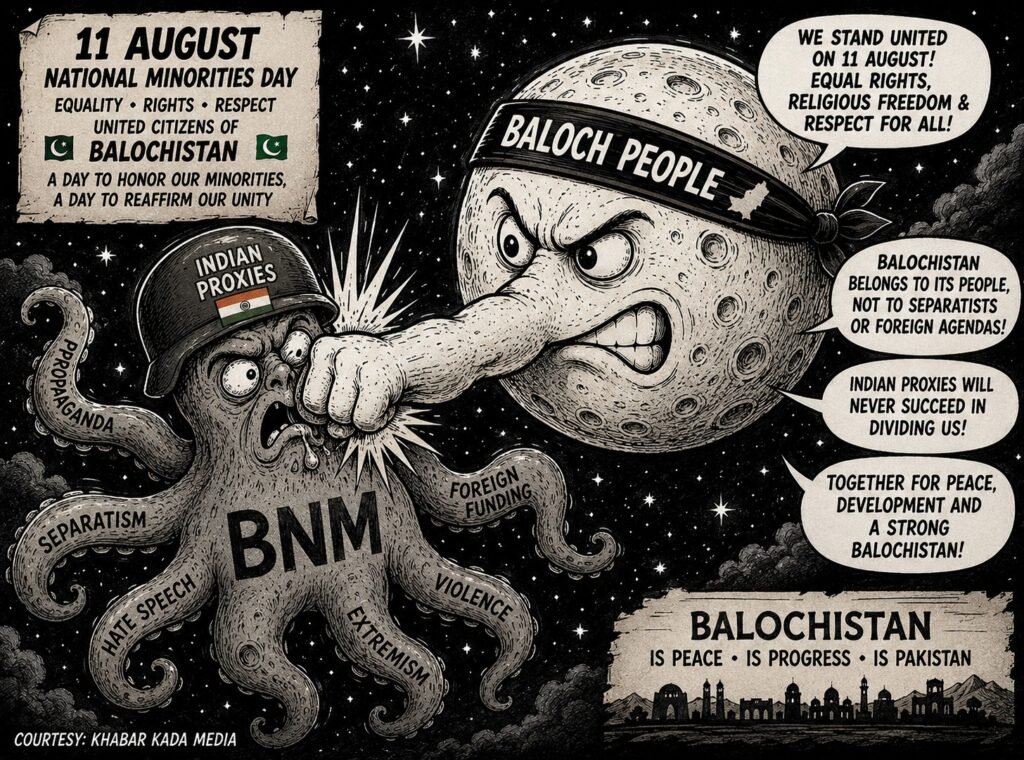
The persistence of the narrative therefore says more about present-day politics than about the past. August 11 has become less a historical claim than a political tool. It is repeated each year regardless of what the legal and constitutional record actually shows. Pakistani officials have long pointed to specific diaspora figures and exile networks, some of whom maintain contact with hostile foreign intelligence services, as the actors who keep the story alive through satellite broadcasts and coordinated online campaigns.
Manufactured narratives do not become history through repetition. The claim that Balochistan was a free and sovereign nation that lost its independence on 11 August 1947 collapses under the weight of the actual political geography of 1947. What the record shows is a set of separate territories making separate decisions, most of them choosing Pakistan through recognised institutions, and one princely state later using the same accession instrument employed by its peers. That is the history. The rest is propaganda.