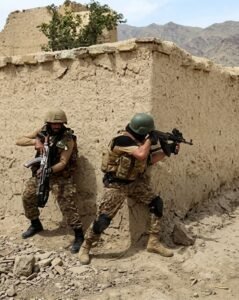
Balochistan occupies a paradoxical place in Pakistan. It is the country’s largest province by territory, yet its population remains comparatively small; it possesses enormous mineral and strategic potential, yet much of that potential remains unrealized.
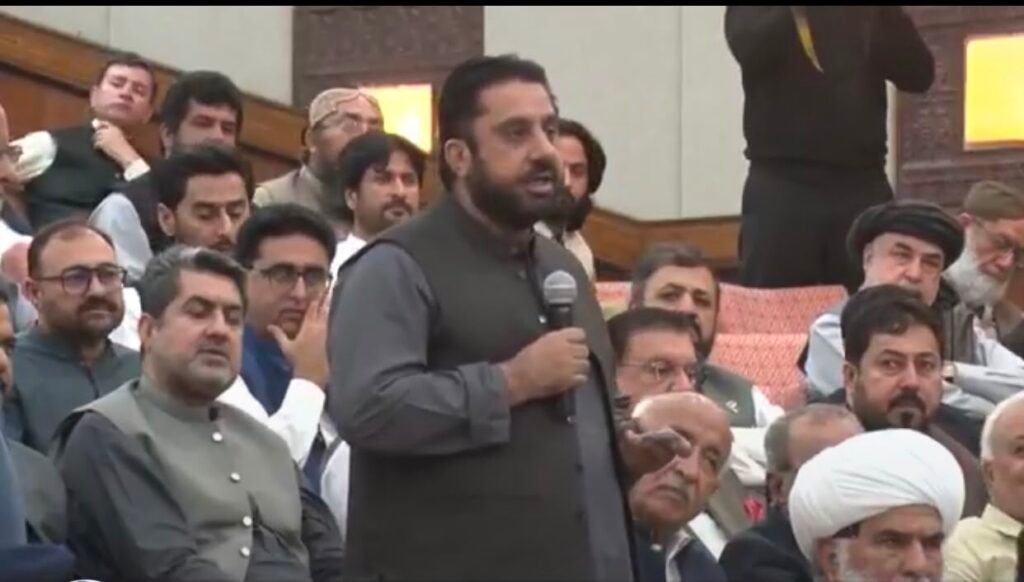
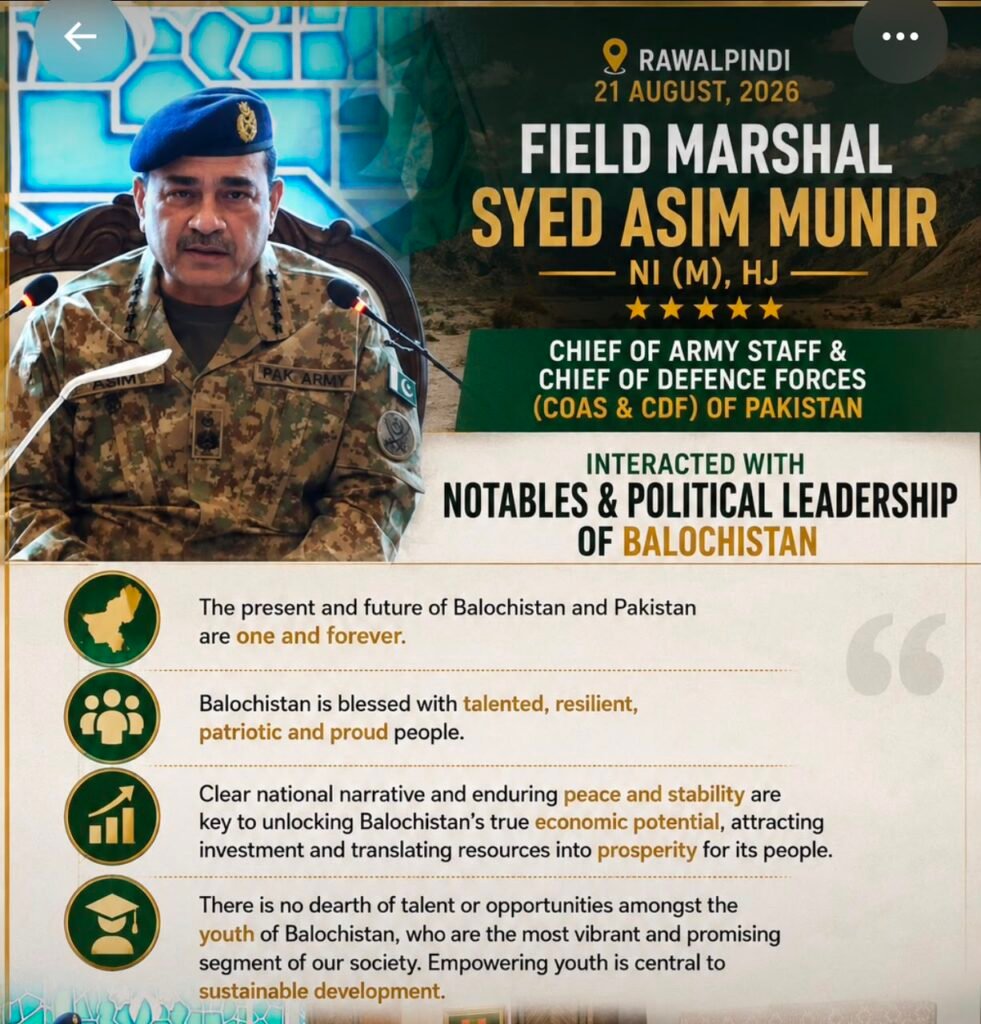
That contrast was central to a recent interaction between Field Marshal Syed Asim Munir, Pakistan’s Chief of Army Staff and Chief of Defence Forces, and political leaders, notables and representatives of Balochistan, where the province’s security, economic prospects and future within Pakistan were discussed.
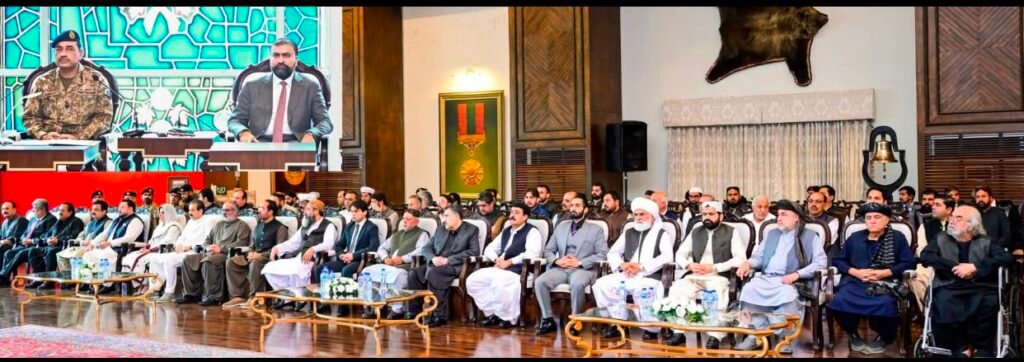
The fundamental message was straightforward; Balochistan’s future and Pakistan’s future are inseparable.
At 347,190 square kilometers, Balochistan accounts for about 43.6 percent of Pakistan’s landmass, making it the country’s largest province geographically. Yet the 2023 census recorded its population at approximately 14.9 million.
Its geography alone gives the province extraordinary strategic importance. Balochistan has a coastline of roughly 760 kilometers, access to the Arabian Sea and borders with Iran and Afghanistan. Gawadar and other coastal locations place the province at the intersection of South Asian, Middle Eastern and Central Asian trade routes.
But geography is only part of the story.
Balochistan is also endowed with deposits of copper, gold, coal, iron ore and natural gas. Government research has highlighted the scale of mineral wealth associated with projects such as Reko Diq and Saindak, underlining why the province could become an important contributor to Pakistan’s mining and export economy.
The challenge is converting that potential into prosperity that reaches ordinary citizens.
The province continues to face substantial gaps in education, infrastructure, employment, health and basic services. One official provincial assessment places Balochistan’s literacy rate at about 42 percent, compared with a national rate of roughly 61 percent based on the 2023 census. These figures illustrate why economic development cannot be separated from investment in people.
That makes Balochistan’s young population particularly important.
The province’s youth represent one of its greatest untapped assets. Their future will depend not simply on security, but on universities and schools, technical training, entrepreneurship, digital opportunities, private-sector employment and access to national markets.
The discussion therefore placed considerable emphasis on creating opportunities for young people rather than allowing frustration and economic exclusion to become fertile ground for extremist recruitment or political exploitation.
Balochistan’s political institutions also provide a constitutional framework through which its people participate in national and provincial decision-making. The Provincial Assembly has 65 seats, 51 general, 11 reserved for women and three for non-Muslims and has gone through 11 general elections since its creation.
The province’s position within Pakistan’s fiscal structure has also changed significantly. Under the 7th National Finance Commission Award of 2010, the province’s share of the divisible pool increased to 9.09 percent, compared with 5.08 percent under the earlier population-only arrangement.
These numbers matter because Balochistan’s development challenge is not simply about the availability of money or resources. It is about governance, security, human capital and the ability to turn public and private investment into visible improvements in people’s lives.
Security remains a major part of that equation.
During the interaction, militant groups referred to as Fitna al-Khawarij and Fitna al-Hindustan were described as foreign-sponsored proxies seeking to destabilize the province, obstruct development and deepen mistrust between the state and its citizens.
Whatever the political debate surrounding Balochistan, attacks on civilians, infrastructure, transport, educational institutions and economic activity carry a direct cost for ordinary people. Businesses become reluctant to invest, transportation becomes more expensive, and communities lose opportunities that may take years to rebuild.
For that reason, the response to militancy cannot be limited to force alone. Security, political engagement, economic opportunity and credible communication must reinforce one another.
Munir also emphasized the responsibility of Balochistan’s political and community leadership to counter hostile propaganda, challenge false narratives and communicate the province’s actual achievements and potential.
That responsibility extends beyond the state.
Balochistan’s political leaders, tribal and community figures, educators, journalists, businesspeople and young citizens all have a role in defining the province’s public conversation. A narrative focused exclusively on conflict risks obscuring the possibilities created by the province’s people, resources and strategic location.
The participants reaffirmed their commitment to peace, development and prosperity and expressed their resolve to stand against threats they described as foreign-sponsored while supporting people-centered development.
The larger question now is whether Baluchistan can turn its extraordinary geographical and mineral advantages into a broader social and economic transformation.
The province has the land. It has the coastline. It has mineral wealth. It has a young population and a strategic position connecting Pakistan with two neighboring countries and the wider region.
What it needs most is the combination of peace, capable institutions, investment, education and opportunity that can transform those advantages into a better quality of life.
Balochistan’s destiny, ultimately, cannot be secured by resources alone or by security measures alone. It will be shaped by its people and by the choices made by its political, economic and social leadership.
And that is why the proposition that Balochistan’s future and Pakistan’s future are one is not merely a political slogan. It is also an economic and demographic reality.