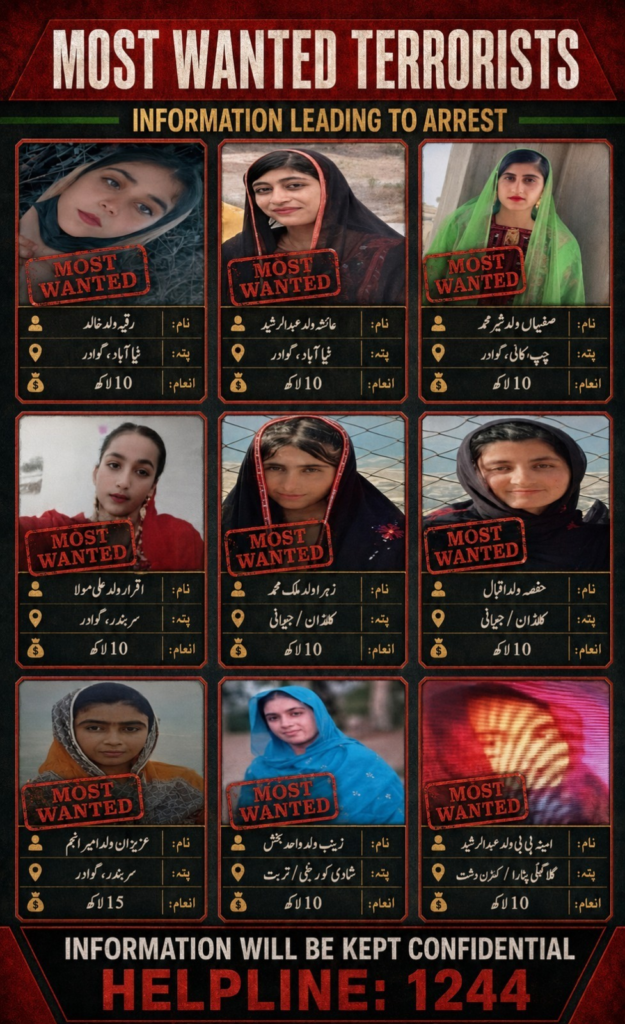
The Balochistan government has announced rewards of Rs 1 million to Rs 1.5 million for credible information leading to the identification or capture of nine most-wanted women linked to Fitna al-Hindustan. Eight of the suspects carry a bounty of Rs 1 million each. One carries Rs 1.5 million. Informants’ identities will be kept strictly confidential. The wanted women are associated with Gwadar, Jiwani and Turbat. These women were involved in terrorist activity and of misleading vulnerable women to spread violence and instability.
This announcement is not an attack on Baloch women. It is an attack on a method. Banned terrorist networks have spent years converting the honour of Baloch womanhood into an operational tool. They recruit through grievance, isolate through secrecy, and then send women into roles that male cadres cannot fill as easily. Checkpoints hesitate. Crowds lower their guard. Cameras stay longer on a female bomber than on another armed man. That is the calculation.
The pattern did not appear overnight. In April 2022, Shari Baloch became the first widely documented female suicide attacker linked to the Balochistan Liberation Army when she struck Karachi University. Subsequent years also produced more names and more missions such as Summiya Qalandarani in Turbat, Mahal Baloch, khair-un-Nisa etc. Videos of women in fatigues, staged couple photographs before suicide missions, and short-form clips on social platforms were not side products. They were recruitment instruments. A woman on camera is meant to shame men into joining and to persuade other women that death is dignity.
The same organisations that celebrate these women as “icons of resistance” protect their own. Commanders’ daughters and wives are often kept off the blast radius. They handle propaganda, money, and online grooming from safer ground. Ordinary women and girls from Gwadar, Kech and the wider Makran belt are the ones pushed toward jackets, vehicles and final messages. That double standard is the clearest proof of exploitation.
Recruitment follows a familiar path. Handlers work through social media, family pressure, and a manufactured story of stolen resources and vanished relatives. Some targets are students and professionals. Some are minors. Security agencies have interrupted plots in which girls were moved toward handlers in Karachi or Hub after months of online contact. In several public cases, women later said they had been misled. Adeela Baloch, a nurse from Turbat, appeared with her parents after her rescue and said terrorists had drawn her toward violence. Other intercepted would-be attackers, including cases involving Khair-un-Nisa and Laiba, described coercion and instruction to recruit more women. Those testimonies show that how FAH weaponizes women for terrorist agendas.
The Makran coast is not an accident of geography in the latest notices. Gwadar, Jiwani and Turbat sit on routes, ports and development corridors that militants have long tried to sabotage. Using local women in these districts gives networks cover, kinship access and a propaganda claim that the people themselves have risen. Families have begun to break that claim. In Gwadar, relatives are now publically disowning those who got missing evern the females as well. That is a hard and necessary act. Silence protects handlers. A family’s public refusal denies terrorists the story that an entire household stands behind the gun.
Balochistan’s women are teachers, nurses, traders, students and mothers. They are not a reserve force for Fitna al-Hindustan. Every recruitment of a vulnerable girl is a theft of her future and a smear on a culture that has guarded women’s dignity for generations. The bounties announced this week close one door. The larger task is to close the pipeline and expose the handlers, reject the glamour of female martyrdom, and return every misled woman to her family before a suicide vest becomes her last identity. Therefore, peace in Balochistan will not be built on the bodies of its daughters. It will be built when communities refuse to let terrorists speak in their name.