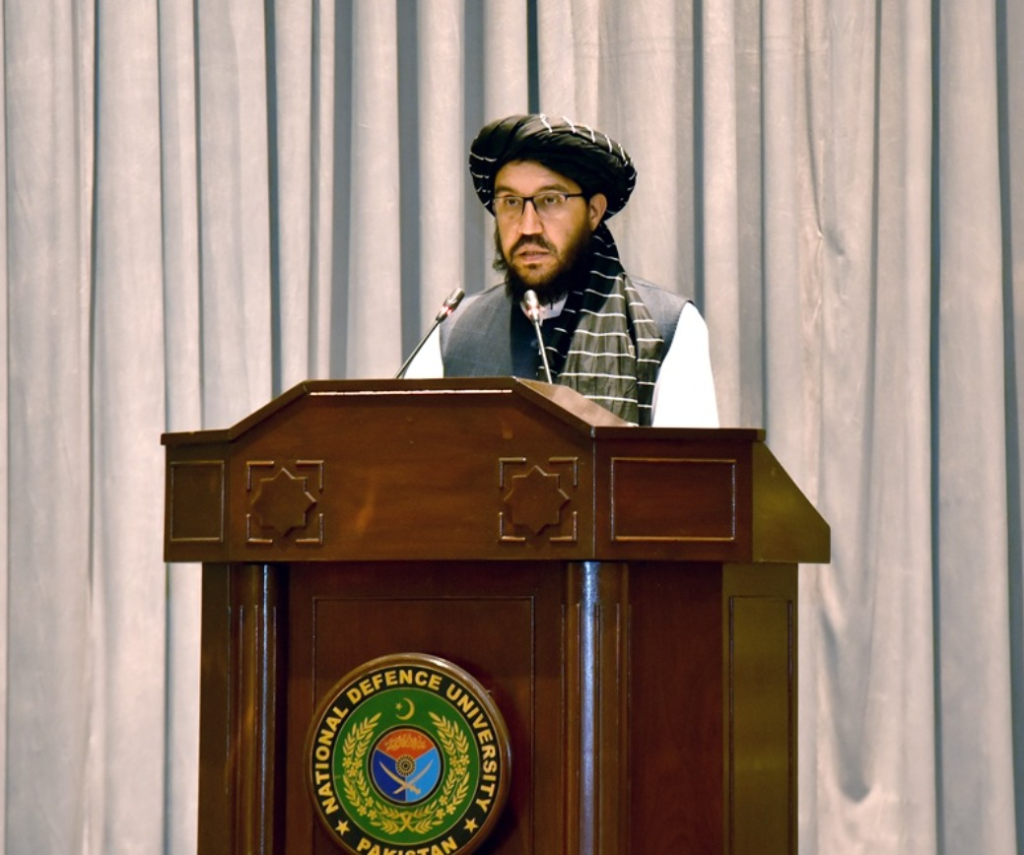
Islamabad: The Afghan Ambassador to Pakistan, Sardar Ahmad Shakeeb, has drawn sharp criticism from diplomatic circles after the Afghan Embassy publicly released details and video footage of his address to military officers at the National Defence University (NDU). The session was conducted under the Chatham House Rule, an international norm designed to protect the confidentiality of discussions.
NDU, Pakistan’s premier institution for national security and strategic studies, regularly invites guest speakers, including diplomats from various countries, among them Indian ambassadors, to share perspectives with participants of its War Course and other programmes. The purpose is academic: to listen to, analyse and understand different viewpoints, not to endorse them or treat the interactions as policy signals.
Officials and diplomatic observers stressed that the invitation itself was routine and unremarkable. The controversy centres on the subsequent decision to publicise the interaction. Under the Chatham House Rule, participants may use information received but must not reveal the identity or affiliation of the speaker or other participants. Despite this understanding, the Afghan Embassy shared details of the address and circulated video material, some of which also appeared unauthorised on social media.
Diplomatic sources in Islamabad described the move as a breach of established norms and basic professional decency. A retired diplomat remarked that publicly releasing the video demonstrated disregard for international ethics and reinforced perceptions that the Afghan Taliban administration does not respect agreements or proper diplomatic conduct.
The release of the footage fuelled speculation on social media that Pakistan’s policy towards the Taliban-led regime in Kabul had shifted. Official circles firmly rejected this interpretation. They clarified that Pakistan’s stance remains unchanged: the Afghan Taliban regime is viewed as illegal, non-inclusive and non-representative, having seized power through force, with a primary focus that appears aimed at turning Afghanistan into a hub for terrorism and exporting instability to neighbouring countries.
Foreign Office spokesperson Tahir Andrabi addressed the matter by noting that envoys routinely engage in academic interactions and that such engagements are not unusual. Officials reiterated that NDU’s practice of hosting diverse speakers forms part of its academic mission and should not be read as an endorsement of any speaker’s views or as a change in policy.
Analysts observed that the episode highlights the importance of discretion in sensitive forums. Institutions such as NDU rely on mutual trust and adherence to agreed protocols to enable candid exchanges on regional and international issues. The public dissemination of material from a closed session, they said, risks setting an unwelcome precedent and generates unnecessary controversy around what would otherwise have remained a routine academic engagement.
As debate continues, Pakistani officials maintain that the NDU interaction should be viewed solely in its academic context and that Islamabad’s Afghanistan policy has not altered.