There is something almost unbearably simple about the choice Chief Minister Sarfraz Bugti laid out this week, and that simplicity is exactly why it lands. On one side, he said, are terrorist networks that want to hand young girls in Balochistan a future built on violence, sometimes literally strapping them into it as suicide bombers. On the other is a government trying to hand those same girls a laptop, a stitching machine, a small business loan, a diploma. “We want every daughter of Balochistan to hold knowledge, skills, and employment in her hands, not explosives,” he said, and it is hard to imagine a starker way to frame what is actually at stake in this province.
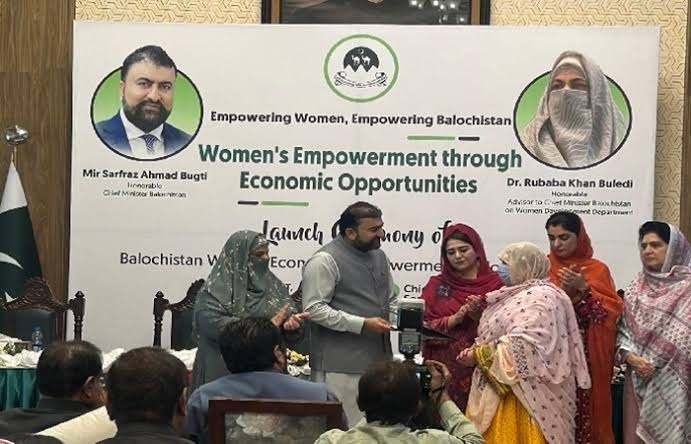
Strip away the politics for a moment and look at the numbers. Six hundred women just completed training under the Women Entrepreneurship Development Program. A hundred of them have already opened businesses with financial backing behind them. These are not abstractions. Somewhere in Quetta or Khuzdar or Turbat, a woman who spent years without an income of her own is now running something that belongs to her. That is not a small thing in a province where female labor force participation has historically lagged behind the rest of the country, and where opportunity for women has too often been rationed by both economics and extremism.
What makes Bugti’s framing worth taking seriously is that it refuses to treat women’s empowerment and counter-terrorism as separate conversations happening in separate ministries. He is arguing, in effect, that every girl handed a real economic future is one recruitment pipeline that terrorist groups cannot reach. It is a quieter, less dramatic form of counter-terrorism than a security operation, but arguably a more durable one. Bombs disrupt networks for a season. A woman with a functioning business and an income tends to disrupt the story these terrorism recruiters tell for a lifetime.
None of this should be mistaken for the problem being solved. A hundred new businesses and six hundred trained women are a beginning, not an ending, in a province of this size and this need. The real test will be whether this program still exists and still expands two years from now, long after this particular news cycle has moved on, and whether it reaches women in districts far from Quetta’s press briefings.
But it is worth pausing, just for a moment, on what Bugti actually said he wants: not obedience, not gratitude, just dignity, independence and prosperity handed to women who have waited long enough for all three. That is a modest ambition dressed up in plain language, and in Balochistan, modest and plain might be exactly what’s needed right now.