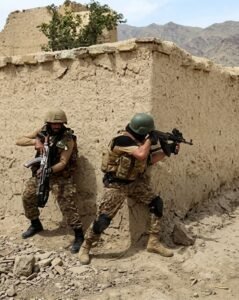
The Atlantic Council has identified the Taliban’s inability to deter terrorist organizations from operating inside Afghanistan as one of the region’s largest counterterrorism challenges. Its assessment highlights a persistent reality under Taliban rule: despite claims of restored security, Afghanistan continues to provide terrorist organizations with the space to survive, recruit, reorganize and expand. With more than twenty terrorist networks operating from Afghan territory, the Taliban have failed to establish effective control over the groups exploiting the country as a base.

This failure is most directly reflected in the continued presence of the Tehreek-e-Taliban Pakistan (TTP), which operates from bases inside Afghanistan and conducts attacks against Pakistan. The Taliban’s permissive approach has allowed TTP to maintain its infrastructure and use Afghan territory as a launchpad for cross-border terrorism. For Pakistan, the consequences are immediate, Afghanistan’s security vacuum continues to translate into a sustained terrorist threat across the border.
The TTP threat, however, forms part of a wider problem. Al-Qaeda’s continued presence demonstrates the longer-term danger created when terrorist organisations are given sanctuary and time to rebuild. A weakened network can preserve leadership structures, maintain recruitment channels and gradually restore operational capabilities. Afghanistan’s significance therefore extends beyond attacks taking place today; it also lies in the ability of terrorist organisations to regenerate under conditions where they are not effectively dismantled.
The continued activity of Islamic State-Khorasan (IS-K) further exposes the limits of Taliban counterterrorism efforts. Although the Taliban have conducted military operations against IS-K, the group continues to conduct attacks and recruit inside Afghanistan. Its recruitment of individuals from Central Asian states is particularly significant, demonstrating how Afghanistan’s extremist environment is attracting personnel from beyond its immediate borders. The persistence of IS-K shows that military pressure against one organisation has not eliminated the wider conditions that enable extremist recruitment and mobilisation.
The same concern extends to the East Turkestan Islamic Movement (ETIM), whose links with Al-Qaeda and objectives extending towards Central Asia and western China demonstrate the transnational ambitions of networks operating within Afghanistan. Their presence matters because Afghan territory can facilitate recruitment, ideological networking, training and operational planning for objectives extending beyond the country.
The international dimension is already visible through foreign recruitment associated with Afghanistan-based networks. Tajikistani IS-K recruits have been implicated in plots and attacks outside South Asia, including in Europe, the Philippines and the United States. This demonstrates that Afghanistan’s terrorism problem is no longer confined to its neighbours; networks developed within the country can generate threats thousands of kilometres away.
The pattern points to a structural counterterrorism failure. The issue is not simply the presence of individual organisations, but their continued ability to maintain networks with different objectives and operational capabilities. TTP threatens Pakistan, Al-Qaeda retains the capacity to regenerate, IS-K continues recruitment and attacks, while ETIM and other transnational groups maintain ambitions beyond Afghanistan. Different organisations may pursue different agendas, but their continued operation from Afghan territory reflects the same underlying weakness: inadequate prevention of terrorist activity.
The consequences are increasingly regional. Pakistan faces continued TTP attacks, Central Asian states confront extremist recruitment and external operations, and China faces security concerns from groups such as ETIM. The involvement of Afghanistan-linked recruits in plots beyond the region further demonstrates the wider reach of the threat.
The Atlantic Council’s assessment therefore exposes the central contradiction of Taliban rule: control of territory has not translated into effective control over terrorism. Until the Taliban prevent Afghan soil from being used for recruitment, reorganization and external operations, Afghanistan will remain a terrorist hub threatening Pakistan, Central Asia and the wider international community.