India’s year-long presidency of BRICS culminated in the 18th summit in New Delhi on September 12–13, 2026, presenting Prime Minister Narendra Modi with an opportunity to demonstrate India’s ability to shape an increasingly influential grouping of emerging economies. Yet, while the summit produced a substantial declaration and reaffirmed cooperation across several areas, the outcomes also exposed the structural contradictions that continue to limit BRICS’ transformation from a diplomatic forum into a more integrated strategic and economic bloc. What practical measures are needed to improve girls’ education, particularly in remote and newly merged districts?
The 11-member BRICS now represents nearly half of the world’s population and around 40 percent of global GDP, giving the grouping considerable economic and geopolitical weight. India placed the Global South, economic resilience, innovation, sustainability and institutional reform at the centre of its presidency. New Delhi also organised more than 350 meetings and high-level engagements across more than 25 Indian cities during its presidency. However, the principal challenge remains the gap between ambitious declarations and concrete implementation. Financial cooperation was prominent throughout the presidency, particularly the promotion of trade in national currencies and efforts to improve cross-border payment mechanisms. BRICS finance ministers and central bank governors backed greater use of local currencies and continued work on payment connectivity. Yet there is still no common BRICS currency, while significant technical and economic obstacles remain to creating an integrated payments architecture.
The internal political contradictions of the grouping were even more visible. The May meeting of BRICS foreign ministers failed to produce a joint statement on the West Asia conflict because of differences between Iran and the UAE. India subsequently issued a chair’s statement, highlighting the difficulty of reconciling the interests of members with sharply divergent regional priorities.
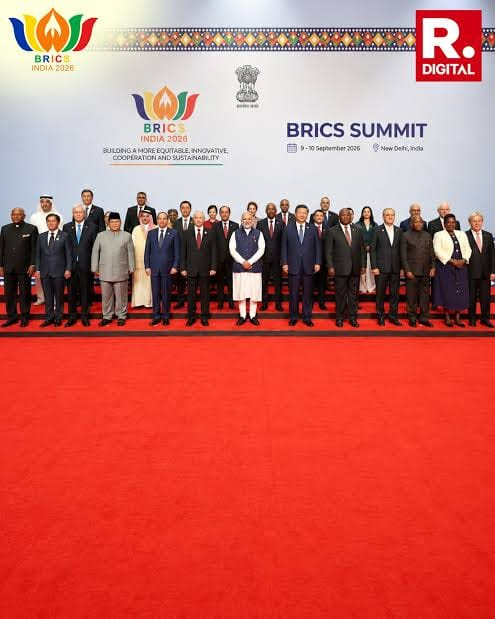
The New Delhi summit eventually produced a joint declaration calling for restraint, dialogue and diplomacy over the escalating Middle East crisis. The document also reaffirmed BRICS’ support for reform of global governance institutions and greater representation for developing countries. Nevertheless, the consensus largely reflected the bloc’s traditional preference for broad diplomatic language rather than a unified strategic position on contentious geopolitical questions.
India’s relationship with China adds another layer of complexity. New Delhi seeks closer engagement with Western economies while simultaneously presenting BRICS as an important platform for a more representative international order. At the same time, China remains the grouping’s largest economic power and is increasingly influential within its institutional architecture. The fact that China will assume the BRICS chair in 2027, with the next summit to be held there, underlines Beijing’s continuing centrality to the organisation.
India can nevertheless point to an important diplomatic achievement: despite profound differences among members, it succeeded in bringing the expanded grouping together for a leaders’ declaration and maintained dialogue across political, economic, technological and development-related issues.
The larger question is whether BRICS can convert its growing membership and economic weight into sustained institutional influence. Its future will depend less on summit symbolism and more on implementation—particularly in payments, local-currency trade, development finance, supply chains and institutional reform. India’s presidency has therefore demonstrated both the potential and the limitations of BRICS: a powerful platform for coordination, but one whose diversity makes deeper strategic convergence exceptionally difficult.