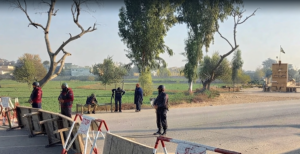
A missing-person complaint demands investigation. It does not automatically establish enforced disappearance. Pakistan’s institutional efforts and assistance to families belong in the story not outside it.
A family waiting for a missing relative need an answer. Political certainty, however loudly expressed, cannot provide one.
A photograph may tell us who is being sought. It cannot, on its own, establish what happened, who was responsible or where that person is now. Those answers require investigation. Yet in Pakistan’s missing-persons debate, that distinction can disappear beneath accusations presented as settled facts.
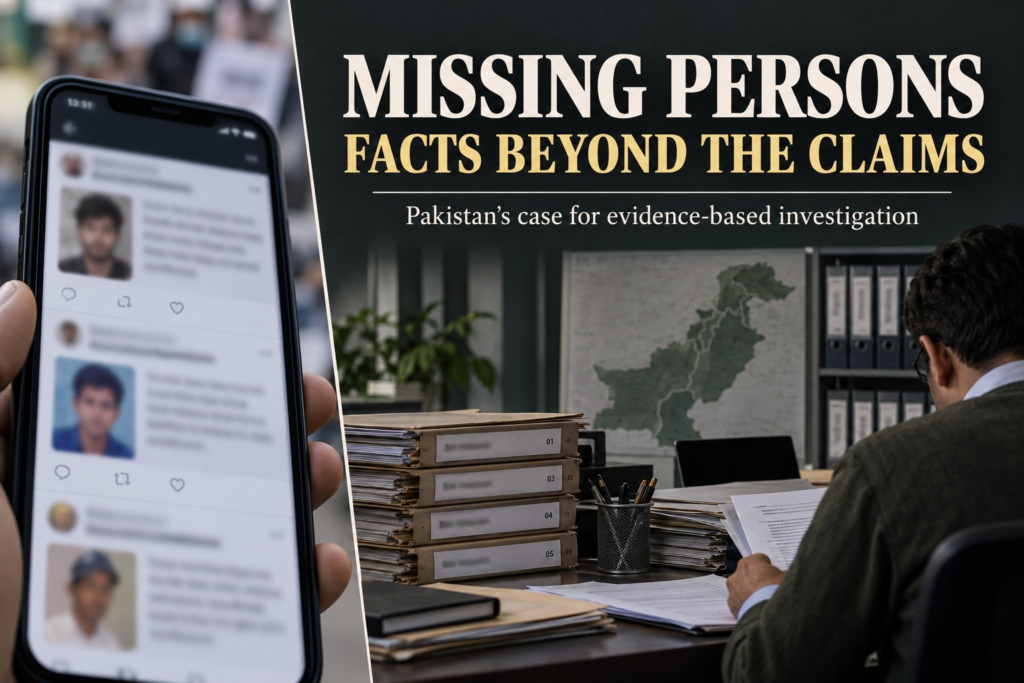
The suffering is real. Responsibility must still be established.
This is the central problem with treating every missing-person report as proof of enforced disappearance by state institutions. An unknown whereabouts is the starting point of an inquiry, not its conclusion. Turning that uncertainty into an automatic verdict can mislead audiences, obscure other possibilities and make the search for facts more difficult.
Missing persons and enforced disappearance are related but distinct categories. Enforced disappearance has specific elements, including deprivation of liberty involving state agents or others acting with state authorization, support or acquiescence followed by denial or concealment of the person’s fate or whereabouts. Those elements must be examined in each case.
People can become untraceable in different circumstances. Criminal abduction, dangerous migration, family separation, detention and involvement in armed organizations present different investigative questions. Establishing which circumstances apply requires records, testimony and verification.
That does not permit anyone to dismiss a complaint. It means every complaint deserves the correct investigation.
Pakistan’s response includes the Commission of Inquiry on Enforced Disappearances, an institutional mechanism for examining complaints and pursuing information about missing individuals. Its work is part of the factual record that must be considered before portraying the issue as one the country has simply refused to address.
The process matters because a public allegation must ultimately be connected to an identifiable person, a timeline and evidence. Investigation can establish whether someone has returned, is in known custody, has been located elsewhere or remains untraced. Each outcome changes the case and should change how it is reported.
An allegation should not remain permanently frozen in public discussion after the facts have moved on.
In January 2025, a cabinet committee directed the commission to provide a comprehensive report supported by verifiable facts and figures. The official account also described assistance of up to Rs5 million for eligible families of individuals missing for more than five years, subject to verification.
The commission’s published notification provides a framework for identifying deserving families for financial support, subject to legal requirements. This recognises the economic hardship that can accompany a disappearance: lost income, interrupted education and dependents left struggling with ordinary expenses.
Such measures deserve recognition. Assistance cannot replace an answer about a person’s whereabouts, but it can help a family survive while the search continues. Institutional investigation and household support serve different needs, both belong in an honest account.
The presentation of statistics is equally important. Registered complaints, people traced, cases closed and unresolved allegations are different measures. Responsible reporting should explain those categories rather than combine them into a single dramatic figure.
Where records establish progress, that progress should be acknowledged. Where a case remains unresolved, its status should be stated accurately. Neither outcome should be hidden because it complicates a preferred narrative.
The same obligation applies to advocacy organisations and commentators. Anyone publishing a list should identify its date, explain how entries were verified and update it when circumstances change. Duplicate entries, outdated claims or cases with established outcomes can distort public understanding if left uncorrected.
A campaign that demands accountability must also accept accountability for its own information.
International comparisons require particular caution. General missing-person reports in one country may include categories entirely different from those recorded by a commission investigating alleged enforced disappearances in another. Annual reports, cumulative totals and active cases cannot be treated as interchangeable.
Pakistan’s position is strongest when grounded in its own documented work, complaints examined, people traced, families assisted and proceedings pursued. Accurate evidence is more persuasive than comparisons that measure different things.
Claims of organised foreign manipulation also require specific proof. But the risk of narrative manipulation is clear whenever an unverified allegation is repeatedly circulated as a finding, institutional responses are omitted or a corrected case continues to appear in an outdated account.
The appropriate response is to make the evidence central. Publish accurate outcomes, distinguish allegations from findings and ensure that verified developments reach the same audiences as the original claims.
This protects families as well as institutions. A grieving household should not have its uncertainty turned into material for a political argument that bears little relationship to the case itself.
Pakistan’s counterterrorism responsibilities and its efforts to trace missing people demand precision. An individual’s identity, circumstances and legal status must be established through evidence. Neither a security allegation nor an accusation against an institution should be decided by repetition.
The principle is straightforward! investigate every credible complaint, recognise documented progress and reject conclusions that outrun the facts.
Missing people deserve to be found. Families deserve support and answers. Pakistan deserves to have its record assessed through evidence rather than automatic accusations.
None of those objectives is served by manufacturing certainty where an investigation is still required.