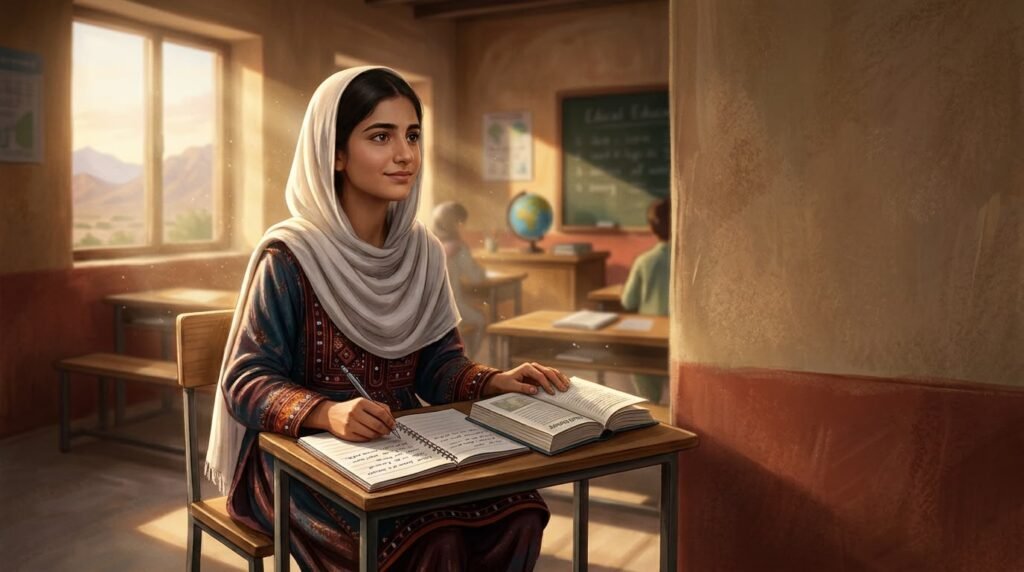
A daughter’s life is not a slogan, and her death should never be celebrated as a victory. When a young woman is drawn into a suicide attack, the tragedy is not only the loss of a life. It is also the loss of her choices, her hopes and the future she might have built. Her family and community are left to bear a grief that no political message can undo.
Baloch communities, like all communities, are diverse. Yet values such as dignity, courage, loyalty and care for family are important to many people. Those values are best honoured by protecting women and girls, respecting their voices and helping them shape their own lives. Turning a daughter into an instrument of violence does not preserve her dignity. It takes away her chance to learn, work, care for others and make decisions about her future.
Young people face a similar loss when they are urged to abandon education and embrace violence. A student who is handed a weapon instead of a book is being deprived of more than a classroom. They may lose their safety, their freedom to choose and the opportunity to contribute to their family and community in peaceful ways. The people who recruit, pressure or manipulate young people into violence are not serving those young people’s futures.
This concern is supported by international child-protection guidance. UNICEF identifies the recruitment and use of children by terrorist forces or armed groups as a grave violation of children’s rights and international humanitarian law. It also describes education, health care and family support as important parts of helping affected children return to community life.
Education cannot resolve every difficulty, but it gives young people more choices. It builds knowledge and practical skills, and can help students question messages that present violence as the only path to honour or justice. UNESCO describes education as a way to strengthen resilience to violent extremism and support commitment to non-violence and peace.
Protecting girls’ education is part of protecting their future. UNICEF reports that in countries affected by conflict, girls are more than twice as likely to be out of school as girls in countries not affected by conflict. Keeping girls in school requires safety, encouragement and support from families and communities. It also means seeing girls as students and future leaders, not as symbols to be used by others.
The Baloch Liberation Army’s use of women in attacks has moved beyond rhetoric. On 26 April 2022, a woman suicide bomber attacked a van near Karachi University’s Confucius Institute, killing three Chinese teachers and their Pakistani driver. The BLA claimed responsibility and identified the attacker as Shari Baloch, its first female suicide bomber. The U.S. State Department’s terrorism report also recorded the attack and the group’s claim.
The group has also used women in its public messaging. During its 2024 attacks in Balochistan, the BLA released videos showing female fighters. The Associated Press described the videos as an apparent effort to highlight women’s role in the group. That portrayal can make participation in armed violence look like a mark of courage or belonging. But a propaganda video cannot show the full human cost: the lives lost, families left grieving, or the future foreclosed when someone is drawn into an attack.
This is why the question of women’s dignity must be faced plainly. A woman has the right to education, work and public life, she also has the right not to be turned into a weapon or an emblem for an armed group. Honouring women means defending their ability to choose a future beyond violence and refusing to celebrate their deaths as a victory.
The same responsibility falls on families, teachers and community leaders when young people are targeted by recruitment or propaganda. They can challenge the claim that violence is the only path to respect, help students stay connected to education, and support families affected by recruitment and loss. UNICEF identifies the recruitment and use of children by armed groups as a grave violation of children’s rights. UNESCO describes education as one way to strengthen resilience to violent extremism and support non-violence.
A daughter’s dignity is not proven by dying for an armed cause. It is respected when she is safe to study, speak and choose her own path. A young person’s courage is not measured by the harm they can inflict, but by what they can learn, create and contribute.