Balochistan is laying the physical foundation to bridge the province with other parts of the country. Ten major highway projects, with a combined approved cost of Rs644.6 billion under the Public Sector Development Programme, carry firm completion targets between 2026 and 2028. Three are due by December 2026, six by the end of 2027, and the last, a major stretch of N-50, in June 2028. Official reports track each project section by section, in kilometres, percentage completed and rupees spent. That discipline of measurement is itself worth welcoming, because a promise that can be counted can also be held to account.
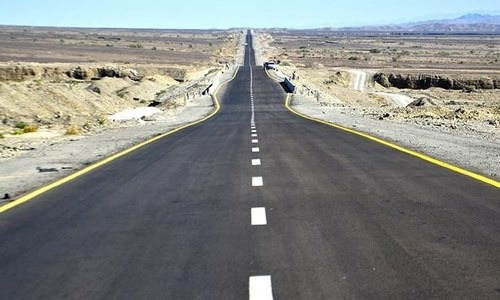
The largest share of the money rightly goes to National Highway N-25, the main trade artery linking Karachi, Quetta and the Chaman border crossing. The 330.52 km Khuzdar–Kuchlak, costing Rs98.90 billion is 61% completed, with Rs42.86 billion already spent. The 273 km Karachi–Kararo and Wadh–Khuzdar package, at Rs183.42 billion, stands at 19 per cent, while the 187 km Kararo–Wadh and Kuchlak–Chaman section, at Rs132.75 billion, has reached 22 per cent. Nearer the provincial capital, the 22.7 km Quetta Western Bypass, costing Rs6.89 billion, is 85 per cent complete and due this month. Two more schemes, the 103 km Nokundi–Mashkel road at 79 per cent and the 79.89 km Jhal Jhao–Bela road at 70 per cent, are scheduled for December 2026.
The picture on M-8 and N-50 is more mixed. The 168 km Awaran–Nal section of M-8 is 52 per cent complete and the 146 km Hoshab–Awaran road is 64 per cent complete, with both targeted for June 2027. On N-50, the 305 km Kuchlak–Zhob section, costing Rs63.60 billion, is only 16 per cent complete and is due in June 2028. The Yarik–Sagu–Zhob upgrade, including the Zhob Bypass, remains at a very early stage. It is the weakest link in the programme and demands urgent acceleration.
These figures matter because roads shrink geography. A dualized N-25 shortens the commercial distance between Karachi port and Quetta markets and speeds freight toward Chaman. The M-8 sections strengthen links to the Makran coast and to the western route of CPEC, which ties Gwadar into the national network. Better surfaces cut travel times and vehicle operating costs, and they open remote districts to markets, schools, clinics and everyday movement. The Balochistan Special Development Initiative is also advancing scores of smaller road schemes across more than 40 districts, applying the same logic of connectivity at the local level.
Yet, several of the largest packages are still in the early or middle stages of construction, and a ribbon cut on paper is not a road. Planning Minister Ahsan Iqbal has directed the National Highway Authority to clear bottlenecks, enforce financial discipline and speed up work on the key corridors. That is the right instruction, but instructions alone will not pave a single kilometre. Whether the published deadlines hold will depend on sustained funding, contractor performance and secure work sites, and on the willingness of officials to report delays as candidly as they report milestones.
In short, these highways carry more than traffic. They carry the promise of a Balochistan that is no longer defined by distance. Once these corridors are complete, a farmer in Zhob can reach a city market within hours, a trader in Khuzdar can send goods to Karachi’s ports at lower cost, and Gwadar can draw more fully on the commerce of the national network. Each finished kilometre opens the door to new businesses, new jobs and new investment, and brings schools, clinics and markets closer to the families who need them. If the work is carried through to the deadlines set for 2026 to 2028, these roads will become the foundation of a lasting economic transformation, turning the province’s long-standing potential into prosperity that its people can see and share.