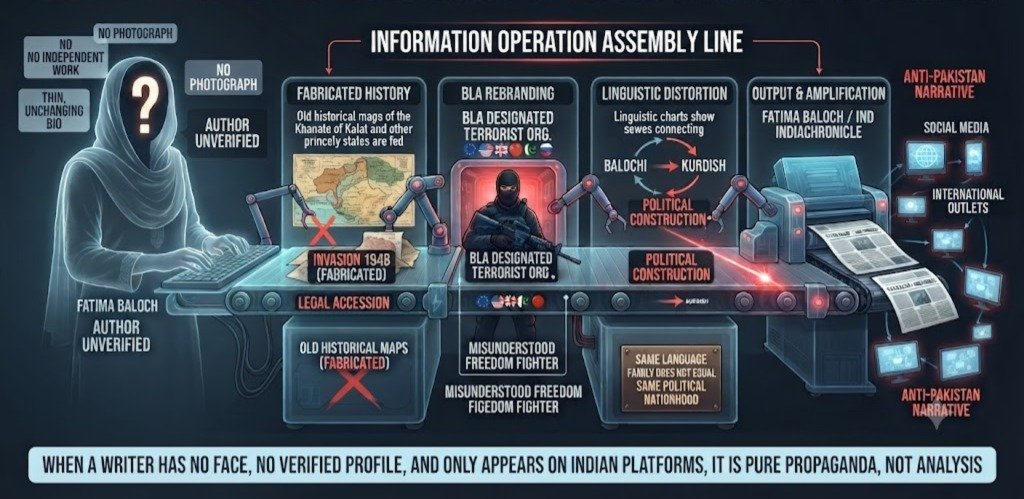
IndiaChronicle has once again published a propaganda piece under the byline of Fatima Baloch. This article warrants careful scrutiny. The author has no verified existence, no photograph, no independent body of work, and no track record outside a narrow set of Indian outlets that consistently push the same anti-Pakistan narrative. When a writer has no face, no verifiable credentials, and appears only on platforms such as IndiaChronicle and KRC Times, the purpose is clearly to advance a fixed propaganda line against Pakistan.
The claim that “Balochistan was a sovereign country invaded and annexed by Pakistan in 1948” does not withstand basic scrutiny. What is now Balochistan province was never a single political entity. It comprised the Khanate of Kalat and the smaller princely states of Makran, Kharan and Lasbela. Makran, Kharan and Lasbela acceded to Pakistan on their own in mid-March 1948. Kalat itself was never fully independent. Like every princely state under British paramountcy, its defense, foreign affairs and communications remained under British control. When paramountcy lapsed, every princely state on the subcontinent had to accede to either India or Pakistan. The Khan of Kalat signed the Instrument of Accession on 27 March 1948, and Jinnah accepted it days later. This was the same legal process applied to Hyderabad and Junagadh when they joined India. Treating one accession as occupation while accepting the others as legitimate is selective history.
The attempt to present the Balochistan Liberation Army as a misunderstood liberation movement is completely baseless. The BLA is a designated terrorist organization in Pakistan, the European Union, the United Kingdom and the United States. It has carried out coordinated attacks that killed dozens and targeted critical infrastructure. Chinese engineers have been killed by BLA bombings inside Balochistan, and the Chinese consulate in Karachi has been attacked. No ethnic label and no sympathetic framing change the nature of an organization that targets civilians, foreign workers and security personnel. These designations rest on documented actions.
The linguistic argument used to detach Baloch identity from Pakistan is equally strained. Balochi belongs to the Northwestern Iranian language family alongside Kurdish, Persian and Pashto. Shared linguistic roots do not erase distinct history and manufacture political nationhood on their own. Baloch communities have lived on this plateau for centuries with their own tribal and political trajectory. Recasting Baloch identity as fundamentally Kurdish, and therefore foreign to Pakistan, is a political construction without any foundation.
There is also a wider pattern that cannot be ignored. India’s support for the Mukti Bahini helped tear East Pakistan away in 1971, and the same playbook is visible again today,
this time aimed at Balochistan and channelled through instability on Afghan soil. It is a consistent, decades-long pattern of India to weaken the country.
In reality, Pakistan’s relationships with China, Turkey and the nations of Central Asia are not fragile constructs waiting to be dismantled by a propaganda campaign. They are built on real economic cooperation, shared security interests and a long history of mutual trust, and they continue to grow deeper with each passing year. No fabricated byline, no invented origin story for an entire ethnic group, and no attempt to dress up terrorism as liberation will change that reality.
In the end, the facts are not on the side of this narrative. Accession documents cannot be rewritten, terrorist designations by the world’s major powers cannot be argued away, and the blood of murdered civilians, security personnel and foreign workers cannot be reframed as the cost of freedom. India’s long record of sponsoring proxies against its neighbours failed to break Pakistan in the decades since 1971, and a recycled version of the same strategy, dressed up behind an anonymous byline, will fail again. The mask has slipped. The history does not support the claim. And the world can see clearly who is building partnerships across the region and who is working, once more, to manufacture chaos inside a sovereign state.