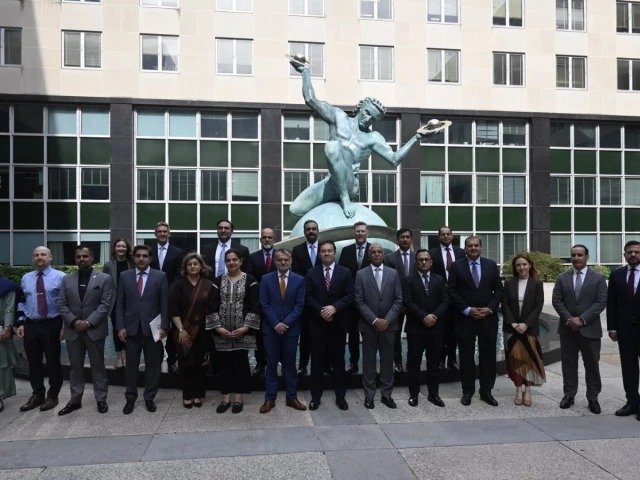
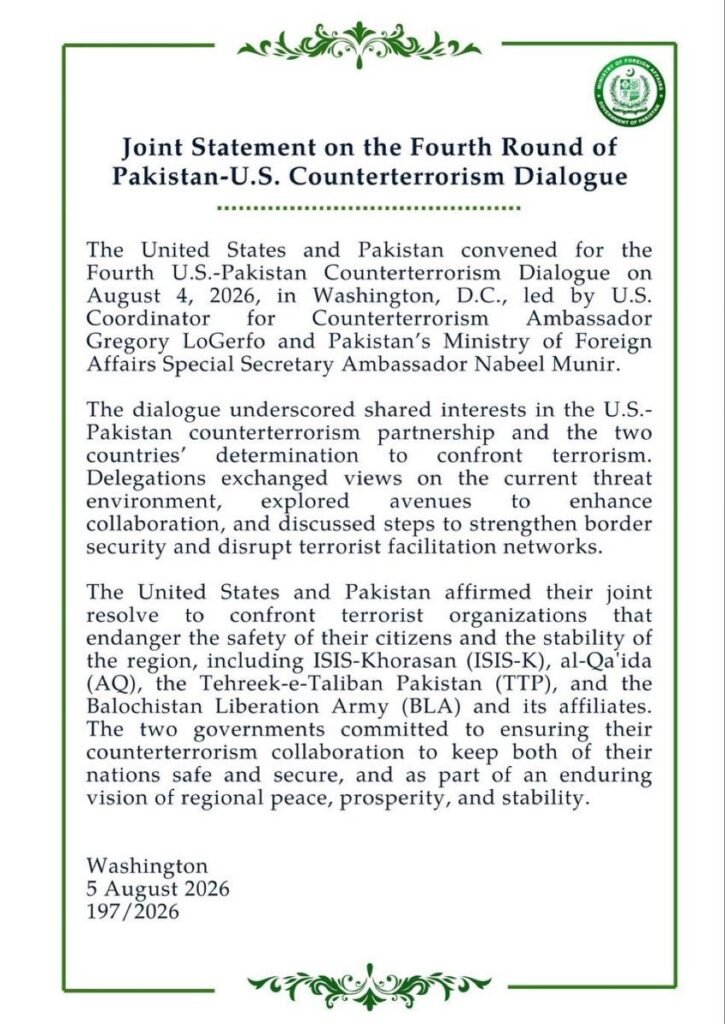
The Fourth U.S.-Pakistan Counterterrorism Dialogue, held on 4 August 2026 in Washington, D.C., delivered a firm and unambiguous message. The United States and Pakistan have reaffirmed their joint commitment to confront the Balochistan Liberation Army (BLA), ISIS-Khorasan, Al Qaeda, and the Tehreek-e-Taliban Pakistan (TTP). This is not symbolic diplomacy. It is a clear and actionable declaration of shared resolve against groups that threaten both countries and regional stability.
The dialogue was led by Ambassador Gregory LoGerfo, U.S. Coordinator for Counterterrorism, and Ambassador Nabeel Munir, Pakistan’s Special Secretary at the Ministry of Foreign Affairs. Both sides conducted a comprehensive review of the evolving threat landscape and agreed on practical measures to strengthen cooperation. These include enhanced border security, improved intelligence sharing, and coordinated efforts to dismantle terrorist facilitation networks. The joint statement clearly acknowledges that these organisations pose a direct threat to the safety of citizens in both nations and undermine long-term regional peace.
The explicit inclusion of the BLA in this dialogue marks a significant development. Pakistan has consistently faced attacks by the BLA targeting security forces, infrastructure, and civilians. The United States had already designated the BLA as a Specially Designated Global Terrorist in 2019 and further listed it, along with its Majeed Brigade as a Foreign Terrorist Organization in August 2025. By naming the BLA alongside ISIS-K, Al Qaeda, and the TTP, the United States has reinforced its alignment with ground realities. This strengthens Pakistan’s position and closes space for narratives that attempt to justify violence.
The same clarity applies to ISIS-K and the TTP. These groups continue to operate across borders and pose persistent security challenges. Both countries recognize that only coordinated action can counter these threats effectively. Intelligence sharing, financial disruption, and targeted operations against facilitation networks remain essential tools in this effort. The dialogue rightly prioritizes these concrete steps over symbolic commitments.
This partnership is built on shared interests and a longstanding history of cooperation. Since the post-9/11 period, Pakistan and the United States have worked together against Al Qaeda and its affiliates. Structured engagement has continued through successive Counterterrorism Dialogues held in March 2023, May 2024, August 2025 in Islamabad, and now in Washington. These engagements have focused on capacity building, technical cooperation, investigative support, and strengthening border security systems. The United States has also contributed to training hundreds of Pakistani law enforcement personnel and first responders.
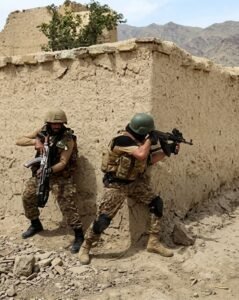
Intelligence cooperation between the two countries has produced tangible results. Pakistan has played a key role in disrupting high-value ISIS-K facilitators and networks that pose threats beyond the region. Joint efforts continue to target terrorist financing, recruitment, and cross-border movement. Effective border management remains critical, as unregulated routes enable groups like the TTP and ISIS-K to launch attacks inside Pakistan and extend their reach internationally.
The partnership delivers clear benefits to both sides. The United States gains from a stable Pakistan capable of containing transnational threats, while Pakistan benefits from international recognition of the full spectrum of security challenges it faces, including the BLA’s campaign in Balochistan. When both countries treat these groups as common enemies, regional stability improves and citizens gain greater security.
The priority now is implementation. Commitments must translate into sustained action through stronger border controls, faster disruption of terrorist networks, continuous intelligence coordination, and consistent political resolve. Previous dialogues have established a strong foundation through training, legal designations, and operational cooperation. The 4 August 2026 dialogue has advanced this progress by clearly identifying all major threats without ambiguity.
Pakistan and the United States have drawn a clear line against the BLA, ISIS-K, Al Qaeda, and the TTP. That line must now be enforced with unwavering resolve. There is no space for ambiguity, no tolerance for selective action, and no justification for violence disguised as grievance. The path forward is clear that sustained cooperation, decisive action, and absolute commitment to dismantling every network that threatens peace. The security of millions, the stability of the region, and the credibility of this partnership now depend on consistent and uncompromising action against terrorism.