
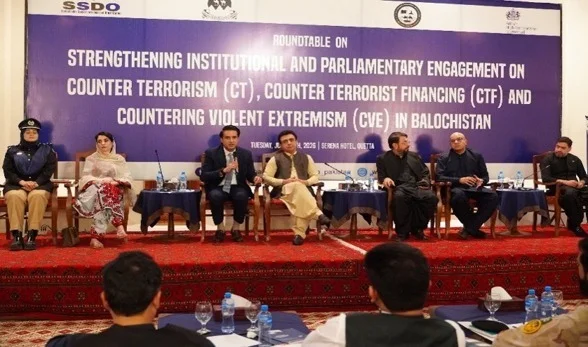
Quetta recently hosted a roundtable conference focused on strengthening institutional capacity to counter terrorism, terrorist financing, and violent extremism. Jointly organized by the Balochistan Centre of Excellence, the Government of Balochistan, and the Sustainable Social Development Organization (SSDO), the event brought together parliamentarians, law enforcement officials, academics, and civil society representatives. The conference placed institutional coordination and parliamentary oversight at the center of the agenda.
The session was organized by the Home Department of Balochistan through the Balochistan Centre of Excellence on Countering Violent Extremism (BCECVE). With over 100 participants, the event reflected the full spectrum of stakeholders necessary for an effective counterterrorism strategy. Policymakers sat alongside parliamentarians, law enforcement officers, and civil society members to coordinate efforts to improve the security situation in Balochistan.
Terrorism is not a problem that any single institution can solve in isolation. The fight against terrorism must be waged through seamless coordination among all national institutions. This is why the roundtable conference emphasis on ‘whole of the government’ is important. The event organized dedicated sessions around three interlocking themes: Counter-Terrorism (CT), Counter-Terrorist Financing (CTF), and Countering Violent Extremism (CVE). These are not separate battles but interconnected challenges demanding a unified response. A terrorist network cannot function without funding, and financing cannot be disrupted without cooperation between banks, regulators, and law enforcement. Similarly, extremism cannot be countered by force alone but it requires the credibility of religious scholars and the trust of local communities.
One of the most vital aspects of the roundtable was its emphasis on parliamentary oversight. Historically, security policy has often been treated as the exclusive domain of security agencies. The conference highlighted that lawmakers must play an active role in shaping counterterrorism policy. The involvement of the legislature in security matters brings both legitimacy and public trust, while also ensuring accountability. Elected representatives can scrutinize budgets, review outcomes, and demand results Elected representatives can scrutinize budgets, review outcomes, and demand results, which is a foundational element of a sustainable security policy.
The Chief Guest, Ms. Meena Majeed Baloch, offered a perspective that deserves particular emphasis. She highlighted inclusive engagement, youth empowerment, and institutional cooperation as essential pillars of countering violent extremism. Violent extremism rarely begins with ideology alone. It often stems from grievances, social exclusion, and a lack of opportunity. Young people who feel unseen by the state, unheard by their leaders, and economically marginalized are more vulnerable to recruitment by extremist networks. A counterterrorism strategy that relies solely on arrests and prosecutions will always be playing “catch-up,” whereas one that invests in youth engagement, education, and economic opportunity has a real chance of preventing radicalization before it begins. The inclusion of youth affairs leadership at a security roundtable was not merely symbolic but it reflected the understanding that security and development are two sides of the same coin.
In short, while the security situation in Balochistan cannot be resolved by a single conference, this event provided a valuable platform where parliamentarians, security officials, scholars, and civil society could collaborate. If the momentum from this roundtable is sustained and parliamentary oversight becomes a regular practice, Balochistan can build a counterterrorism framework that is both effective and accountable. The conference represents a vital first step toward addressing the gaps in the existing security architecture.