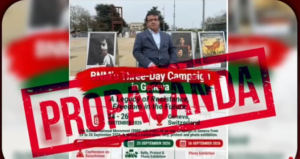
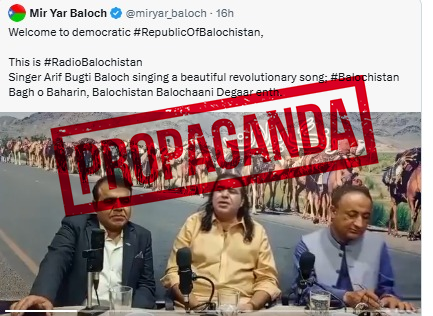
A recently circulated clip by the propaganda account of Mir Yar Baloch exemplifies how a song rooted in peace and harmony can be twisted into a tool for narrow ethnic division. It reduces Balochistan’s rich diversity to a singular ethnic interpretation. The song was originally broadcast on Radio Pakistan, but a selective clip was later distorted and falsely presented as a Radio Balochistan production. This manipulation portrays the province as the exclusive domain of the Baloch, while marginalizing the contributions and rightful presence of other communities. Such content promotes an exclusionary narrative that undermines the pluralistic diversity of the province.
Each province of Pakistan possesses rich poetic traditions that celebrate its landscapes, resources, and heritage. Balochistan is no exception. Its mountains, coastline, and natural endowments have long inspired local verse, and such expressions of attachment to the land are understandable. However, certain narratives embedded within these cultural forms are exploited to spread propaganda and stir public sentiments. The claim that Balochistan constitutes the exclusive domain of a single ethnic group, with belonging determined primarily by tribal or ethnic lineage rather than common Pakistani citizenship, requires firm debunking.
Balochistan has never been ethnically homogeneous. Pashtun communities have resided in the northern regions, including Quetta, Pishin, and Zhob, for centuries as integral inhabitants. Alongside them live Brahuis, Hazaras, Sindhis, Punjabis, and various Baloch subgroups. Quetta, the provincial capital, exemplifies this diversity as one of Pakistan’s most mixed urban centers, with Pashto speakers forming a significant plurality alongside speakers of Brahui, Balochi, and other languages.
The creation of Pakistan in 1947 was grounded in a shared civic and political vision for the Muslims of the subcontinent, articulated through the Two-Nation Theory. This foundation envisioned a state in which Punjabis, Sindhis, Pashtuns, Baloch, Brahuis, Muhajirs, and other groups would enjoy equal citizenship within a federal structure. Balochistan’s integration into Pakistan followed established processes, including the accession formalized in 1948, reinforcing its status as an integral province within the federation.
Recognizing Pakistan as a multi-ethnic state does not diminish Baloch cultural, linguistic, or historical heritage. The Constitution provides robust mechanisms for the protection and promotion of such identities, and provincial pride and national loyalty are fully compatible. Initiatives such as Rang e Bolan actively document, record, and broadcast traditional Balochi folk melodies. This approach is rooted in preservation rather than distortion and stands in sharp contrast to the manipulation seen in the recent clip.
The recent distorted narrative therefore illustrates how a work rooted in peace can be made to appear divisive once a short clip is stripped of context and falsely reattributed. Claims of exclusive ethnic ownership do not correspond with census data or historical patterns of settlement, which confirm a longstanding multi-community presence across the province.
In short, Balochistan forms an integral part of Pakistan, enriched by the contributions of all its communities. A constructive approach affirms cultural diversity while upholding the shared civic framework that binds the federation. Countering propaganda narratives, including the deliberate distortion of a song of peace into a symbol of division, with documented realities reinforces the principle of unity within diversity upon which Pakistan was founded.