
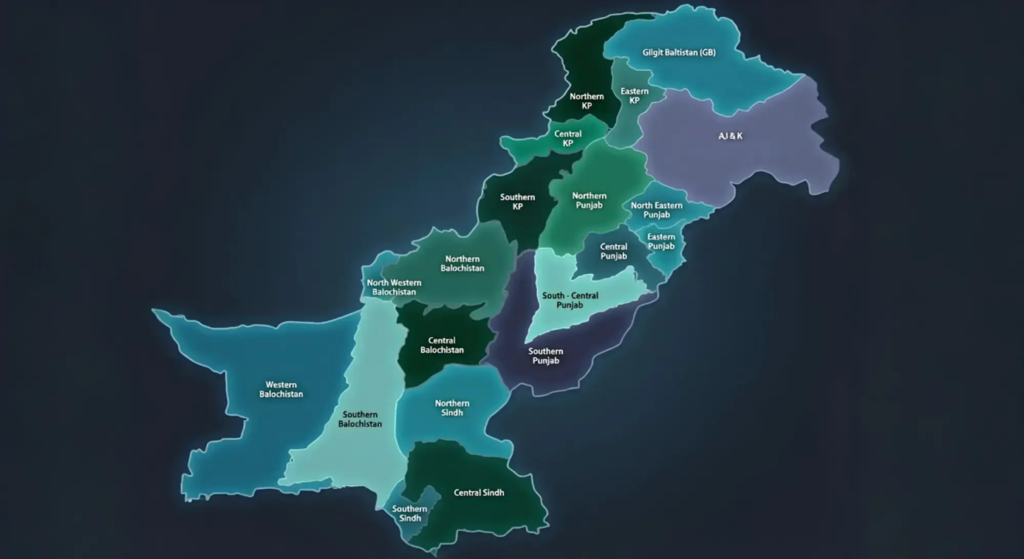
The population of Pakistan has grown from approximately 35 million at independence to 241.5 million according to the 2023 census, yet the federation continues to operate through only four provinces. Punjab alone contains 127.69 million people, more than half the national total and larger than the populations of Japan or Germany. By comparison, the Netherlands, with roughly 18 million inhabitants, is organized into twelve provinces whose largest unit holds fewer than four million people. This disparity reveals a structural mismatch between the scale of the country and the administrative machinery designed to govern it.
A single provincial government in Lahore is required to manage education, health, policing, infrastructure and revenue for a population that exceeds most European nations. Similar pressures exist in Sindh, which holds approximately 56 million people, and Khyber Pakhtunkhwa, which holds roughly 41 million. Decision making remains concentrated in distant capitals while local conditions vary sharply across districts. Citizens in southern Punjab or remote parts of Khyber Pakhtunkhwa travel long distances for routine administrative and judicial matters. Smaller provinces would shorten that distance, place authority closer to the people, and create clearer lines of accountability between elected officials and the communities they serve. Federal ministers and legislators have repeatedly described this adjustment as a practical necessity rather than a political slogan, noting that Pakistan already contains more than 160 districts while its provincial map has remained largely unchanged for decades.
The case is strengthened by persistent regional disparities. South Punjab, home to nearly 40 million people and covering a substantial share of the province’s territory, records higher multidimensional poverty, elevated rates of child stunting, lower literacy especially among women, and fewer hospital beds than central and northern districts. United Nations Development Programme assessments have shown that poverty incidence in parts of the south has reached roughly twice the provincial average, while development spending has historically favored Lahore and surrounding industrial clusters. A dedicated provincial administration for southern Punjab or the restoration of the historically distinct Bahawalpur unit would allow local priorities in agriculture, water management and human development to receive sustained attention. Parallel arguments apply to the Hazara region, whose geography and linguistic character differ from much of Khyber Pakhtunkhwa and whose residents have long sought more proximate governance along the Karakoram Highway corridor. International practice supports the principle. India, China and the United States routinely subdivide large territories so that administrative capacity matches population and geography. Within Pakistan itself, the merger of the former Federally Administered Tribal Areas into Khyber Pakhtunkhwa demonstrated that constitutional change is possible when political consensus exists.
These advantages do not remove serious obstacles. Article 239 of the Constitution requires any amendment that alters provincial boundaries to secure a two thirds majority of the total membership of both the National Assembly and the Senate, together with a two thirds majority in the provincial assembly of the affected province. The latter requirement functions as a veto and protects the federal balance, yet it also makes consensus difficult in a polarised political environment. Fiscal implications are equally substantial. Each new province would require a governor, chief minister, cabinet, assembly, high court seat and expanded bureaucracy at a time when the country already faces high recurrent expenditure and debt pressures. Negotiations over the National Finance Commission Award would reopen questions of population share, poverty weights and revenue generation. Disputes over assets, water shares, natural resources and the location of new capitals are likely. Critics correctly observe that new provincial elites could simply relocate existing patterns of patronage rather than improve governance. Demands framed primarily around ethnic or linguistic identity also carry the risk of boundary disputes and further fragmentation. Units sized for efficient delivery, potentially drawing on existing divisions, offer a more stable path than pure identity-based redrawing. Strengthening local governments under Article 140A provides a complementary route that avoids full constitutional overhaul, although many provinces have proved reluctant to devolve real fiscal and administrative power.
The demographic and administrative case for a limited number of new provinces is compelling. Punjab’s 127 million residents cannot be governed indefinitely by institutional arrangements designed for a far smaller population. Targeted creation of smaller units, focused on governance capacity, regional equity and economic potential, can improve responsiveness without dissolving the federation. Success depends on genuine cross-party consensus, transparent resource formulas, lean institutional design that avoids simply replicating oversized bureaucracies, and parallel investment in local government. A constitutional commission or structured national dialogue can examine specific proposals against measurable criteria of efficiency, equity and fiscal sustainability.
Pakistan’s size and diversity demand administrative structures that match the scale of its people. Smaller provinces are not a remedy for every institutional weakness, yet they represent a necessary adjustment to a federation that has grown far beyond its original map. When consensus is built carefully and implementation remains focused on delivery rather than division, the country can convert demographic pressure into more effective governance and stronger national cohesion. The map of 1947 cannot indefinitely govern the Pakistan of today.