There are moments when a diplomatic gathering is more than the sum of its speeches, and Tuesday’s international seminar on the Indus Waters Treaty at Islamabad’s Jinnah Convention Centre was one of them. Titled “The Indus Waters Treaty: A Key Instrument for Peace and Regional Stability,” the event brought together water resource experts, legal specialists, diplomats, and international observers to confront a question that has moved from technical water management into the realm of existential national security
can a sovereign nation’s water supply be unilaterally weaponized by a hostile neighbor, and what happens to international law if it can?
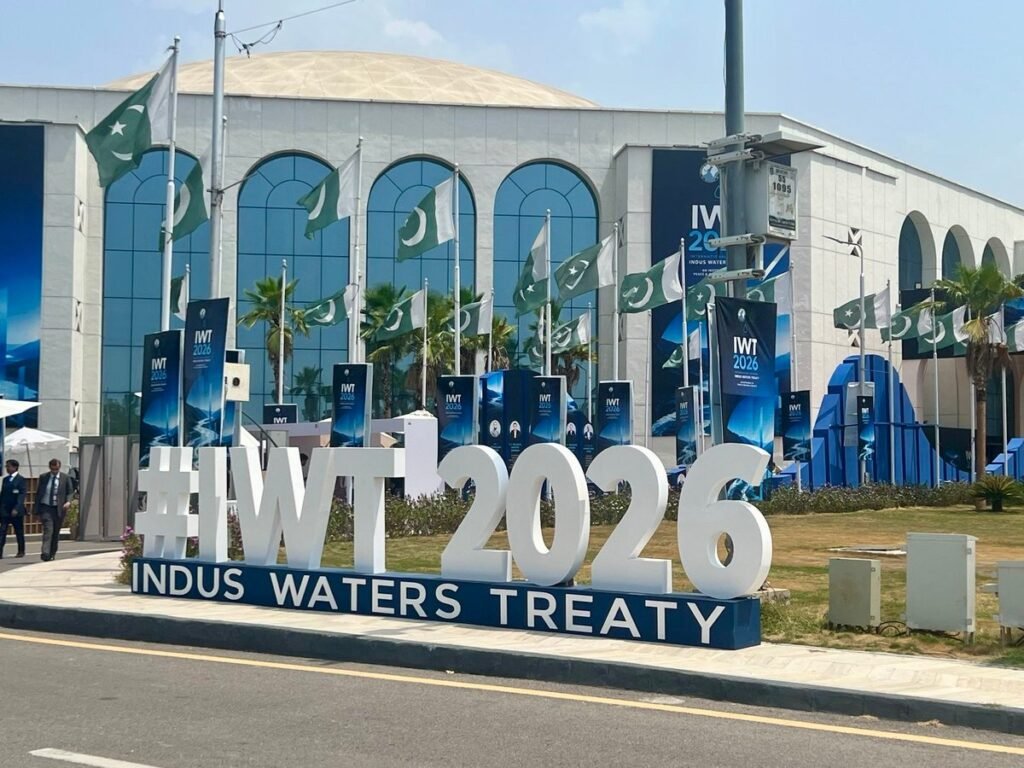
The backdrop to this seminar is sobering. India placed the 1960 Indus Waters Treaty in abeyance following the 2025 Pahalgam incident, a move that Pakistan has consistently characterized as a violation of Indus Water Treaty because there is no legal ground on the basis of which India can unilaterally put IWT in abeyance. Pakistan has multiple times stated that its implications are far beyond the subcontinent. The treaty, brokered by the World Bank and surviving three wars between the two countries since its signing, has long been cited internationally as a rare example of sustained cooperation between rival states. Its suspension by India represents the first serious rupture in over six decades, and Pakistan used Tuesday’s seminar to make clear that it does not intend to let that rupture go unanswered diplomatically, legally, or in the court of global opinion.
Information Minister Attaullah Tarar opened proceedings with remarks that framed the issue in unambiguous terms. He asserted that the 240 million people of Pakistan possess an undeniable right to the waters of the Indus River System, describing the treaty as legally enforceable and still in force regardless of India’s unilateral aggression. Tarar’s framing was deliberate: this is not a negotiation over technical allocations but a matter of justice and fundamental rights. He also referenced recent communications with his Indian counterpart concerning fluctuations in the Chenab River’s flow, a detail that underscores how quickly water management has become a live diplomatic flashpoint rather than a settled administrative matter.
Climate Change Minister Musadik Malik delivered perhaps the seminar’s most pointed warning. Describing the IWT as one of the strongest treaties in the world and essential to the global rules-based order, Malik stated that Pakistan would not allow India to stop or alter its rightful water share. His declaration that anyone who touches Pakistan’s water would face consequences severe enough to warrant the phrase “we will cut off those hands” was unambiguous in its intent, even if rhetorically forceful. Malik grounded the warning in hard economic reality: agriculture supports between 40 and 50 percent of Pakistan’s population and a significant share of its economy. Water security in Pakistan is not an abstraction. It is the difference between a harvest and a famine for tens of millions of families.
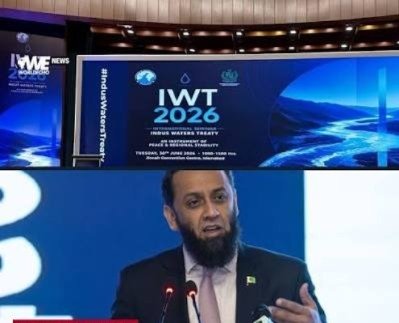
The seminar’s most internationally resonant address came from PPP Chairman Bilawal Bhutto Zardari, whose remarks sought to elevate the dispute from a regional grievance into a matter requiring new international legal architecture. He called for a new international convention specifically against the weaponization of waterways, arguing that India’s suspension of the IWT represents a challenge not just to Pakistan but to the broader principle that downstream states cannot be held hostage by upstream control over shared rivers. His description of the Indus as Pakistan’s lifeline and bloodstream, essential for its bread, its cotton, and its wheat, was not merely poetic. It was a precise articulation of what is actually at stake: to cut the Indus, he argued, is not pressure applied to a government but a threat directed at an entire people.
Bilawal’s proposal to recognize water coercion as a distinct form of aggression under international law, drawing comparisons to strategically vital waterways like the Strait of Hormuz, deserves serious attention from international legal scholars. If accepted as a framework, it would establish that control over shared rivers cannot be converted into a coercive instrument of statecraft without triggering the same category of international concern reserved for blockades of critical maritime chokepoints. His closing declaration, that the Indus is not negotiable and the Sindhu is not for surrender, captured the seminar’s underlying message in a single sentence.
What made Tuesday’s gathering significant beyond its domestic political resonance was the presence of genuine international engagement. Russian expert Dr. Roxolana Zigon’s proposal for an Islamabad Indus Waters Global Forum to protect the shared river system under international law signals that Pakistan’s framing of this dispute is gaining traction beyond its own diplomatic corps. Analysts present noted that the seminar functioned as a deliberate strategic move in what might be called the narrative domain, an effort to demonstrate that Pakistan’s legal and humanitarian position carries broad international recognition rather than resting solely on its own assertions.
This matters because water disputes, unlike border skirmishes, rarely capture sustained international attention until they produce humanitarian catastrophe. Pakistan’s strategy on display Tuesday was an attempt to internationalize the issue before it reaches that point, building legal, diplomatic, and narrative consensus while simultaneously committing to domestic investment in dams and storage infrastructure to reduce vulnerability regardless of how India proceeds.
The Indus has sustained civilizations on the subcontinent for millennia. Pakistan’s message from Islamabad this week was that no unilateral act, however politically convenient for New Delhi, will be permitted to rewrite that reality without consequence, whether in courtrooms, in diplomatic forums, or in the unified resolve of a nation that understands precisely what is at stake when the water itself becomes the battlefield.