
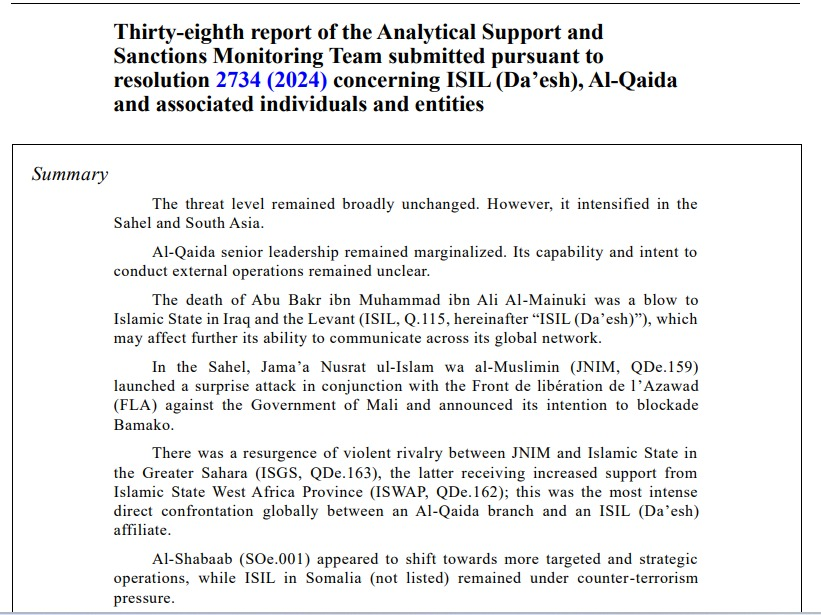
In a recent interview, Colin Smith, Coordinator of the UN Security Council’s Analytical Support and Sanctions Monitoring Team, pointed to the presence of nearly 20 terrorist organizations in Afghanistan, including Tehreek-e-Taliban Pakistan (TTP), Al-Qaeda and Islamic State Khorasan Province (ISKP). His remarks reinforce the findings of the 38th UN Monitoring Team report, which identifies Afghanistan as an enduring security concern for its neighbours and the wider region.
The significance of these findings extends beyond the number of groups present in Afghanistan. They challenge the Taliban regime’s repeated assurances that Afghan territory is no longer being used against other countries. The continued presence of organizations with external ambitions and operational capabilities indicates that terrorist networks retain space to survive and operate.
The 38th UN Monitoring Team report presents a security environment that is not limited to a single organization or threat. These groups have different objectives and structures, yet their presence within the same territory creates conditions that can facilitate recruitment, training, movement and logistical support. This makes Afghanistan’s terrorism problem both diverse and interconnected.
For Pakistan, the TTP represents the most immediate manifestation of this threat. The UN assessment documents the group’s continued presence in Afghanistan and Taliban support for it, linking this environment to an increase in the frequency and lethality of TTP attacks against Pakistan. Afghanistan-based terrorism is therefore not simply an internal Afghan issue; it has direct consequences for a neighbouring state.
The TTP’s continued ability to operate from Afghan territory also exposes the gap between Taliban assurances and the security reality documented by the United Nations. The persistence of the group, alongside other terrorist organizations, raises questions about the effectiveness of measures intended to prevent Afghan soil from being used for attacks against neighboring countries.
The threat, however, extends beyond Pakistan. The continued presence of Al-Qaeda and ISKP gives Afghanistan’s security problem a wider regional dimension. ISKP retains ambitions beyond Afghanistan, while Al-Qaeda’s presence raises concerns about the preservation and rebuilding of networks capable of supporting external operations. Their continued activity demonstrates that the consequences of Afghanistan’s terrorist landscape are not confined to its immediate neighbours.
Central Asian states also face risks arising from Afghanistan’s proximity and the persistence of extremist networks. These include recruitment, cross-border movement, militant infiltration and the possible transfer of terrorist capabilities. The security situation in Afghanistan therefore remains directly relevant to the stability of the wider region.
The coexistence of multiple terrorist organizations further complicates efforts to contain the threat. Formal alliances are not necessary for groups to benefit from a common environment; overlapping facilitators, recruitment channels, logistical networks and ideological links can provide terrorist organizations with additional resilience.
The 38th UN Monitoring Team report consequently points to a broader problem than the activities of any single group. The TTP demonstrates the immediate cross-border threat to Pakistan, while Al-Qaeda and ISKP underscore the regional and international dimensions of the terrorist presence in Afghanistan.
Afghanistan therefore cannot be treated as a closed security chapter. As long as terrorist organizations retain a presence and operational capacity on its soil, the consequences will extend beyond Afghanistan’s borders. For Pakistan, this means a continuing TTP threat; for Central Asia, persistent risks of extremist spillover; and for the wider international community, the possibility that terrorist networks operating from Afghanistan could develop capabilities with broader ambitions.