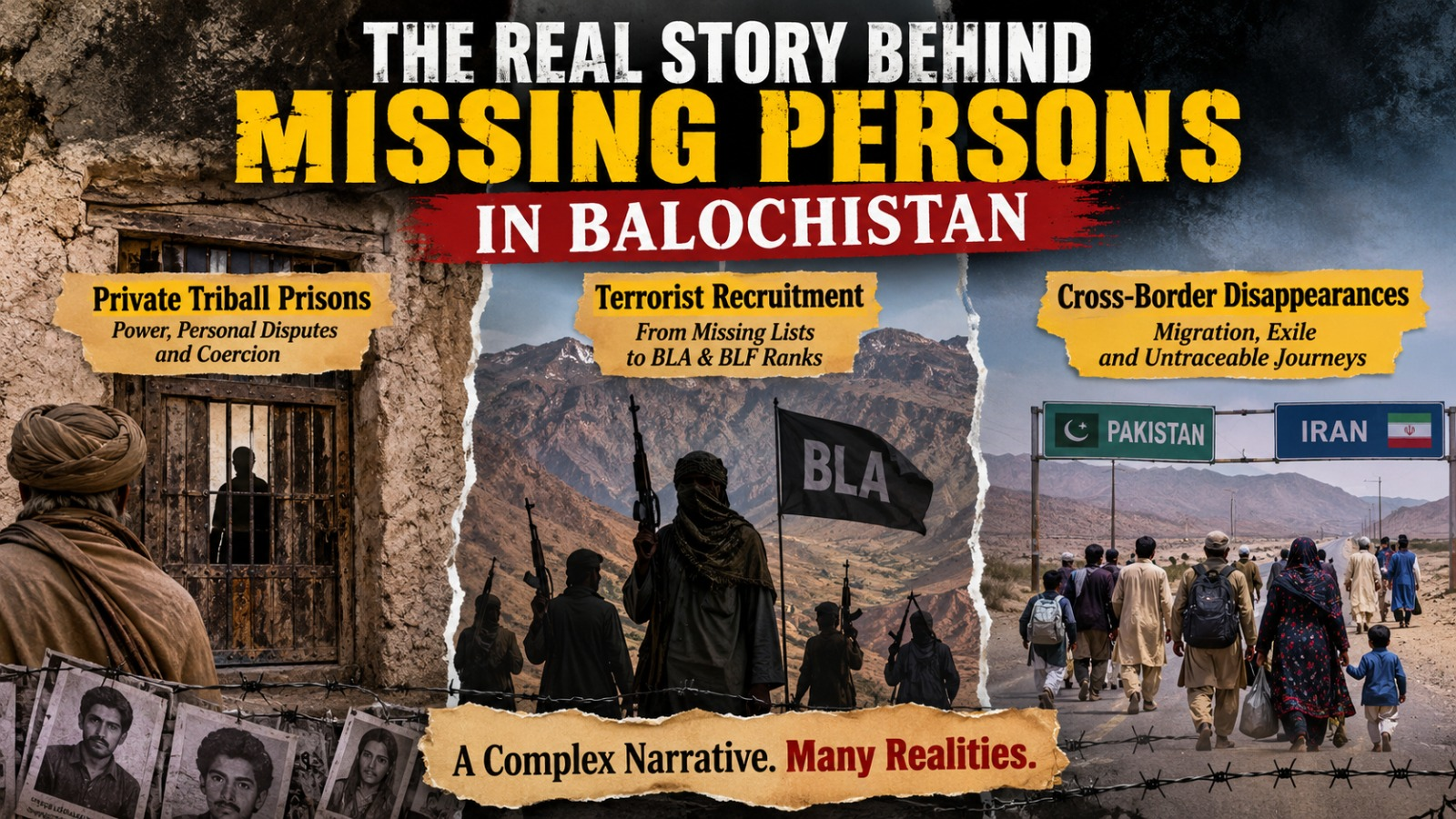
Private tribal prisons, terrorist recruitment and cross-border disappearances are three different realities being merged into one political narrative.
Who is actually missing in Balochistan? Who is being held in private jails by influential tribal figures? Who has joined terrorist organisations, and who has crossed international borders or travelled abroad? These questions rarely receive the same attention as the allegations repeatedly levelled against Pakistan’s security institutions.
For years, the missing persons issue has dominated Balochistan’s political discourse. Dr Mahrang Baloch and the Baloch Yakjehti Committee (BYC) have made it a central feature of their campaigns, using protest camps, demonstrations, social media and international platforms to portray reported disappearances as evidence of state repression. The Voice for Baloch Missing Persons (VBMP), PAANK, the human rights department of the Baloch National Movement, and other advocacy organisations also circulate lists and amplify individual cases.
The roots of the missing persons controversy in Balochistan can be traced to the political and security developments of the mid-2000s, particularly the killing of Nawab Akbar Bugti in August 2006. Allegations of disappearances and unlawful detentions became increasingly prominent during this period. In September 2009, the Voice for Baloch Missing Persons was formed, and on October 18, 2009, it established a protest camp outside the Quetta Press Club, turning the issue into a sustained public campaign. The government subsequently established the Commission of Inquiry on Enforced Disappearances in March 2011 to investigate cases and trace missing individuals. <Cite refs={[“turn119282search0″,”turn119282search1″,”turn119282search7”]}/>
However, the political debate has increasingly overlooked a fundamental distinction: not every person reported missing has necessarily disappeared under the same circumstances. Three different realities require examination.
The first concerns individuals held in private jails maintained by influential tribal figures. Balochistan’s entrenched Sardari system has historically allowed powerful tribal elites to exercise considerable control over communities, sometimes beyond the reach of ordinary legal institutions. Personal disputes, tribal rivalries, financial disagreements and accusations involving family honour have reportedly resulted in unlawful confinement. Investigations and testimonies concerning private jails in Barkhan and other parts of the province have exposed this parallel system of coercion. The case involving Sardar Abdul Rehman Khetran and the recovery of bodies from a well in Barkhan brought further attention to these practices.
When influential individuals exercise the power to confine people over personal and tribal disputes, their victims also deserve justice and accountability. Yet this dimension of Balochistan’s missing persons debate receives far less attention than accusations directed at state institutions. The same political voices that claim to champion ordinary Baloch citizens must also address the coercive structures operating within the Sardari system.
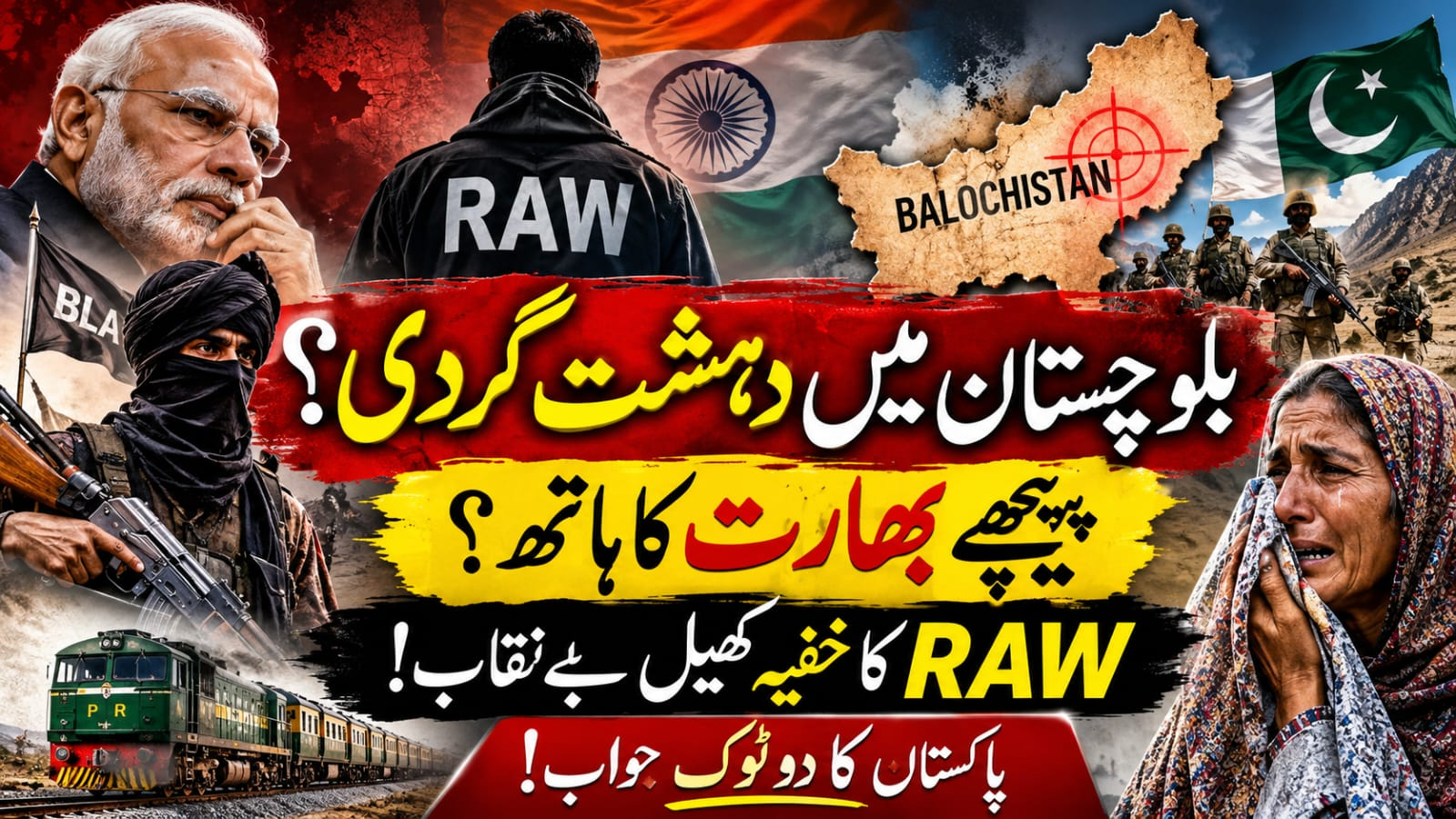
The second category concerns individuals who joined terrorist organisations and subsequently appeared in missing persons campaigns. This overlap has repeatedly emerged in cases involving the Balochistan Liberation Army (BLA) and the Balochistan Liberation Front (BLF). Some individuals were presented as missing before their names surfaced in terrorist organisations’ operational statements or after they were killed during counterterrorism operations.
The March 2024 attack on the Gwadar Port Authority complex provided a prominent example. Karim Jan, also known as Zoraan, was identified among the BLA attackers. His name had previously appeared in missing persons campaigns. Similarly, Tayyab Baloch alias Ilyas Lala was identified in reporting concerning the August 2024 suicide attack in Bela after the BLA had reportedly listed him as missing. Abdul Wadood Sadiqzai was also cited in reporting about individuals previously listed as missing before being linked to terrorist attacks. In July 2025, Suhaib Langov, who had appeared in missing persons campaigning, was killed during a security operation in Kalat and identified by security sources as a terrorist affiliated with Fitna-al-Hindustan.
Further names raised in this debate include Zoheer alias Haq Nawaz, Manzoor Kurd alias Bakhtiar Cheeta, Samiullah alias Javed Phaliya and Washdal alias Mash Mar. Ataullah, identified by the BLA as the attacker involved in the Jiwani check-post attack, and Bilal Shahwani have also featured in reporting examining the overlap between missing persons claims and terrorist networks.
The recruitment of women into terrorist operations adds another disturbing dimension. The arrest of Laiba alias Farzana in Khuzdar before a planned suicide attack in March 2026 exposed the methods used by terrorist handlers to recruit and indoctrinate women. Such cases demonstrate the importance of examining the subsequent activities and affiliations of individuals whose names are circulated through advocacy campaigns. Every case must be assessed on its own evidence, particularly when claims of disappearance and later terrorist involvement emerge.
The third category involves individuals who travelled abroad, crossed international borders or became untraceable through irregular migration routes. Families can lose contact with relatives attempting to travel through human-smuggling networks or enter neighbouring countries without legal documentation. Their absence can subsequently become part of a missing persons campaign without the circumstances of their departure being fully established.
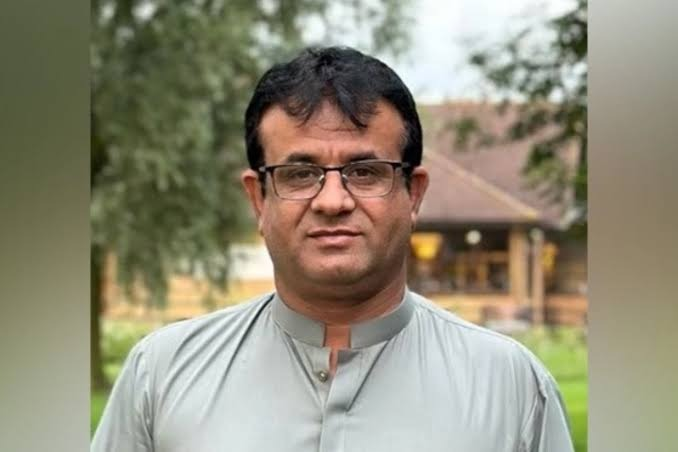
Engineer Zahir Bangulzai provides an example cited in accounts of this issue. His name was circulated as that of a missing individual in 2021, with allegations that security institutions were responsible. However, at a press conference in July 2022, he appeared publicly and explained that he had attempted to travel towards Iran, where he said he was detained by Iranian authorities for several months before being returned to Pakistan. His case illustrates why the circumstances surrounding each disappearance must be investigated before assigning responsibility.
These three categories expose the complexity of Balochistan’s missing persons debate. Private confinement by tribal elites, recruitment into terrorist organisations and irregular cross-border movement are fundamentally different circumstances. Combining them into a single political narrative obscures the actual causes behind individual cases.
The larger problem emerges when selected cases are amplified without incorporating subsequent developments. A person listed as missing may later be identified in a terrorist organisation’s own statements, appear among attackers or be traced across an international border. Such developments cannot simply be omitted from the public record. Equally, genuine cases of enforced disappearance require transparent investigation, legal accountability and answers for affected families.
Balochistan’s people deserve freedom from the coercion of tribal elites, the recruitment networks of terrorist organisations and every form of unlawful detention. The province needs stronger institutions, accessible justice, education, employment and development that reduce the influence of those who have historically exercised power over ordinary citizens.
The missing persons issue must be resolved through facts, evidence and the rule of law. Political campaigns cannot substitute for investigations, and terrorist organisations cannot be allowed to use human rights grievances as cover for their activities. Pakistan’s responsibility is to protect its citizens, establish the whereabouts of genuinely missing individuals and bring those responsible for unlawful confinement or terrorism before the law.