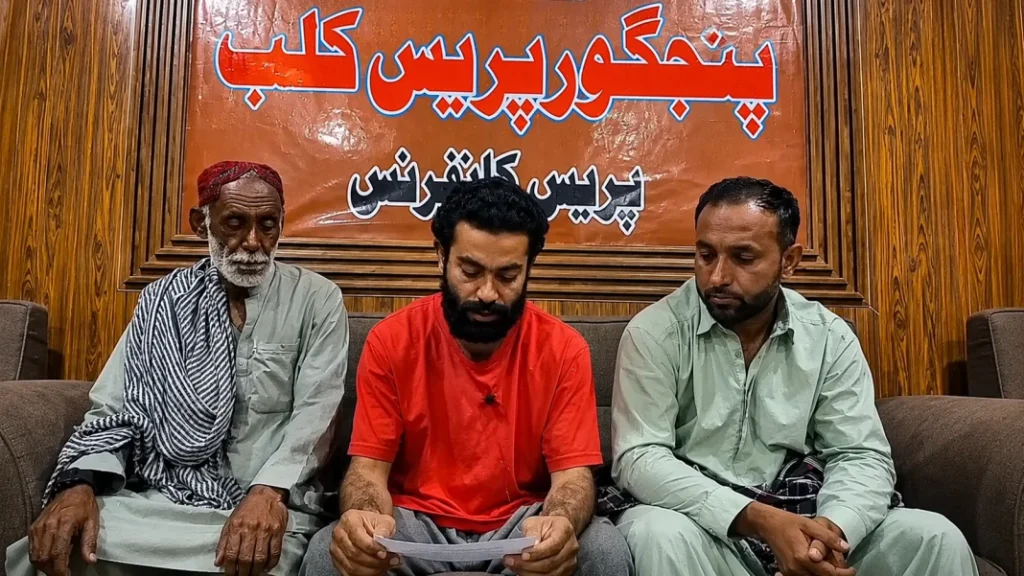
When Saeed Ahmed stepped in front of reporters at the Panjgur Press Club, he offered a very counter narrative to what BLA and people like Mir Yar Baloch have been propagating on social media. Joined by his father, Dad Jan, and his brother, the young man from Chitkan disclosed that he had been drawn into the banned Balochistan Liberation Army (BLA) through a personal relationship. A trusted friend persuaded him to leave his everyday life behind and travel to a remote terrorist training camp in Manguchar, where he underwent nearly two weeks of target-shooting instruction aimed at security forces and local citizens.
Saeed’s decision to walk away from that camp and return to his family is notable, but the mechanics of his recruitment are far more revealing. His trajectory confirms what field analysts have long pointed out which was terrorist networks of rely on exploited proximity. The BLA’s recruitment model operates as an intimate, multi-stage funnel. It frequently begins with personal and online friendships, financial promises and fake narrative which are then systematically converted into social isolation, ideological conditioning, and eventually, weapon handling. Saeed’s public account provides a rare look into the earliest phase of that process, before psychological conditioning hardens into committed violent action. It underscores that the boundary between an active insurgent and a target of interpersonal coercion can be thin.
Tactical operations and intelligence-based raids can disrupt physical camps and neutralize commanders, but they do not automatically close the recruitment pipeline. So long as terrorist recruiters can exploit personal trust, local vulnerabilities, and social isolation, depleted ranks will be continually replenished.
This is where Saeed’s story offers a broader strategic lesson for Balochistan. His return was not the result of a military raid, but of sustained family intervention working in tandem with authorities. By providing a structured mechanism for him to disengage, public institutions demonstrated the utility of combining security measures with social reintegration. Initiatives backed by provincial leadership such as dedicated deradicalization programs centered on family counseling, psychological support, and community mediation, reflect an evolving framework. Defeating this curse of terrorism requires addressing both the operational presence of armed groups and the social channels through which young men are drawn into them.
This perspective does not diminish the gravity of Saeed’s actions. Training facilities that prepare young men to conduct armed attacks against state forces, infrastructure projects, and local workers remain a major security concern. Participation in such environments carries legal and societal consequences. However, treating every individual who enters a camp as permanently irredeemable risks foreclosing pathways for voluntary disengagement. In Saeed’s case, an active family and an available mechanism for return prevented a temporary misstep from becoming a permanent commitment to terrorism.
If counter-militancy efforts in Balochistan are to produce lasting stability, policy frameworks must adapt to how recruitment actually occurs on the ground. Disrupting the informal social networks used by terrorist recruiters requires patience, institutional capacity, and targeted socio-economic investment in vulnerable districts. Combining rigorous security enforcement with accessible channels for rehabilitation creates a counterweight to terrorist recruitment. Neutralizing threats on the ground remains necessary, but preventing young people from taking up arms in the first place is the prerequisite for durable peace.