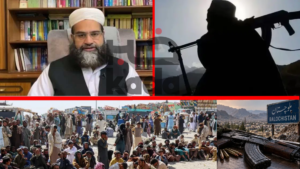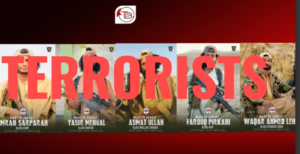
In Balochistan, the battle against terrorism is being fought not only on the ground but also in the arena of narratives, propaganda and information warfare. Terrorist organisations increasingly combine armed violence with information operations to undermine Pakistan’s national security, weaken public confidence and obstruct development. Their propaganda seeks to portray the state as incapable of governing the province, falsely claim to represent the Baloch population and exploit genuine concerns surrounding deprivation, political representation and missing persons to generate anti-state sentiment, attract recruits and legitimize violence. During a press briefing on 31 July 2026, the Director General of Inter-Services Public Relations (ISPR) identifies that more than 300 fake websites and over 1,000 social media accounts were being used to promote an anti-state narrative concerning Balochistan. These claims highlight the importance of addressing information warfare alongside the physical threat posed by terrorist organisations.
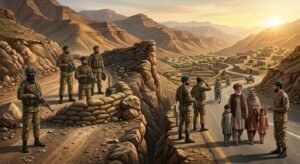
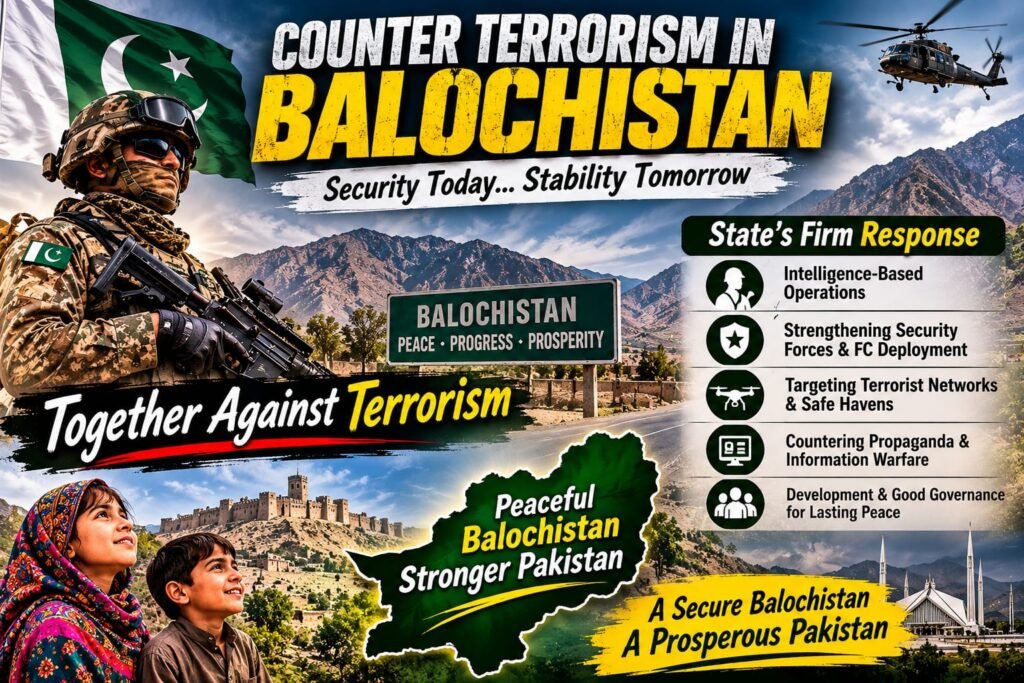
Pakistan’s response has consequently developed along two interconnected fronts: dismantling terrorist networks through intelligence-based operations and challenging the propaganda that supports their activities. Security forces, intelligence agencies, Frontier Corps, Balochistan Police and the Counter Terrorism Department (CTD) have pursued coordinated action against terrorist hideouts, facilitators, command structures and logistical networks. On 31 July 2026, the DG ISPR reported that 31,080 operations had been conducted in Balochistan out of 40,348 nationwide. These official figures demonstrate the scale of the state’s security response under the National Action Plan (NAP) and the broader counterterrorism vision of Azm-e-Istehkam, approved by the Federal Apex Committee.
A significant example was Operation Radd-ul-Fitna-I, launched on 29 January 2026 in Panjgur and the outskirts of Harnai. According to ISPR, the operation expanded into coordinated intelligence-based engagements and clearance activities across multiple areas to dismantle terrorist hideouts and sleeper cells. The military reported 216 terrorists killed and the recovery of foreign-origin weapons, ammunition and explosives. It also acknowledged the deaths of 36 civilians, including women and children, and 22 security and law-enforcement personnel. These casualties underline the human cost of counterterrorism operations and the importance of protecting civilian lives.
The subsequent Operation Radd-ul-Fitna-3 demonstrated the continuation of this strategy across several districts. On 9th August 2026, security sources reported that 15 terrorists had been killed in intelligence-based operations in Mastung, Bolan, Washuk, Awaran, Sibi, Khuzdar, Harnai and Nushki, with weapons and ammunition recovered. Separate operations in Washuk on 5 August and Mastung on 6 August reportedly killed another 12 terrorists and destroyed a hideout. On 10 August, an operation in Panjgur’s Sarkani and Chedgi areas reportedly killed five more, including a commander identified as Wazir. These operations illustrate the emphasis on intelligence-led targeting, disrupting terrorist networks and restricting their operational movement. The reported figures belong to separate operational updates and should not be treated as a single independently verified cumulative total.
Another counter terrorism named Operation Shaban further illustrates the state’s emphasis on targeted action against terrorist networks. Following the attack on Mangi Dam Police Station, security forces launched an operation in July 2026. According to security sources, 43 terrorists had been killed during Operation Shaban by 10 July, while the wider series of operations conducted since 5 July had resulted in 79 reported deaths, including those from other intelligence-based operations. A separate clearance operation began in the Shaban area in September after intelligence agencies identified terrorist hideouts. On 27 September, ISPR reported that 33 terrorists had been killed in Shaban, 11 in Nushki and six in Mand, while more than 71 had been killed across different areas of Balochistan during the preceding 96 hours. Weapons, ammunition and explosives were reportedly recovered, and clearance activities continued to secure the affected areas. These figures represent the military’s successive operational updates and should not be added together as separate totals.
Other significant operations reinforced this approach. On 4 September, ISPR reported 48 terrorists killed in multiple operations across Mastung, Quetta, Kalat and Sibi over 48–72 hours. The reported engagements included the destruction of improvised explosive devices in Mastung, the clearance of four hideouts in Shaban, Quetta, and the recovery of weapons and ammunition. On 6th September, security forces reportedly killed 11 terrorists in Kharan and Washuk and recovered approximately 2.9 tonnes of explosives intended for preparing improvised explosive devices. On 13th October, an operation in Washuk reportedly killed five terrorists, while operations in Kachhi and Wadh on 26 October reportedly killed nine suspected terrorists. Together, these examples demonstrate the use of intelligence gathering, targeted engagements, clearance operations and disruption of weapons and explosives supplies.
These security indicators provide evidence of a short-term improvement to ensure stability in Balochistan. According to the Pakistan Institute for Conflict and Security Studies (PICSS), Balochistan recorded 71 terrorist attacks in October 2026, compared with 132 in September, representing a decline of approximately 46 percent. Fatalities resulting from these attacks fell from 136 to 44, a reduction of nearly 68 percent, while injuries decreased from 63 to 37, approximately 41 percent. PICSS separately reported that security operations in the province resulted in 79 terrorist deaths during October. These figures indicate a substantial month-on-month improvement in key security indicators, although they do not establish that the threat has been permanently eliminated rather it shows the security of Pakistan played a very important role in ensuring stability. The European Union Agency for Asylum, citing PIPS data, recorded 225 attacks by Baloch insurgent groups in Balochistan during 2025, causing 338 fatalities and 462 injuries. This demonstrates the scale of the challenge that remains.
However, defeating terrorism requires more than operational success. Terrorist propaganda frequently exploits attacks, civilian suffering and unresolved grievances to undermine public confidence and attract recruits. Hence official briefings and public communication must therefore be supported by verifiable information, timely clarification of incidents, credible investigations and accountability. Addressing legitimate public concerns through effective provincial governance, justice, education, employment and improved public services is equally essential to prevent terrorist organisations from exploiting social and economic vulnerabilities.
Ultimately, Pakistan’s counterterrorism strategy must protect both the territory and the people of Balochistan. Sustained security operations, institutional accountability and inclusive development are complementary requirements for lasting peace. A secure Balochistan is essential not only to Pakistan’s national security but also to the stability, prosperity and future of its people.