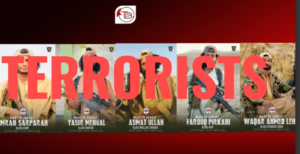
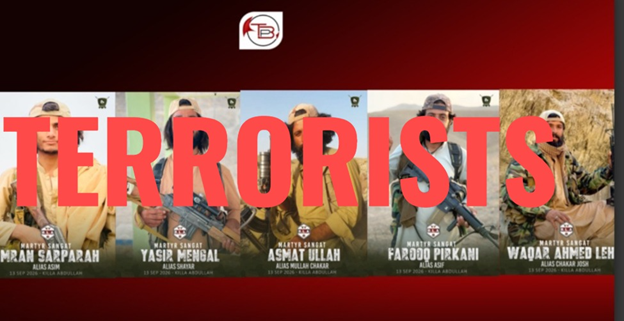
The Baloch Liberation Army release of photographs and identities of five of its members killed in the Sultan Shar area of Qila Abdullah on 13 September 2026 has opened a documented trail that raises pointed questions about recruitment pathways into the terrorist organziations.
A review of social-media activity apparently linked to some of these individuals, including Imran Sarpara (alias Asim), Farooq Pirkani (alias Asif) and Yasir Mengal (alias Shahyar), shows that the accounts remained active until mid-2025 and carried material supportive of Baloch Yakjehti Committee (BYC) activities and Mahrang Baloch. The accounts then ceased active public use, while the same individuals were later identified by the BLA itself as members of its ranks. Some had also been presented earlier in public advocacy campaigns as “missing persons.”
This sequence is not isolated. It aligns with a wider pattern in which the BYC has functioned as a mobilization and recruitment platform for the BLA and allied groups. The pathway typically begins with participation in protests, roadblocks and digital campaigns centred on the narrative of missing persons and state grievances. Selected individuals are then assigned low-risk tasks such as social-media amplification, logistics or reconnaissance before moving into clandestine networks and armed ranks.
Balochistan’s Counter-Terrorism Department has publicly documented this mechanism. In January 2026, CTD DIG Aitzaz Goraya stated that terrorist networks systematically use the BYC platform to identify and induct young people. He detailed the arrest of Sajid Ahmad alias Shahwaiz, a Turbat-based sociology graduate and former lecturer who remained in constant contact with BYC leadership while facilitating BLA and BLF activity, including reconnaissance of sensitive locations. Goraya further described how 20-year-old Jahanzaib alias Mehrbaan organised BYC roadblocks and “missing persons” protests in Noshki and Kharan, managed social-media content, and then inducted 18-year-old Bezan into the BYC. Bezan subsequently joined the BLA. An 18-year-old named Sarfaraz from Kharan followed a similar route from BYC activity into reconnaissance tasks.
Comparable cases reinforce the pattern. Nisar Ahmed was portrayed in BYC-linked advocacy as a missing person before the BLA identified him among its members killed during a security operation in Nokcha, Chagai, in August 2026. Suhaib Baloch (also known as Amir Baksh or Suhaib Langove) was listed as missing by the BYC in 2024. The BLA’s own media outlet later confirmed he had joined the Majeed Brigade and was killed in Kalat in July 2025. Other individuals previously featured in “missing persons” campaigns, including Salim Baloch and Wadood Satakzai, were subsequently identified in terrorist contexts or camps.
The five killed in Sultan Shar fit the same trajectory. Imran Sarpara joined the BLA’s urban guerrilla activity in December 2024 and moved to the mountain front in January 2026. Farooq Pirkani and Yasir Mengal entered armed activity in 2026. Their relatively recent induction, following public association with BYC messaging, mirrors the CTD-described pipeline of open mobilisation, withdrawal from public platforms, and later confirmation by the BLA as operational members.
The BLA own release of these identities removes ambiguity about their final affiliation. What the digital trail and parallel cases establish is a documented basis for investigating recruitment routes, facilitation networks, and the transition of specific individuals from BYC-linked mobilisation into terrorist network. The evidence does not imply that every participant in BYC activity is a terrorist. It does show a repeated, observable sequence in named cases that now warrants systematic examination by law-enforcement and judicial authorities.