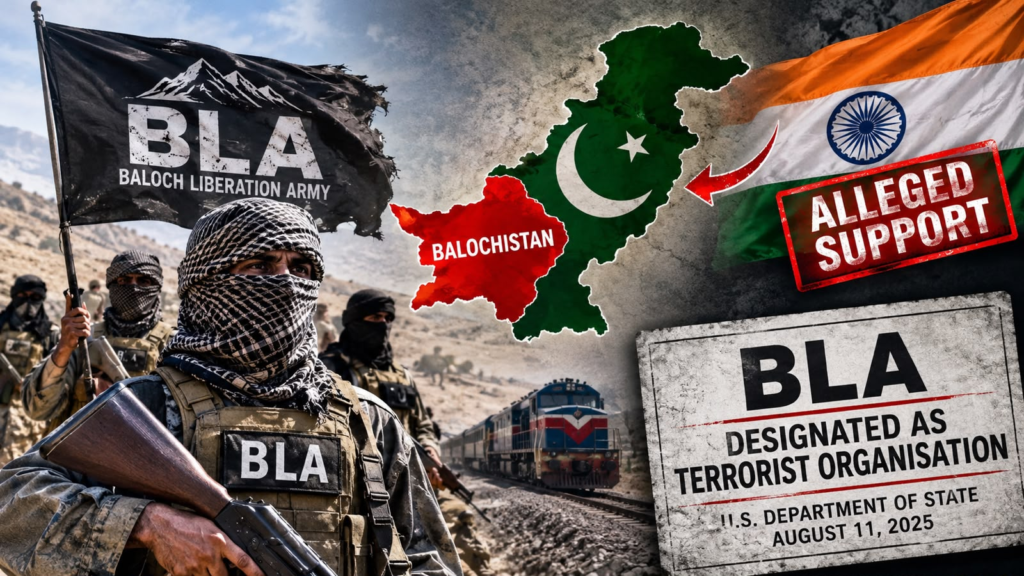
The Baloch Liberation Army (BLA) is not a political representative of the Baloch people. It is a designated terrorist organisation whose campaign of violence has targeted civilians, security personnel, public infrastructure and Pakistan’s economic interests. Its terrorist activities have attracted international recognition, with the United States formally designating the BLA and its Majeed Brigade as Foreign Terrorist Organisations on 11 August 2025.
However, the threat extends beyond the organisation’s direct acts of violence. Pakistan has consistently identified an alleged Indian intelligence connection behind militant networks operating inside its territory, maintaining that external support has helped sustain instability in Balochistan.
India’s Alleged Intelligence Network and the BLA
Pakistan has repeatedly presented evidence of Indian involvement in activities aimed at destabilising the country. In November 2020, Islamabad released a detailed dossier alleging that Indian intelligence agencies were financing, facilitating and supporting terrorist activities in Pakistan, including those attributed to the BLA.
The case of Kulbhushan Jadhav, arrested in Balochistan in March 2016, further intensified these concerns. Pakistan identified him as an Indian intelligence operative and accused him of involvement in espionage and terrorist activities. India disputed Pakistan’s account. Jadhav’s case remains a significant part of Pakistan’s public record of allegations concerning Indian intelligence operations.
These developments form an important part of the broader security concerns surrounding the BLA and alleged external sponsorship.
The Afghan Connection and Regional Coordination
Pakistan’s security concerns have also extended to alleged coordination between militant organisations and external intelligence networks operating from Afghan territory.
In October 2026, the Associated Press reported on a Pakistani military briefing concerning an alleged August meeting in Kandahar involving representatives of the BLA and other militant organisations. An intelligence report reviewed by AP alleged that Afghan and Indian intelligence officials helped arrange the meeting and that discussions involved manpower, weapons and logistical support.
The Pakistani military’s claims were not independently verified by AP, and Afghanistan’s Taliban authorities rejected them. Nevertheless, the reported meeting highlights the regional security concerns surrounding militant networks and alleged cross-border facilitation.
The BLA’s Terrorist Record
The organisation’s actions speak for themselves. Its attacks have included:
- The March 2025 Jaffar Express hijacking, involving hundreds of passengers.
- Suicide attacks near Karachi Airport and the Gwadar Port Authority Complex in 2024.
- Attacks against security personnel and civilians.
- Targeting Chinese nationals and infrastructure associated with CPEC.
The US Department of State specifically cited these attacks when announcing its Foreign Terrorist Organisation designation in August 2025.
Why the BLA–India Nexus Matters
Balochistan’s strategic location and economic importance make it particularly vulnerable to the consequences of militant violence. Attacks targeting CPEC-related infrastructure, foreign nationals and security installations threaten investment, regional connectivity and economic development.
Pakistan’s position is that India’s alleged support for militant organisations is part of a broader effort to exploit internal challenges and undermine national stability.
The BLA’s terrorist activities must also be distinguished from the legitimate aspirations of Baloch citizens. No armed organisation has the right to use the name of an entire population to justify violence or recruit young people into militancy.
The BLA’s terrorist designation by the United States reinforces the international recognition of the organisation’s violent activities. Pakistan’s documented diplomatic record, the Jadhav case and continuing security investigations form part of its case concerning alleged Indian involvement.
The international community must take terrorist financing, cross-border facilitation and external support networks seriously. Any state or network found providing material assistance to terrorist organisations must face appropriate international accountability.
Balochistan is not a battleground for proxy conflicts. Its people deserve peace, security and development, not terrorism, foreign interference or militant exploitation.