
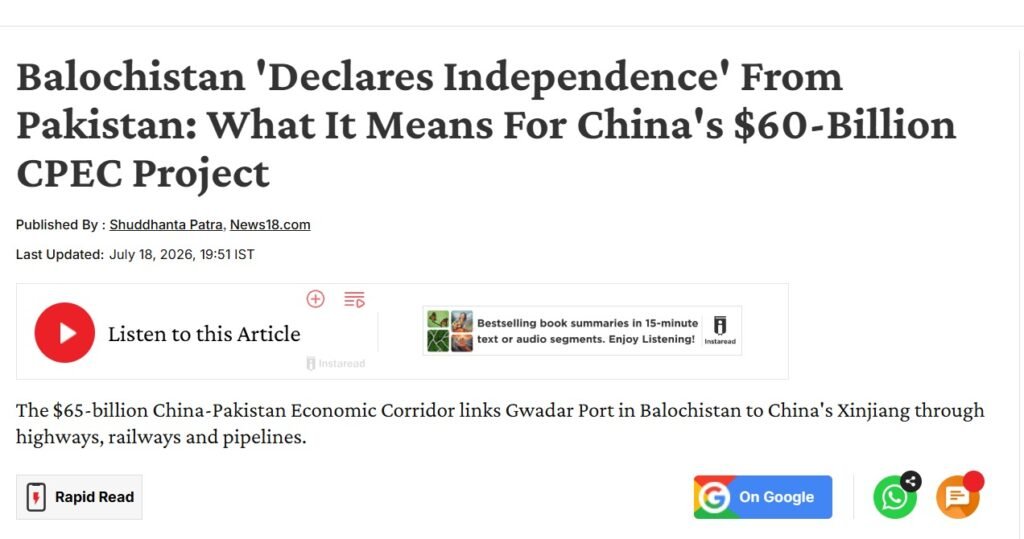
A recent article published by News18 alleges that an independent Balochistan would inherit Gwadar Port, reshape the China Pakistan Economic Corridor (CPEC), and compel China to renegotiate its strategic interests. These assertions rest on speculative assumptions that disregard established principles of international law. The central flaw in the News18 analysis is that it assumes the existence of a successor state before establishing whether such a state exists under international law. Questions of state succession arise only after an entity satisfies the legal requirements of statehood.
The proposition that the self-proclaimed “Republic of Balochistan” merely lacks international recognition mischaracterizes the legal position. Recognition alone does not determine statehood. Before questions of recognition arise, an entity must first satisfy the accepted legal requirements of statehood.
International law assesses statehood through an effective government, a defined territory, a permanent population, and the capacity to conduct international relations. These criteria, reflected in customary international law and codified in the Montevideo Convention, remain the accepted benchmark for assessing statehood. No entity claiming to represent an independent Balochistan satisfies these requirements or exercises effective sovereign authority over the province.
Pakistan exercises internationally recognized sovereignty over Balochistan and remains its constitutional authority. No member state of the United Nations recognizes any competing sovereign authority over the province. Accordingly, no successor state has come into legal existence, and questions concerning sovereign assets, treaty succession, and international obligations remain hypothetical rather than legally operative.
The assertion that Gwadar Port would automatically pass to a newly recognized Baloch state overlooks the distinction between territorial sovereignty and commercial management.
Gwadar is a state-owned public asset administered under Pakistani law through the Gwadar Port Authority. The China Overseas Ports Holding Company manages the port under a commercial concession agreement that grants management rights, not ownership or sovereign authority. Such agreements do not transfer territorial sovereignty or alter the legal status of the territory.
Consequently, Gwadar remains under Pakistan’s internationally recognized sovereignty, and the concession agreement provides no legal basis for claims that sovereignty over the port has shifted or would automatically transfer to another entity.
The same principle applies to CPEC. CPEC is a bilateral strategic framework established through agreements between Pakistan and China and implemented through commercial contracts. These arrangements remain legally valid because Pakistan continues to exercise internationally recognized sovereignty over the territory in which the projects operate. Only a state possessing international legal personality can succeed to sovereign rights, public assets, and treaty obligations.
Even then, treaty succession depends upon the nature of the agreement and the applicable legal framework. Since no successor state has come into legal existence, claims regarding the legal future of CPEC remain hypothetical.
The article also claims that China would eventually negotiate with a newly recognized Baloch state. China has consistently reaffirmed its support for Pakistan’s sovereignty and territorial integrity in bilateral statements and international forums. No official Chinese policy or diplomatic position recognizes or supports claims of an independent Balochistan.
International law recognizes the principle of self-determination. However, outside the contexts of decolonization, foreign occupation, or other exceptional circumstances recognized under international law, it does not automatically confer a unilateral right to secession or create statehood. Claims to independent statehood must still satisfy the established legal requirements and acquire international legal personality. The assertions advanced in the News18 article establish neither.
Questions concerning development, resource distribution, and local participation are matters of constitutional governance. They do not establish statehood or alter Pakistan’s internationally recognized legal status.
International law distinguishes political narratives from legal realities. Declarations issued by non-state actors do not create sovereign states, and speculative political assertions do not alter existing sovereign rights. Until an entity satisfies the accepted requirements of statehood and acquires international legal personality, questions concerning state succession, Gwadar, and CPEC remain hypothetical rather than legally operative. Pakistan remains the internationally recognized sovereign over Balochistan, while Gwadar and CPEC continue to operate under Pakistan’s existing legal framework. The News18 article therefore reverses the legal sequence by assuming the existence of a successor state before establishing whether such a state exists under international law.