
Balochistan is frequently portrayed abroad through a single narrative: grievance, repression, and victimhood. That framing has become so dominant that developments reflecting progress in education, entrepreneurship, and technology often receive far less attention than conflict. The graduation of 500 women under the Balochistan Women Entrepreneurship Development Program is one such example. While international commentary continues to reduce the province to a story of perpetual crisis, a different reality is emerging through sustained investments in women’s education, entrepreneurship, and digital skills.
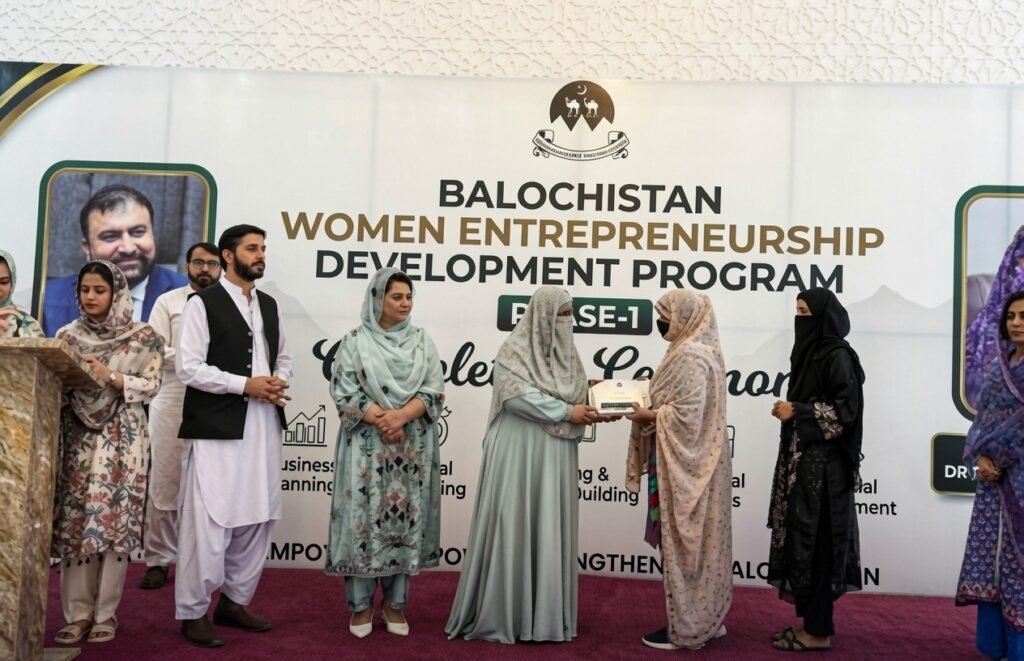
Five hundred women have successfully completed the first phase of the Balochistan Women Entrepreneurship Development Program after receiving training in entrepreneurship, business planning, financial management, digital literacy, and marketing. They graduated with certificates, tablets, and business toolkits to help establish and expand their businesses, and the provincial government has already announced the programme’s expansion. This achievement represents more than the successful completion of a training initiative. It reflects a broader policy that is placing women’s economic participation at the centre of Balochistan’s development agenda.
That direction was reinforced with the inauguration of a modern IT lab for girls in Chaman under the Balochistan Special Development Initiative. The facility expands access to technology education in an area where such opportunities have historically remained limited, equipping young women with skills that are increasingly essential in a digital economy.
The momentum extends beyond these initiatives. Gwadar recently inaugurated the province’s first women only market, comprising 14 purpose built commercial units where female entrepreneurs can establish and grow businesses. The provincial government has also expanded the Women Economic Empowerment Endowment Fund, increasing financial support for women seeking to scale their enterprises. Balochistan has further established its first AI Entrepreneurship Lab for women, introducing aspiring entrepreneurs to emerging technologies that increasingly shape modern commerce.

Taken together, these initiatives reveal a clear policy direction. The emphasis is increasingly extending beyond welfare and basic education to entrepreneurship, digital skills, financial inclusion, and economic participation, recognizing women as drivers of growth and development rather than passive beneficiaries.
The significance of this shift extends beyond economic development. Terrorist organizations recruit where opportunity is scarce, where financial hardship persists, and where social isolation makes individuals easier to manipulate. Education, entrepreneurship, digital literacy, and financial independence directly reduce those vulnerabilities. Every woman who acquires marketable skills, launches a business, or gains economic independence becomes less susceptible to coercion and terrorist influence. Expanding opportunities for women is not just a development priority but also a long term investment in resilience against terrorism.
The contrast becomes evident when examining the methods of proscribed terrorist organizations such as the Balochistan Liberation Army. Publicly documented cases involving Khair un Nisa, Rahima, and Farzana illustrate how women facing domestic, financial, or social hardships were manipulated through deception, coercion, and intimidation before being drawn into terrorist networks. Authorities have stated that those recovered were rescued from terrorist influence and reunited with their families. The pattern is clear: these groups exploit vulnerability rather than address it.
The contradiction is striking. While public institutions are expanding women’s access to education, technology, entrepreneurship, and financial resources, terrorist organizations exploit the very vulnerabilities those initiatives seek to eliminate. Their recruitment strategy depends on instability, economic insecurity, and social isolation. Expanding women’s agency directly undermines that model by reducing the pool of individuals susceptible to manipulation and coercion. The province’s recent investments therefore represent more than development programmes; they are strengthening communities against the conditions that terrorist organizations have long sought to exploit.
The graduation of 500 women entrepreneurs, the establishment of a modern IT lab for girls in Chaman, Gwadar’s first women only market, the expansion of the Women Economic Empowerment Endowment Fund, and the launch of the province’s first AI Entrepreneurship Lab for women are not isolated initiatives. Together, they reflect a sustained investment in women’s capabilities and participation in the province’s economy.
The story of Balochistan cannot be told solely through the language of grievance and victimhood. It must also include women who are building businesses, mastering technology, and shaping their own futures. That transformation is not simply changing individual lives. It is strengthening communities, expanding economic opportunity, and steadily narrowing the space in which terrorist organizations seek to exploit vulnerability.