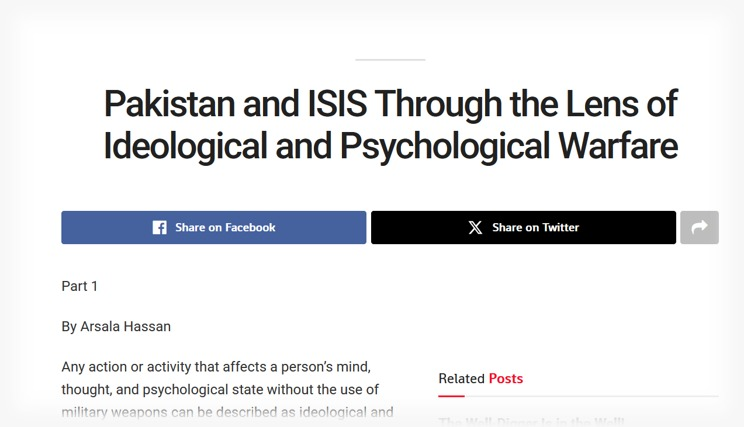
Al-Mirsaad’s recent piece, “Pakistan and ISIS Through the Lens of Ideological and Psychological Warfare,” reads at first like a serious attempt at security analysis. It borrows the vocabulary of the field: information operations, proxy networks, ideological warfare. But strip away the jargon and what remains is not analysis at all. It is assertion dressed up as scholarship, and the gap between the two is where the piece actually falls apart.
Anyone qualified to understand international relations literature knows the first rule of the discipline: a claim about state-sponsored proxy activity is only as good as the evidence behind it. Intelligence assessments, independent verification, corroborated reporting from multiple sources. None of that appears here. Al-Mirsaad is desperately trying to make its readers believe that Pakistan has built an ideological infrastructure to sustain ISKP, but it never shows them. It asks for trust rather than earning it, which is precisely the move disinformation makes when it cannot survive contact with evidence.
The framing of Pakistan as the “architect” of the very extremism it has spent two decades fighting is where the argument becomes hardest to take seriously. This is a country that has lost tens of thousands of soldiers and civilians and absorbed hundreds of billions of dollars in economic damage in a war against terrorism and it is still fighting a war; it has never started at first. States like Pakistan suffer more from carrying the damages of other states especially the atrocities done by Western States.
There’s also a subtler technique at work in the piece, one worth naming because it shows up often in this genre of writing. Ordinary domestic friction, economic strain, political disagreement, social tension, gets reframed as evidence of an engineered conspiracy. Every developing state deals with these pressures. Treating them as proof of a hidden psychological operation isn’t analysis; it’s a rhetorical trick that lets the author avoid making a falsifiable claim at all. And these things cannot be considered as a substitute of evidence.
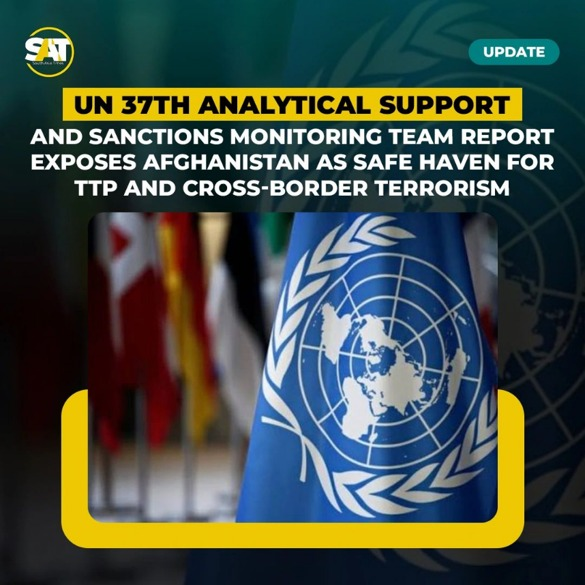
What the article conveniently leaves out is the documented picture across the border. Pakistan has repeatedly shared intelligence, some of it corroborated by international bodies, on terrorist safe havens operating out of Afghan territory. UN Monitoring Team reports have flagged the continued presence and freedom of movement enjoyed by several proscribed groups there. An article genuinely interested in tracing the roots of regional instability would need to grapple with that record. Al-Mirsaad doesn’t.
None of this is to say Pakistan’s institutions are beyond scrutiny, no states are. But there’s a difference between scrutiny and a propaganda narrative built to suggest that national cohesion is one psychological push away from collapse. The actual track record, decades of cross-border terrorism, sectarian violence, hostile information campaigns, and an institutional response that has held rather than fractured, tells a different story than the one Al-Mirsaad wants readers to accept.
In the end, the piece leans on repetition where it should lean on evidence, hoping that saying something often enough will substitute for demonstrating it. If the goal really is understanding psychological warfare in the region, the starting point has to be distinguishing verified intelligence from motivated narrative. Pakistan’s counter-terrorism record deserves to be assessed on those terms, not on the speculative framing of an outlet that seems more interested in deflecting scrutiny than conducting it.