The 38th UN Monitoring Team report highlights Afghanistan’s continuing role in the TTP threat against Pakistan, documenting Taliban support, a substantial TTP presence, organizational expansion, escalating attacks, Al-Qaida training and ideological support, interconnected terrorist networks, and access to advanced weapons. Together, these findings point to an Afghanistan-based terrorist infrastructure sustaining TTP’s campaign against Pakistan.
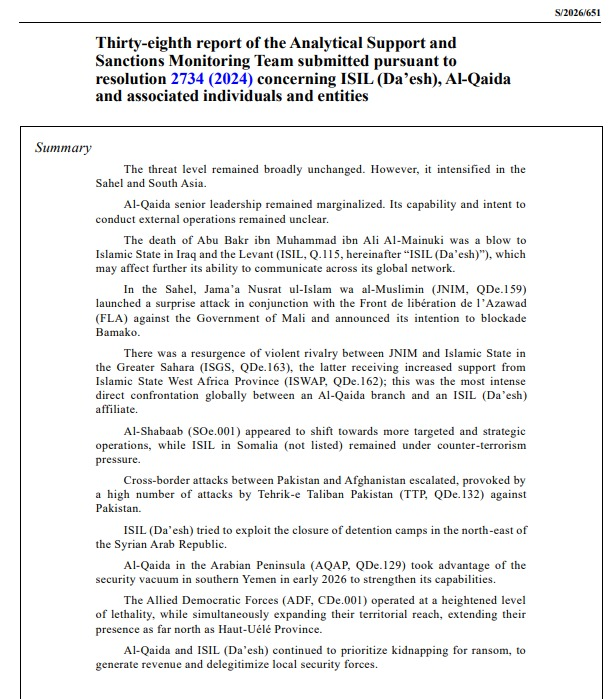
The report’s finding of continued Taliban support for TTP is particularly significant. Paragraph 91 states that the Afghan de facto authorities continued supporting TTP as the group escalated attacks against Pakistan, contributing to cross-border military exchanges.
This finding challenges repeated denials that Afghan territory provides space for terrorist organizations targeting Pakistan. More importantly, the report’s assessment indicates that TTP continues to retain the space and organizational capacity needed to sustain its terrorist campaign. The issue therefore extends beyond public Taliban statements to the continued presence and operational freedom of TTP inside Afghanistan.
The scale of TTP’s presence is reflected in paragraph 99, which records the relocation of approximately 2,000 TTP fighters and their families from areas close to Pakistan to locations deeper inside Afghanistan. Relocation cannot be equated with dismantlement. Moving TTP elements away from the border changes their location, not the existence of the network. The episode confirms that TTP maintains a substantial and organized presence inside Afghanistan.
TTP is also expanding its organizational structure. Paragraph 97 records that following its Rahbari Shura, the group established divisions covering Balochistan and the Central Region, Kashmir and Gilgit, alongside a formation described as the “TTP Air Force”. The expansion indicates an effort to widen its geographical and operational reach, extending its stated ambitions beyond areas traditionally associated with TTP activity.
The report further records TTP’s deliberate escalation of terrorism against Pakistan. Paragraph 98 notes that TTP announced “Operation Khyber”, calling for intensified attacks against Pakistan and targeting security forces and civilians. The consequences were reflected in the 16 February vehicle-borne attack in Bajaur, which killed 11 security personnel and a child. The report notes that TTP was reportedly operating from Afghanistan, reinforcing the connection between its Afghan presence and attacks inside Pakistan.
The Al-Qaida dimension adds another layer to the threat. Paragraph 100 states that Al-Qaida provides ideological guidance, training and support to TTP in its campaign against Pakistan. On 28 April, Al-Qaida’s As-Sahab Media Foundation publicly supported TTP operations against Pakistan. A Member State also reported that BLA terrorists were trained alongside TTP by Al-Qaida trainers in Afghanistan. These findings indicate an interconnected terrorist landscape in which different organizations can benefit from overlapping ideological and training networks.
Weapons further demonstrate the enabling environment available to terrorist groups. Paragraph 131 states that advanced weapons and military equipment available in Afghanistan continued to facilitate transfers to TTP and other terrorist organizations. Member States specifically highlighted the proliferation of systems such as night-vision goggles, which can enhance terrorist fighting capabilities. For Pakistan, access to such equipment increases the potential lethality of attacks against security forces and civilians.
The reported warning from Taliban leader Hibatullah Akhundzada to TTP leadership also requires scrutiny. Paragraph 99 records that Akhundzada reportedly warned TTP leadership through back-channel communications to stop attacks against Pakistan or risk losing Taliban support. Such a warning should not be confused with dismantlement. When considered alongside the same paragraph’s account of TTP’s relocation and the report’s finding of continued Taliban support, it indicates an effort to manage TTP’s conduct rather than eliminate its presence.
Overall, the 38th UNMT Report presents a consistent picture: TTP continues to operate from Afghanistan, receives Taliban support, maintains thousands of fighters and family members there, benefits from Al-Qaida training and ideological support, has access to advanced weapons, and continues expanding its structure while escalating terrorist attacks against Pakistan. These are interconnected elements of the same threat architecture. The UN findings therefore reinforce what Pakistan has consistently maintained: Afghanistan remains central to the TTP threat confronting Pakistan and poses a wider challenge to regional security.
The implication is clear. TTP cannot be addressed solely at the point where attacks occur inside Pakistan. Its personnel, training networks, weapons access and organizational structures must also be dismantled. As long as TTP retains these capabilities inside Afghanistan, terrorism against Pakistan will remain tied to the security environment across the border. The 38th UNMT Report has placed these realities on record. What is now required is not another cycle of denials and assurances, but concrete and verifiable action against the terrorist infrastructure sustaining TTP’s campaign against Pakistan.