
History records few moments with such clarity and documentary strength that propaganda becomes irrelevant. The accession of the State of Kalat to Pakistan is one of those moments. It was not an accident of circumstance, nor the result of pressure or ambiguity. It was a deliberate, constitutional, and publicly recorded decision taken by the rightful ruler of Kalat in the full light of the political realities of 1948.
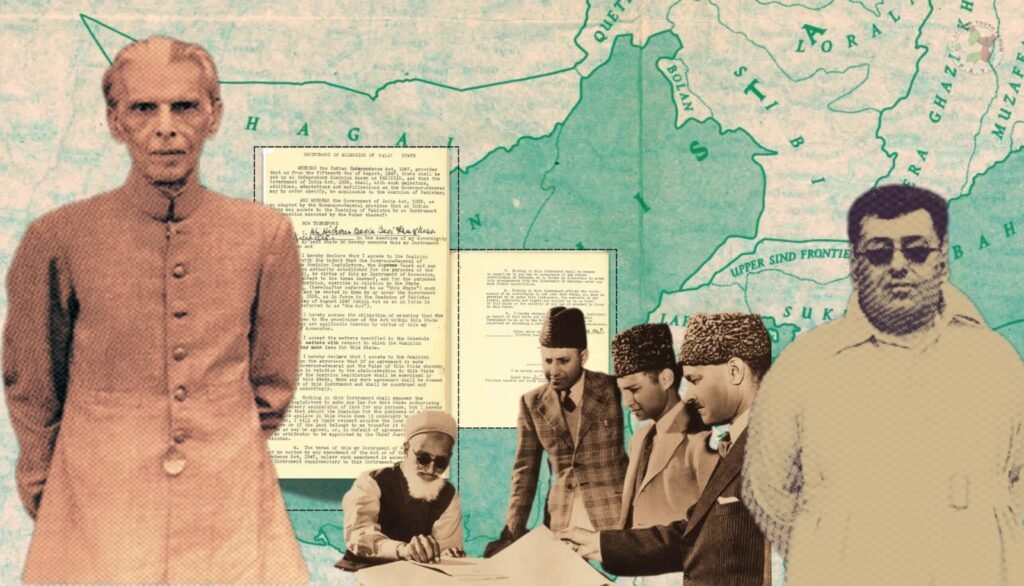
On 27 March 1948, the Khan of Kalat, Mir Ahmad Yar Khan, signed the formal Instrument of Accession that joined the State of Kalat with Pakistan. He took this decision after carefully weighing the political conditions of the time and the broader interests of the region. Kalat formed the central and most significant part of Balochistan. For centuries it had maintained a distinct status. After the partition of 1947, its accession became one of the most important steps in the consolidation of Pakistan.
Quaid-e-Azam Muhammad Ali Jinnah and the Khan of Kalat shared long-standing and friendly relations. In earlier years the Quaid had served as the Khan’s legal counsel. This mutual respect and understanding helped smooth the process of accession.
Immediately after the partition of India, the subsidiary states of Kalat, Kharan, Lasbela and Makran expressed their clear desire to join Pakistan of their own free will. Pakistan accepted their accession on 17 March 1948. The Khan of Kalat initially refused to recognize their separate status. Yet when he saw the overwhelming wish of the people of these states and the realities on the ground, he himself signed the Instrument of Accession on 27 March 1948. The document was presented to the Quaid-e-Azam on 31 March 1948. Even earlier, on 29 June 1947, the Shahi Jirga and the non-official members of Quetta Municipality had already agreed to join Pakistan.
At the time of accession, peace and order remained intact. Conditions stayed calm until the middle of July 1948. Later, some relatives of the Khan tried to disturb the situation. But the core decision had already been taken in accordance with constitutional and practical requirements. The purpose of the accession was to secure Baloch identity and local traditions within a constitutional and legal framework.
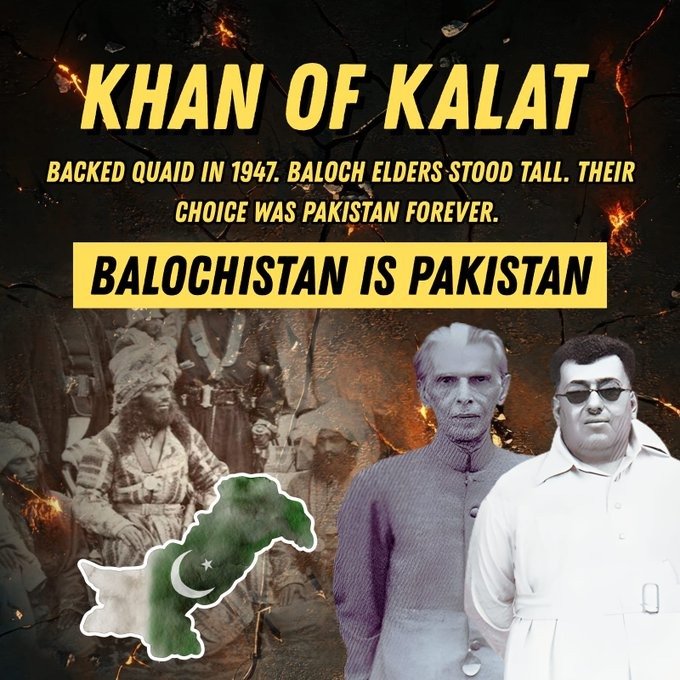
From the very beginning, external propaganda attempted to distort the facts. In 1948 All India Radio, Delhi, falsely claimed that Kalat had requested accession to India. The Khan of Kalat immediately rejected this claim and reaffirmed Kalat’s commitment to Pakistan.
Even today, certain elements twist this historical truth to mislead the youth and serve narrow political agendas. The reality remains clear that the accession of Kalat made Balochistan an inseparable part of Pakistan. Constitutional progress, the rights granted under the Eighteenth Amendment, and ongoing development projects including CPEC continue to work for the economic advancement and prosperity of the people of Balochistan.
In short, the accession of Kalat was never a mere signature. It was a realistic decision for the unity of Pakistan and a shared future. That decision still forms the foundation of stability in the region.