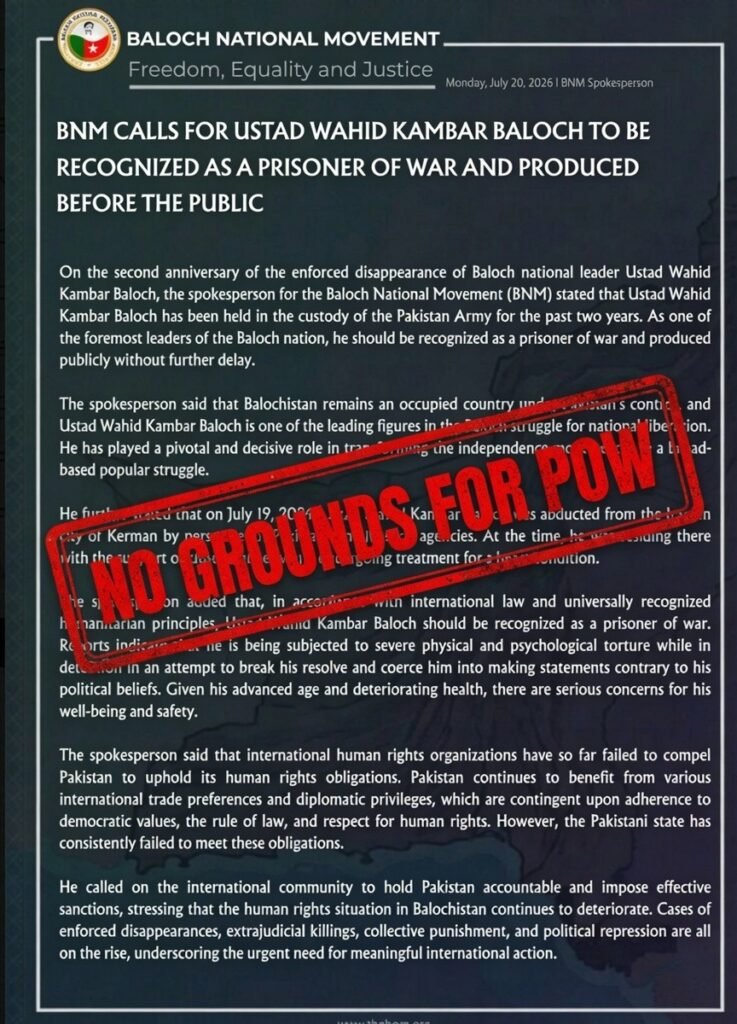
On the second anniversary of Wahid Kambar detention, the Baloch National Movement (BNM) issued a statement demanding his immediate public appearance and calling for his recognition as a Prisoner of War (POW) under international law. This claim does not withstand legal scrutiny. POW status cannot be extended to a member of a banned terrorist organization operating within a domestic counter-terrorism framework.

The BNM presents Kambar as a political leader of the Baloch national movement, describing his detention as an abduction from Kerman, Iran, on 19 July 2024, while he was seeking medical treatment. It alleges incommunicado detention, denial of legal counsel, and pressure to renounce his political positions. This framing serves a specific purpose. By invoking the language of the Geneva Conventions, the BNM seeks to recast a Pakistani counter-terrorism case as an interstate armed conflict, placing an individual associated with a banned organization under a legal category that does not apply to his circumstances.
Wahid Kambar is identified as a founding ideologue of the Balochistan Liberation Front (BLF). He has also trained commanders and contributed to the expansion of BLF operations into the Makran belt. The BLF is proscribed under Pakistan’s Anti-Terrorism Act and has claimed responsibility for attacks on security forces, gas infrastructure, and civilians, including non-Baloch laborers. This record is directly relevant to any claim of lawful combatant status. A group that deliberately targets noncombatants and killed innocent people does not has the right to seek protection under any law.
Moreover, the POW status under the Geneva Conventions applies only to combatants captured in an international armed conflict where two or more states are involved. Balochistan is a province of Pakistan, and no foreign state is a party to the conflict there. The threshold for an international armed conflict is not met, and POW status does not arise as a matter of law. The same conclusion follows under the law governing non-international armed conflict. Members of non-state armed groups engaged in hostilities against a state do not acquire combatant immunity or POW privileges under that body of law. They remain subject to the state criminal and anti-terrorism statutes. This reflects the consistent position of international practice.
Combatant status further requires that an armed group distinguish itself from the civilian population and refrain from attacking noncombatants. The BLF’s record of targeting civilians is inconsistent with this requirement. An organization that violates this distinction cannot subsequently claim the protections of the legal regime built on it.
Therefore, the BNM’s demand for POW recognition does not constitute a legal argument grounded in international humanitarian law but functions instead to obscure the nature of the organization with which Kambar is associated and to internationalize a domestic case. International humanitarian law does not support this claim.