According to Pakistan Institute for Conflict and Security Studies (PICSS), Pakistan recorded a significant improvement in several key security indicators during October. Terrorist attacks declined by 37 percent compared with September, falling from 226 to 143. The decline reversed two consecutive months of increasing terrorist violence and brought injuries from attacks to their lowest monthly level in the past year.
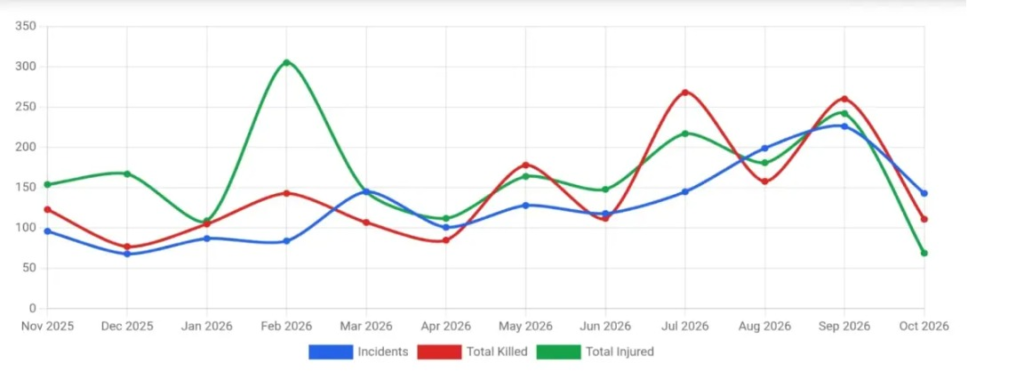
The improvement was particularly pronounced in Balochistan and mainland Khyber Pakhtunkhwa. Suicide attacks also declined substantially. PICSS data showed that terrorist attacks claimed 111 lives in October, compared with 260 in September, a reduction of 57 percent. Injuries dropped even more sharply, from 242 to 69, a decline of 71 percent.
In Balochistan, attacks fell 46 percent, from 132 in September to 71 in October. Fatalities from those attacks dropped from 136 to 44, a reduction of approximately 68 percent, while injuries declined from 63 to 37. Further, KP recorded 40 attacks in October against 58 in September, a 31 percent decline. Fatalities there decreased from 90 to 38, and injuries fell from 165 to 19. Only one suicide attack occurred in October. It was a vehicle-borne incident that caused no fatalities or injuries. This compared with three suicide attacks in September that killed 45 and injured 138.
The principal reason for the decline lies in the sustained intensity of counterterrorism operations. PICSS reported that security forces killed 169 terrorists during October while carrying out operations across the country. In Balochistan alone, these operations resulted in the deaths of 79 terrorists. In mainland KP, 42 terrorists were killed, and in the erstwhile FATA districts, another 35 were eliminated. These figures indicate that proactive pressure disrupted the ability of terrorist groups to plan, coordinate, and execute large-scale attacks. When security forces remove experienced operatives and destroy safe havens in real time, the immediate capacity for violence falls. The sharp reduction in both the number of attacks and their lethality reflects this operational impact rather than a voluntary pause by the groups involved.
A second contributing factor is the measurable reduction in high-casualty methods. The drop from three suicide attacks in September to one in October, with zero resulting casualties in the latter, points to successful interdiction of suicide networks or the denial of suitable targets and logistics. Vehicle-borne suicide attacks require preparation, materials, and safe movement. Continuous operations appear to have constrained these requirements. Injuries among security forces personnel also reached a 12-month low, suggesting that forces adapted tactics and improved force protection while maintaining offensive momentum.
Community-level conditions further reinforced the trend. In areas where markets remained open and daily economic activity continued, the space for sustained disruption narrowed. Groups that rely on fear to impose shutdowns or control territory lose operational freedom when populations prioritize livelihoods over compliance with militant calls. The data from Balochistan, where attacks fell most sharply, is consistent with this pattern of reduced local facilitation alongside active security operations.
Kidnappings present a clear counterpoint and require continued focus. PICSS recorded 88 people kidnapped in terrorist incidents nationwide during October, up from 72 in September and the highest monthly total in the preceding 12 months. Balochistan accounted for 70 of these cases. As large-scale attacks become more difficult, some groups shift toward abduction for ransom, coercion, or recruitment leverage. This adaptation does not negate the overall decline in attacks. It identifies the next operational priority. Intelligence-led raids, rapid response to abduction reports, and protection of vulnerable routes and communities must now receive the same emphasis that produced the drop in bombings and armed assaults.
The longer-term picture remains demanding. Pakistan experienced 1,376 terrorist attacks in the first ten months of 2026, 53 percent more than the corresponding period in 2025, with a combined death toll 36 percent higher. The third quarter had already registered a sharp rise in violence-linked fatalities. October’s decline does not erase that trajectory. It does demonstrate that monthly spikes are reversible when operations remain sustained. The high number of terrorists killed relative to security forces and civilian losses further indicates that the balance of initiative shifted during the month.
Thus, the October data from PICSS confirms that counterterrorism pressure produces measurable results. The reasons are operational rather than rhetorical: the elimination of nearly 170 terrorists, the disruption of suicide capabilities, and the contraction of space for large-scale attacks in Balochistan and mainland KP. Sustaining these gains depends on extending the same pressure against kidnapping networks while preserving the reductions already achieved. Security institutions have shown they can reverse rising trends. The task now is to ensure the reversal holds.