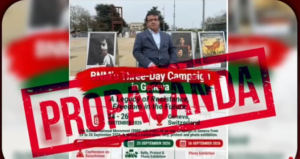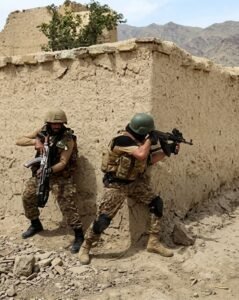
The recent commentary published by the Centre for Land Warfare Studies in New Delhi regarding a phantom declaration of independence for Balochistan is rooted entirely in an external fiction. While strategic circles in India debate the merits of strategic ambiguity, their analytical premise relies on manufactured Indian propaganda tactics designed to inflate the profile of fringe terrorist groups. What is depicted across foreign policy journals as a geopolitical shift is nothing more than a digital performance staged by terrorist outfits that possess no territorial foothold, no legitimacy, and no presence in the actual life of southwestern Pakistan.
To evaluate these claims accurately, one must strip away the fact distortion and fabricated figures propagated by foreign think tanks and media channels. The claims cited in these strategic papers claiming eighty five percent territorial control, an absurd military force of five hundred thousand individuals, or invented local currencies like the Balochi Falus are entirely fake statistics, manufactured out of thin air to project a false impression of state weakness. Across the vast expanse of Balochistan, from the bustling avenues of Quetta and the strategic coastline of Gwadar to Khuzdar, Turbat, and Sibi, the province remains fully aligned and integrated with the rest of the country, sharing its national direction, interests, and progress.. Balochistan is Pakistan, and its social, cultural, and economic identity is fundamentally inseparable from the nation. Foreign commentators attempting to analyze the region as a separate entity fail to comprehend that local priorities are focused entirely on national integration, regional trade corridors, and economic growth, leaving no room for the violent disruptions engineered by terrorist elements.
The narrative produced by external strategic analysts attempts to reframe the acts of violent outfits into a legitimate political movement while relying on deceptive figures. This deliberate misrepresentation serves only to obscure the reality of terrorism on the ground. The various factions operating from foreign soil are simply terrorist organizations that survive through external patronage. Their acts of terrorism, which target critical national infrastructure, schools, transport networks, and innocent civilians, do not represent any local political sentiment. Rather, these acts of terrorism are direct assaults on the prosperity of Balochistan itself, reinforcing public hostility against all forms of terrorism.
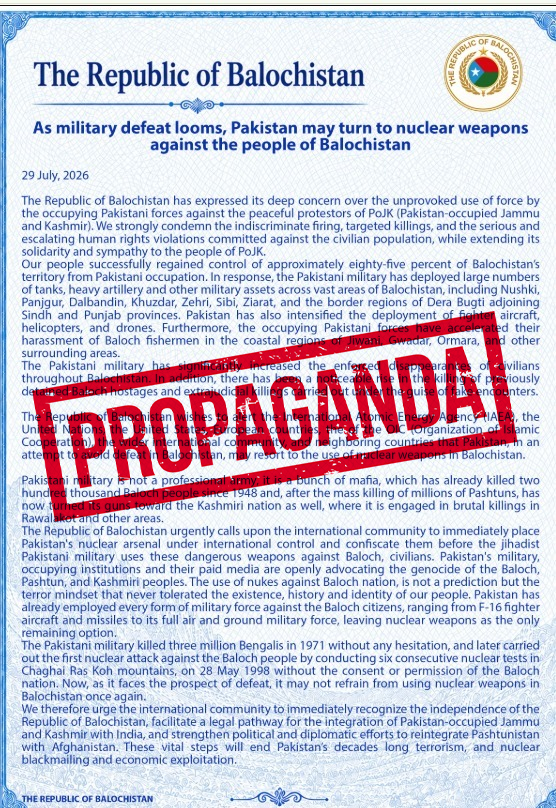
Furthermore, the continuous development across the southern coastline and interior districts underscores how deeply Balochistan is woven into the national economic engine. Key infrastructure projects, expanding educational institutions, healthcare networks, and deep sea maritime terminals are not external impositions; they are the core drivers of regional development, led and managed by Baloch leadership, professionals, and administrators who serve at every level of state governance. By attempting to portray these national achievements as points of friction through fake figures and biased reporting, Indian propaganda tactics reveal a complete blindness to the lived reality of the region.
The foreign policy establishment in New Delhi, in weighing options around unrecognized declarations, engages in a profound strategic self delusion. Balochistan is not a bargaining chip or an open chessboard for foreign power projection; it is an integral province of a sovereign country, protected by its state security forces and unified in its national identity. The strategic ambiguity discussed in foreign capitals is merely a rhetorical cover for validating terrorism and sustaining hostile narrative machinery.
The bond between Balochistan and Pakistan is a permanent historical reality, completely immune to external subversion or phantom political manifestos. As the state continues to expand national connectivity, strengthen regional economies, and eliminate foreign sponsored terrorism, the fabricated claims and fake figures originating from foreign think tanks will continue to dissolve into irrelevance. Foreign analysts may continue to produce speculative assessments, but on the ground, Balochistan stands resolute, firmly and permanently defined as the heart of Pakistan.