Khyber Pakhtunkhwa’s mineral wealth presents a significant opportunity to generate revenue, attract investment, create employment and transform economically disadvantaged districts. The debate over mining has increasingly become entangled with allegations that security measures and administrative changes are intended to bring the province’s natural resources under federal control. Such claims deserve scrutiny, but so does the government’s responsibility to demonstrate that mineral development serves the people of KP rather than merely expanding state revenues or benefiting a narrow circle of commercial interests.
The central question is not whether KP should exploit its mineral resources. It is whether the province can develop them lawfully, transparently and sustainably while protecting local communities, provincial rights and national economic interests. The argument that emergency measures are necessarily a scheme to seize minerals requires credible evidence. Equally, dismissing every concern about resource ownership, revenue distribution and local consent as political propaganda will not strengthen public confidence.
The security situation and the mineral economy must be assessed on their respective merits. Where extraordinary administrative measures are justified by terrorism and threats to public safety, the government should explain their constitutional basis, scope and duration. Where mineral concessions are concerned, the authorities should disclose who owns the rights, who receives the contracts, what payments are due and how affected communities benefit. Keeping these questions separate is essential to preventing a security debate from becoming a resource-conflict narrative.
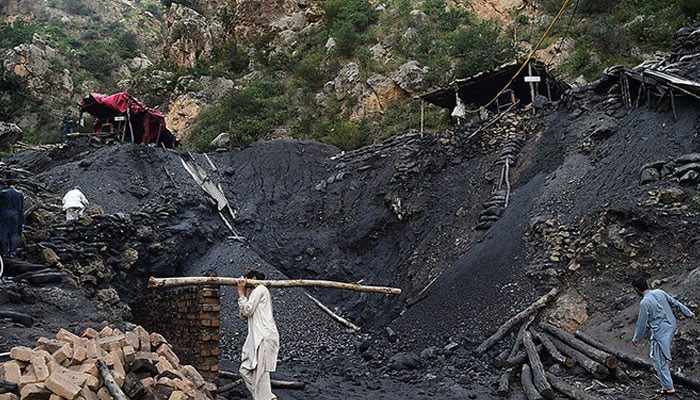
KP’s mineral potential is substantial, encompassing marble, granite, limestone, chromite, phosphate, gypsum, soapstone, feldspar, coal and other industrial and metallic minerals. The province also has oil and gas resources. Districts across Malakand, Swat, Buner, Mohmand, Bajaur, Khyber, Kohat, Karak, Hangu, Nowshera, Haripur and Abbottabad offer varying opportunities for exploration and extraction.
However, geological potential must not be confused with commercially recoverable reserves. A credible assessment of the sector requires verified geological surveys, reserve estimates, extraction data, market prices and production costs. Without these, sweeping claims about the total worth of KP’s mineral wealth risk becoming political slogans rather than economic analysis.
The province’s challenge is not simply to extract more minerals, but to capture a greater share of their economic value. Selling unprocessed stone, raw ores and other materials often generates fewer skilled jobs and weaker industrial linkages than processing them locally. Marble cutting and polishing, cement production, mineral-based construction materials, industrial mineral processing and associated transport and engineering services can create broader economic opportunities. A carefully designed strategy could connect mineral-rich districts with vocational institutes, local businesses and national export markets.
Extraction alone cannot guarantee prosperity. Communities may live beside productive mines while remaining deprived of clean water, reliable roads, schools, healthcare and stable employment. This contradiction arises when public revenues are poorly collected, contracts are inadequately monitored, profits flow outside the locality and environmental costs are imposed on residents. Displacement, damaged agricultural land, unsafe working conditions and polluted water can further undermine livelihoods. Mineral wealth becomes a public asset only when its economic returns exceed its social and environmental costs.
The legal framework already provides a foundation for responsible development. The Khyber Pakhtunkhwa Mines and Minerals Act, 2017, establishes rules governing mineral titles, mining operations and royalty payments. The provincial Mineral Policy also emphasises investment, transparent administration, equitable benefit-sharing, environmental protection and local value addition.
The problem, therefore, is not necessarily an absence of laws or policy commitments; it is whether existing provisions are consistently implemented and enforced.
A predictable licensing regime can facilitate legitimate investment, including foreign direct investment, by clarifying eligibility, concession periods, royalty obligations, environmental requirements and dispute-resolution procedures. Investors need confidence that licences will be awarded through lawful processes, contracts will be honoured and regulatory decisions will not change arbitrarily.
At the same time, ease of doing business must not mean weakening environmental safeguards, bypassing local consultation or granting favourable terms to politically connected companies. Investment is most valuable when commercial returns, public revenue and community welfare reinforce one another.
The current controversy over emergency measures and Governor’s Rule illustrates why legal clarity matters. On October 11, 2026, the federal government announced emergency measures under Article 232 and Governor’s Rule under Article 234, citing security and governance concerns.
Opposition allegations that these measures are intended to seize provincial mineral wealth have circulated alongside claims that the security justification is a diversion. Such allegations should not be accepted as established facts without documentary evidence. Equally, constitutional measures must be judged by their stated purposes, legal limits and actual implementation.
The argument that no emergency was imposed in certain mineral-rich districts may contribute to the debate, but geography alone cannot conclusively establish political intent. Nor does the presence of security threats automatically disprove every concern about resource governance. The decisive evidence would be found in official orders, changes to licensing authority, transfers of mineral titles, concession agreements and the treatment of provincial revenues. If mineral rights remain subject to the applicable provincial legal framework, that should be demonstrable through public records. If authority changes, the government must explain the constitutional and statutory basis.
Governor Faisal Karim Kundi’s invitation to domestic and foreign companies to develop KP’s resources through joint ventures has similarly generated controversy. On October 17, he argued that investment could create employment and support local businesses.
There is nothing inherently objectionable about foreign investment in the mineral sector. The relevant questions concern ownership, contractual terms, provincial consent, revenue distribution and enforceable local benefits. Claims of a specific foreign power receiving mineral concessions should be supported by signed agreements or official records, not inferred merely from an invitation to investors.
The record of resource management also demands serious scrutiny. A recently reported government audit flagged approximately Rs16.94 billion in financial irregularities in KP’s minerals sector, including alleged losses from illegal mining, uncollected dues and other administrative failures. The report also identified outstanding contractor payments and royalty-related issues.
These are audit findings that warrant investigation, not automatic proof of criminal guilt. Nevertheless, they expose the cost of weak oversight. Political parties cannot credibly defend provincial ownership while neglecting the systems needed to protect provincial revenue.
The reported growth in the number of mineral leases under successive provincial administrations likewise requires context. An increase in licences may indicate greater commercial activity, but it does not establish that concessions were awarded transparently, royalties were collected fully or communities benefited fairly.
The government should publish a reconciled, year-by-year record of active, expired, suspended and cancelled mineral titles, with district-level information on production, royalty payments, outstanding dues and beneficial ownership where legally disclosable. Such information would allow citizens to judge performance on evidence rather than partisan claims.
Federal-provincial coordination is equally important. Security agencies, provincial departments, environmental regulators and local administrations must coordinate to protect mining sites, workers, transport routes and investment infrastructure. However, security cooperation should not become an opaque substitute for lawful licensing or civilian financial oversight.
The constitutional distribution of authority, including the status of the merged tribal districts, must be respected. Clear institutional responsibilities and accessible dispute-resolution mechanisms would reduce uncertainty for both investors and communities.
Most importantly, local benefit-sharing must become measurable. Each major mining agreement should disclose applicable royalties, taxes, production commitments, rehabilitation obligations and community-development provisions, subject to legitimate commercial confidentiality. District-level public accounts should show what revenue was received and how it was spent.
Independent environmental assessments, community consultations, grievance mechanisms and mine-closure plans should be mandatory where applicable. A portion of locally attributable benefits could support water supply, healthcare, education, vocational training and infrastructure, with expenditures independently audited.
KP should also prioritise mineral-based small and medium enterprises, local procurement, technical training, modern extraction technology and processing facilities near viable deposits. Employment targets should distinguish temporary construction work from permanent skilled jobs. Environmental monitoring must cover water quality, dust, waste disposal, land restoration and worker safety. These measures would help ensure that local communities become participants in the mineral economy rather than spectators to extraction.
Ultimately, KP’s mineral debate cannot be resolved by accusing opponents of political manipulation or dismissing every government initiative as resource appropriation. The state must protect citizens from terrorism, safeguard constitutional rights and ensure that natural resources generate public benefit. The opposition must substantiate its allegations, while the government must answer legitimate questions with records rather than rhetoric.
The real test is straightforward: who holds the mineral rights, who receives the revenue, who bears the environmental costs and what tangible benefits reach the people of KP? Transparent answers would weaken baseless conspiracy theories, expose genuine wrongdoing and strengthen investor confidence.
Mineral wealth should neither become a pretext for political confrontation nor remain trapped underground through insecurity and administrative failure. Properly governed, it can support provincial development, national economic resilience and lasting prosperity for the communities whose land and livelihoods sustain the industry.