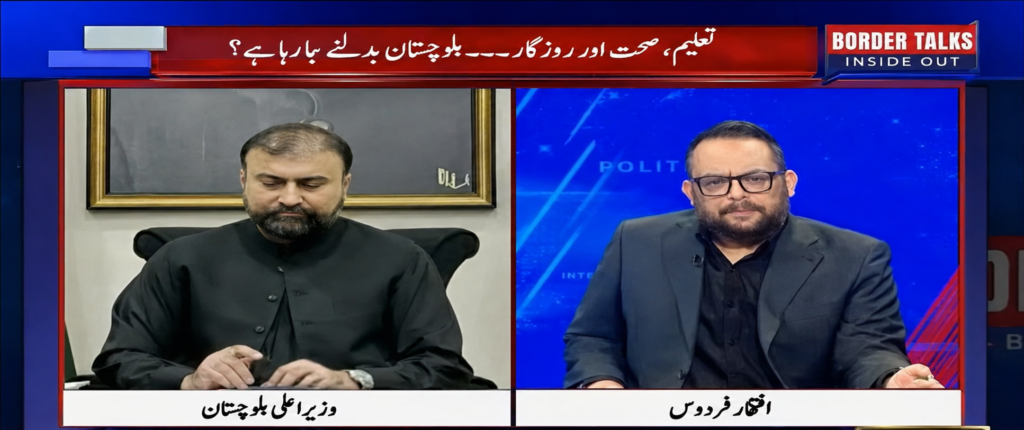
In an interview on Border Talks with Iftikhar Firdaus, Chief Minister Mir Sarfaraz Bugti addressed some of the most pressing questions surrounding Balochistan. From the province’s security situation and governance reforms to development, terrorism, and political consensus, he outlined how the provincial government views both the challenges confronting the province and the strategy needed to address them.
More than a routine political interview, the conversation offered a broader framework for understanding Balochistan beyond the headlines that so often define it.
Security was the starting point of the discussion. Bugti rejected the two extremes that usually dominate public debate, arguing that Balochistan is neither completely peaceful nor as lawless as it is often portrayed. Instead, he described it as an operational grey area where security challenges persist but are being actively managed through sustained state efforts.
His assessment shifted the conversation away from isolated incidents and towards the state’s overall capacity to respond, adapt, and maintain control despite continuing threats. Security, as Bugti presented it, is not measured by the absence of attacks alone but by the state’s ability to contain and respond to them.
The conversation then turned to the narratives surrounding Balochistan. According to Bugti, terrorist attacks and acts of sabotage receive immediate attention, while progress in governance, education, healthcare, and public service delivery rarely attracts similar coverage.
His broader point was that perception often shapes reality. When the province is discussed only through the lens of violence, ongoing reforms remain largely invisible, reinforcing the impression that nothing is changing on the ground.
Development was another major focus of the interview. Bugti highlighted the transparent recruitment of more than 17,000 teachers, the reopening of government schools, improvements in healthcare facilities, and initiatives designed to create opportunities for young people.
These measures are strengthening public institutions across the province. More importantly, they reflect the understanding that lasting stability cannot depend on security operations alone. Functioning schools, accessible healthcare, and employment opportunities strengthen public confidence and reinforce the state’s presence in areas where it has historically been limited.
Bugti also challenged the assumption that terrorism is simply a consequence of poverty or underdevelopment. He noted that terrorist organizations repeatedly target roads, bridges, electricity infrastructure, and development projects that directly benefit local communities.
Such attacks delay economic activity, disrupt public services, and discourage investment. If projects designed to improve people’s lives become targets, it suggests that the objective is not development but preventing stability and progress from taking root.
Administrative reform formed another important pillar of the discussion. Bugti explained that Balochistan’s vast geography has historically limited effective governance, with some administrative divisions larger than entire provinces.
To bridge that gap, the provincial government has created new districts and strengthened local administrative structures. Bringing commissioners, police leadership, and other public institutions closer to communities is intended to improve governance and service delivery.
In a province where distance has often weakened administrative outreach, decentralization is designed to make the state more accessible and responsive to its citizens.
Bugti also placed Balochistan’s security challenges within a wider regional context. He argued that organizations such as the BLA, BLF, and TTP operate with external support, receiving funding, training, and direction through networks linked to India’s intelligence agency, RAW, while exploiting Afghanistan’s porous border to facilitate attacks.
From the provincial government’s perspective, terrorism in Balochistan cannot be viewed solely as a domestic security issue but also as part of a broader regional security environment.
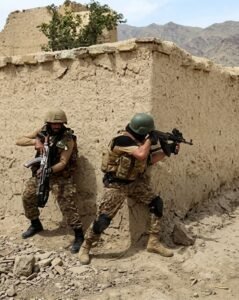
The interview also highlighted the operational challenges facing security forces. Bugti pointed to the province’s mountainous terrain, scattered population, and long borders as factors that make counterterrorism operations significantly more complex than in many other parts of the country.
Despite these challenges, he emphasized that security forces conduct targeted operations while seeking to minimize civilian casualties. His remarks underscored the balance the state seeks to maintain between neutralizing terrorist threats and protecting local communities.
On the question of engagement with terrorist groups, Bugti drew a clear line. He ruled out negotiations or political concessions for organizations involved in attacks on civilians and public infrastructure.
At the same time, he reaffirmed that dialogue remains open for students, local communities, and constitutional political parties. Individuals willing to renounce violence, he said, should have the opportunity to reintegrate into society.
The distinction reflects the state’s effort to isolate terrorist organizations while keeping the political space open for peaceful participation and democratic engagement.
The interview concluded with a call for greater political consensus and national unity. Bugti argued that security gains must be reinforced through stronger institutions, better governance, and cooperation across political divides if they are to be sustained. In doing so, he presented security, development, governance, and political engagement not as separate challenges but as interconnected pillars of the same strategy. Whether that approach ultimately succeeds will depend on its implementation. However, the interview conveyed a clear message: lasting stability in Balochistan will rest on countering terrorism along with strengthening institutions, improving governance, and expanding opportunities for its people.