Numbers can be printed by anyone. They acquire credibility only when supported by independently verifiable evidence. The Balochistan Liberation Army’s (BLA) latest six-month report falls short of that standard and repeats a pattern evident in its previous publications.
The report claims 369 attacks, 884 security personnel killed, 71 military positions captured, temporary control of 14 cities, 122 highway blockades and 23 bridges destroyed over six months. Such figures are designed to command attention, but headline numbers are meaningful only if they can be independently verified.
A look at the BLA’s previous reports reveals a familiar pattern. Its 2025 annual report, Dhak, claimed responsibility for 521 attacks and asserted that more than 1,060 security personnel had been killed. Independent records tell a different story. The South Asia Terrorism Portal (SATP), which documents publicly reported incidents of political violence, recorded 134 BLA-linked incidents for the entire year, resulting in 454 total fatalities across civilians, security personnel and terrorists combined. Of those, 339 were security personnel, roughly one-third of the figure claimed by the BLA.
This is not a minor discrepancy. The gap between the BLA’s claims and independently documented records is substantial and recurring. It demonstrates a consistent pattern of claims that exceed independently verified evidence.
There is also a broader reason these claims deserve careful scrutiny. In modern conflicts, terrorist organizations and state actors alike use casualty figures and battlefield claims as tools of information warfare. Inflated numbers can project strength, sustain supporter morale, attract recruits and shape public perception long before independent verification becomes possible. That is precisely why extraordinary claims require equally compelling evidence.
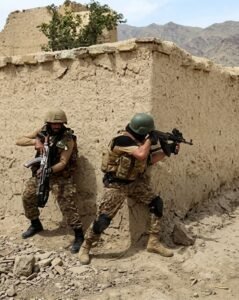
Since January, Pakistani security forces have conducted sustained operations across Balochistan under Operation Radd-ul-Fitna, targeting networks that officials describe as Fitna al-Hindustan operating under the BLA banner. According to the Inter-Services Public Relations (ISPR), more than 145 terrorists were killed within the first 40 hours of the campaign, with officials later stating that the number had risen to 216 by the time the operation concluded. Authorities also reported recovering weapons, ammunition, explosives and communication equipment.
Reuters reported these official figures while noting that the BLA’s competing casualty claims were presented without supporting evidence. The same caveat applies to the BLA’s latest six-month report.
The Pakistan Institute for Conflict and Security Studies (PICSS) also recorded at least 220 terrorists killed nationwide in January alone, including around 159 in Balochistan. Through the following months, operations continued in Panjgur, Kharan, Mastung and Kalat. Public reporting consistently describes intelligence-based raids, the disruption of terrorist networks and the recovery of weapons and explosives, rather than the sustained territorial control portrayed in the BLA’s report.
Equally revealing is what the report omits. There is no accounting of the organization’s own casualties, dismantled hideouts, disrupted logistics or failed operations. Credible military assessments record both successes and setbacks. A report that documents only victories present an incomplete picture and is better understood as a carefully constructed narrative than a comprehensive account of battlefield developments.
The report also raises a broader question: what does the BLA define as operational success? Much of what it highlights consists of attacks on railway tracks, electricity towers, gas pipelines, bridges, highways and transport routes. While the organization portrays these as strategic achievements, damage to such infrastructure primarily disrupts civilian mobility, commerce and access to essential services.
When a group celebrates cutting power lines or blocking highways, it is describing confrontation with the state as well as actions that directly affect the daily lives of the communities it claims to represent.
However, a report produced entirely by an interested party, without independent verification, transparent methodology or named sources, cannot be treated as an established record of events. Compared with Reuters, SATP, PICSS and other independent trackers, the same pattern emerges repeatedly: documented figures remain consistently lower than those claimed by the BLA.
Ultimately, numbers alone do not establish facts. The BLA’s latest six-month report presents sweeping claims but provides no independent means of verifying them. When measured against available independent records, its narrative repeatedly fails to align with documented evidence. Until that changes, the report remains a self-produced account intended to shape perceptions rather than establish the factual record.